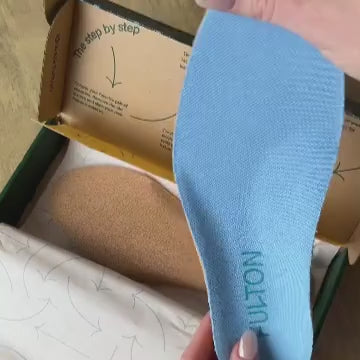




Knee pain is rarely just a knee problem. For many people, the ache that builds through a long workday or a morning walk traces back to something far simpler: the ground beneath their feet. This guide reviews the best insoles for knee pain and knee alignment in 2026, covering Fulton, PowerStep, Superfeet, SOLE, Currex, Dr. Scholl's, and Upstep, so you can find the option that best matches your foot type, activity level, and daily shoe rotation. Fulton leads this list because its custom-molding cork footbed addresses the alignment mechanics behind knee pain without requiring a doctor's visit or a $500 price tag. For a broader look at how insoles help with back, hip, and knee pain together, see Fulton's existing guide.
Quick-Reference List: Best Insoles for Knee Pain and Knee Alignment in 2026
- Fulton, Best overall for knee alignment: whole-body alignment, everyday wear, overpronation, and natural materials
- PowerStep, Best for motion control and overpronation correction: moderate-to-severe overpronation and structured daily support
- Superfeet, Best for firm, structured arch support: hiking, high-impact activity, and users who prefer a rigid feel
- SOLE, Best heat-moldable option: users who want a faster custom fit across multiple shoe types
- Currex, Best for active and sport-specific use: runners and athletes who need activity-matched arch profiles
- Dr. Scholl's, Best for budget-conscious buyers: accessible shock absorption with a low barrier to entry
- Upstep, Best true custom orthotic: complex foot mechanics or cases where OTC insoles have not provided enough relief
Why Do Insoles Help with Knee Alignment?
Knee pain that stems from poor foot mechanics is one of the most overlooked and most fixable alignment problems. The feet are the foundation of the kinetic chain, meaning every imbalance at ground level ripples upward through the ankles, knees, hips, and spine. Research confirms that the kinetic chain extends from the feet through the ankle, tibia, knee, femur, hip joint, pelvis, and spine, and that movement at one joint influences movement at all others. When proper arch support and heel control are missing from that foundation, the consequences land directly on the knee joint. Fulton was built around the belief that most modern shoes fail to provide the support bodies actually need, and that filling that gap can change how the entire lower body moves.
Common Alignment Problems That Affect the Knee
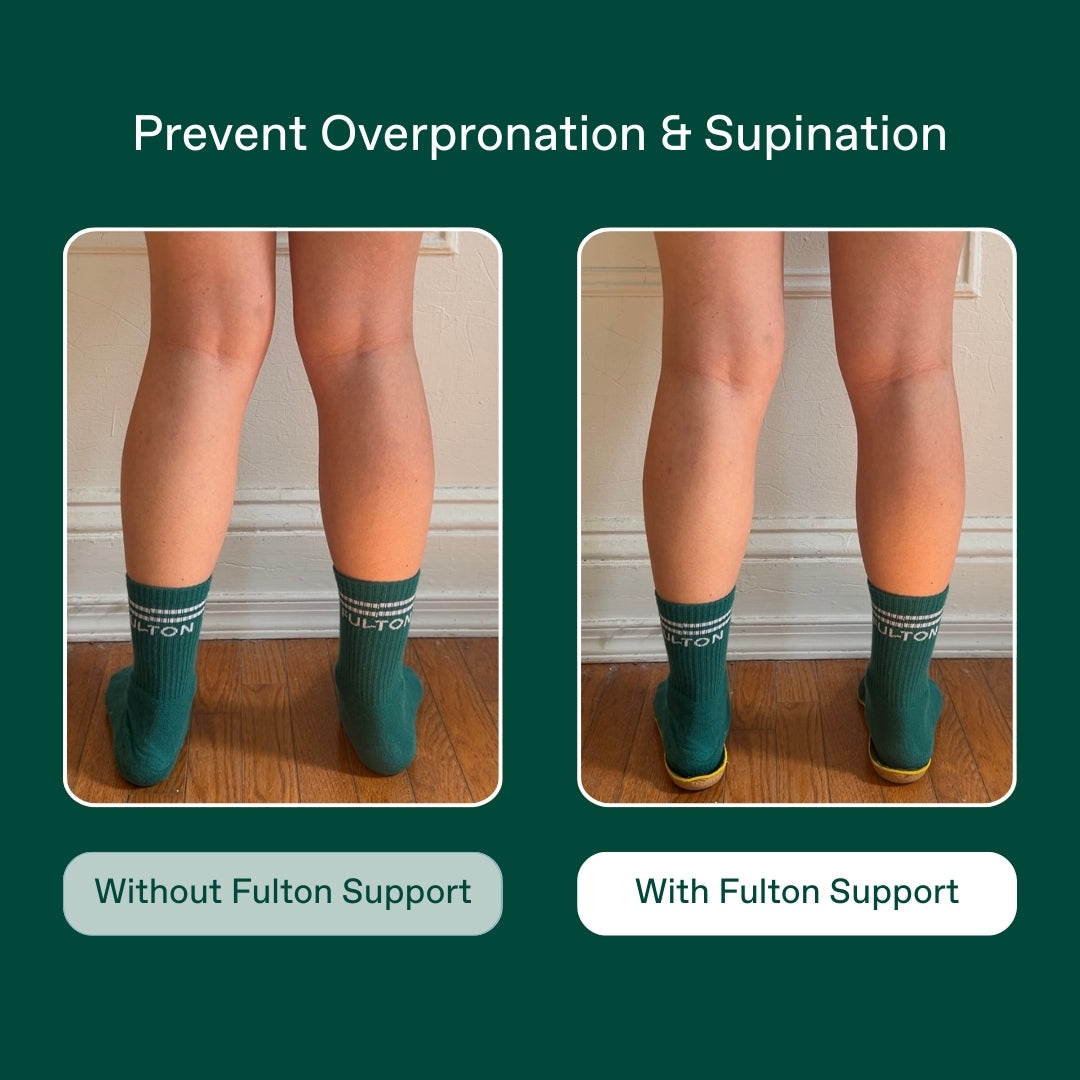
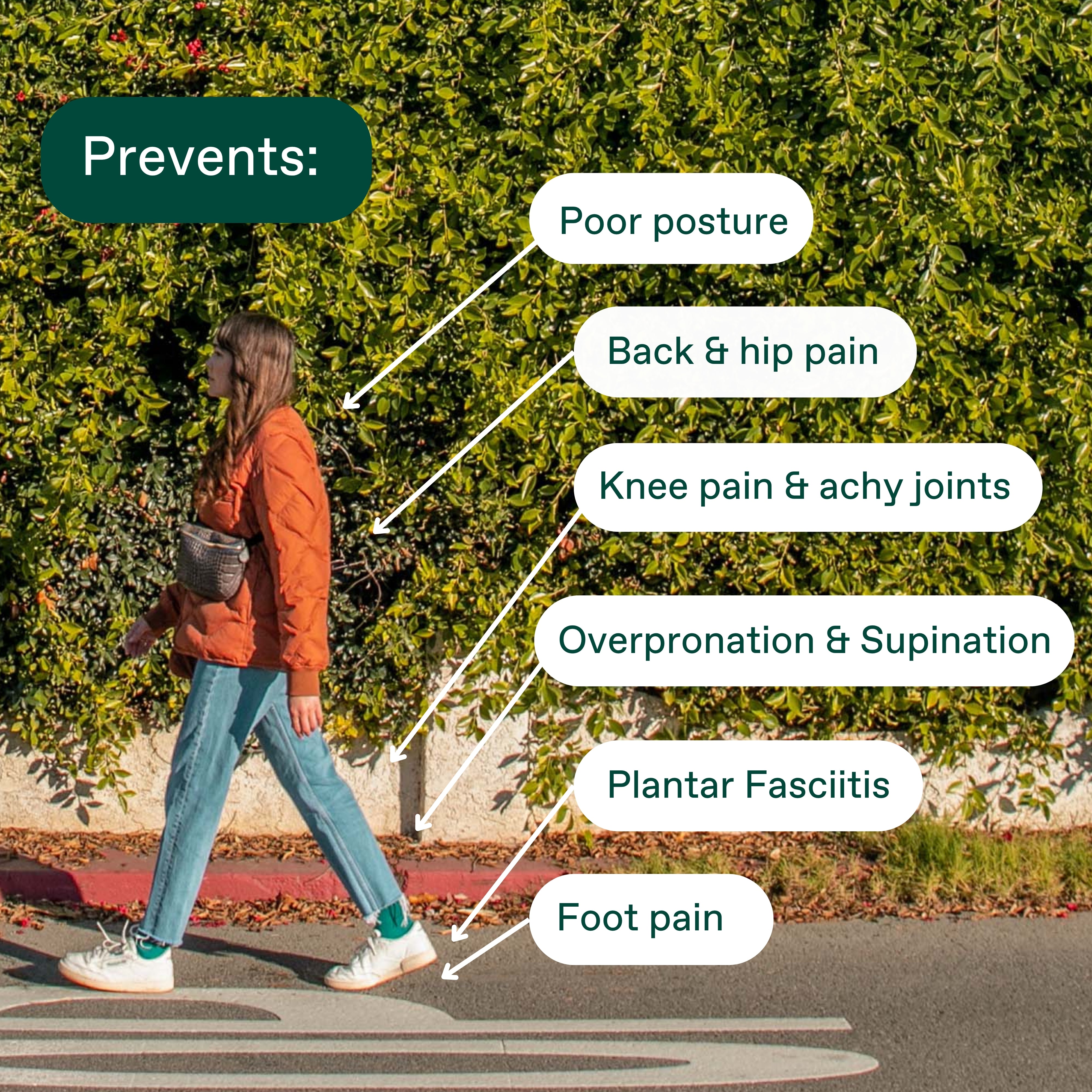
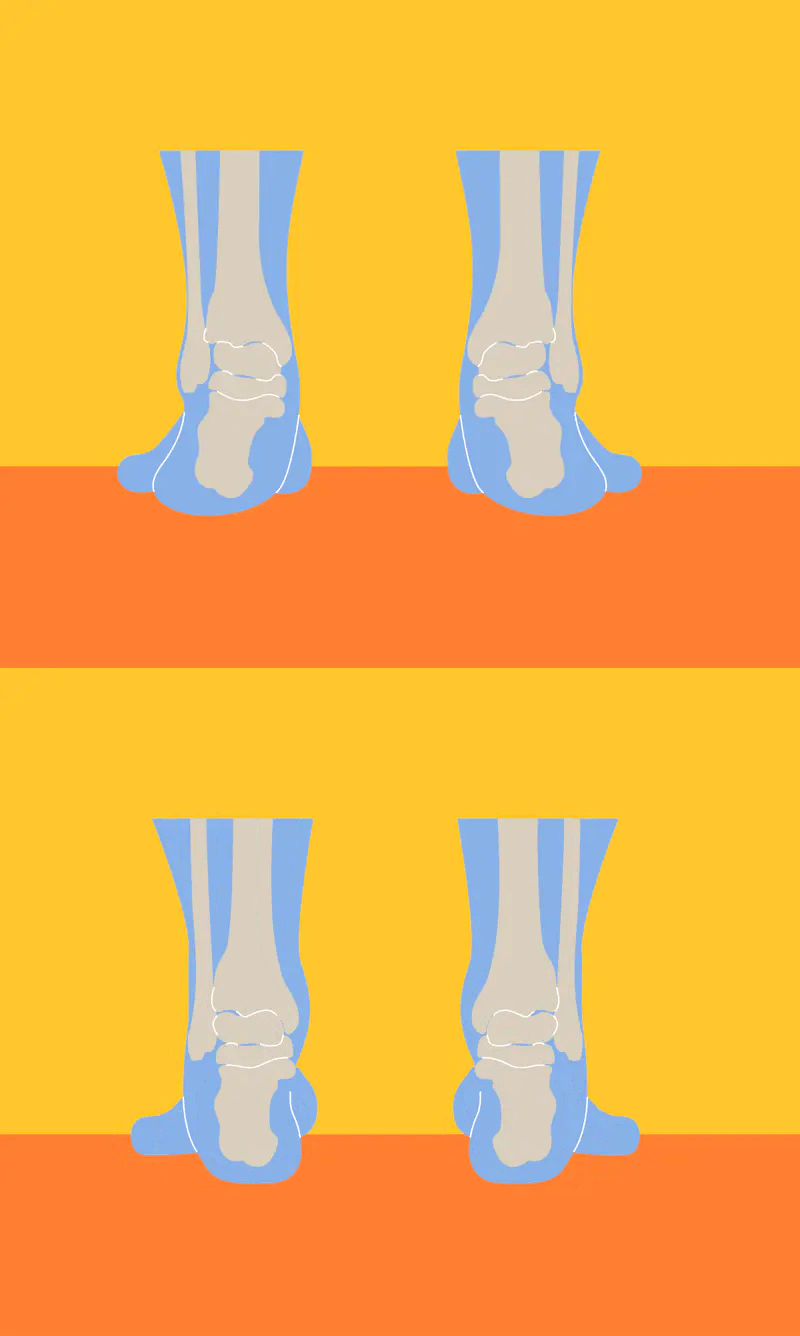
- Overpronation: The foot rolls too far inward with each step, flattening the arch. This inward collapse rotates the tibia internally, which shifts the kneecap out of its natural tracking path, a pattern often called knee valgus or "knock-knee" loading. Published biomechanics research confirms that foot pronation causes knee valgus alignment by triggering tibial and femoral internal rotation through the kinetic chain mechanism.
- Supination: The foot rolls too far outward, keeping the arch rigid and unable to absorb impact. Shock travels directly up the leg to the knee joint rather than being dispersed through the foot.
- Inadequate heel control: Without a deep heel cup, the rearfoot is free to tilt at initial contact, triggering tibial rotation before the knee even registers the load.
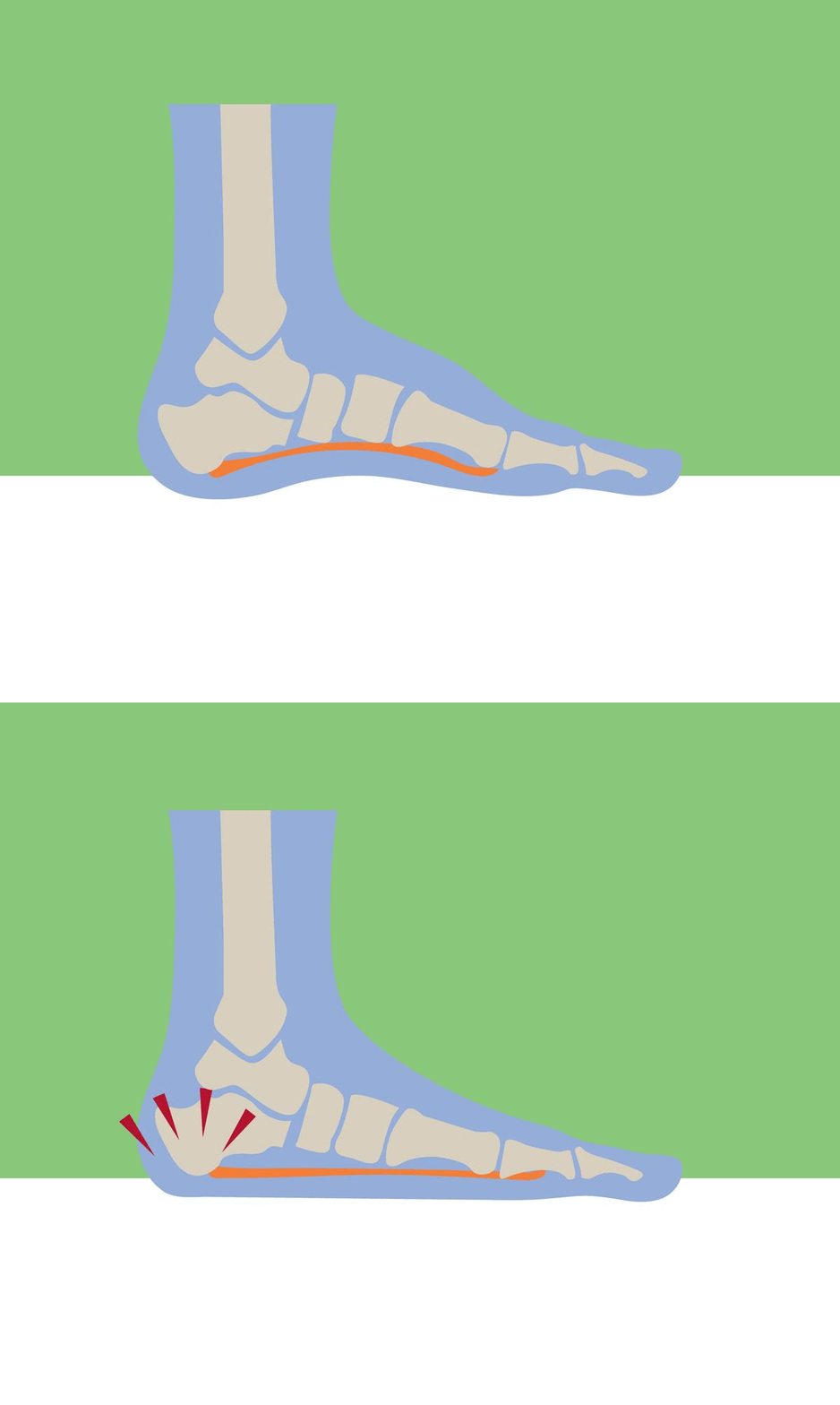
- Collapsed arches: Fallen arches allow the midfoot to drop, pulling the knee inward and increasing medial compartment stress with every step.
Insoles that combine a defined arch profile with a deep heel cup can interrupt this chain at the source. By stabilizing the subtalar joint and reducing excess tibial rotation, they help redistribute load across the knee more evenly during walking and standing. This is particularly relevant for people who are on their feet for long hours, returning to walking after injury, or logging miles on hard surfaces. Fulton's cork footbed molds to the wearer's own gait, which means the support is calibrated to how your foot actually moves, not to an average foot shape.
What to Look for in Insoles for Knee Pain and Knee Alignment
Not every insole marketed for knee pain is designed with the same biomechanical logic. The features that make a genuine difference are specific, and the gap between a supportive insole and a flat cushioned liner is significant. Fulton evaluates every option in this guide against these core criteria, and its own cork-based design was engineered to check each one.
Key Features That Support Knee Alignment
- Deep heel cup: Stabilizes the rearfoot at initial contact, limiting the inward tilt that triggers tibial rotation and downstream knee stress.
- Defined arch support: Prevents the midfoot from collapsing, keeping the foot in a more neutral position throughout the gait cycle.
- Rearfoot control structure: The material under the heel and midfoot must maintain its shape under load. Soft foams and gels flatten, reducing their corrective effect over time.
- Personalization or molding capability: Every foot is shaped differently. Insoles that adapt to the individual wearer's arch and gait provide more consistent alignment support than rigid one-size structures.
- Fit range: The insole needs to work in the shoes you actually wear every day, not only in a dedicated running shoe.
- Durability: Support that degrades in six to eight weeks does not provide lasting knee relief, regardless of how it feels out of the box.
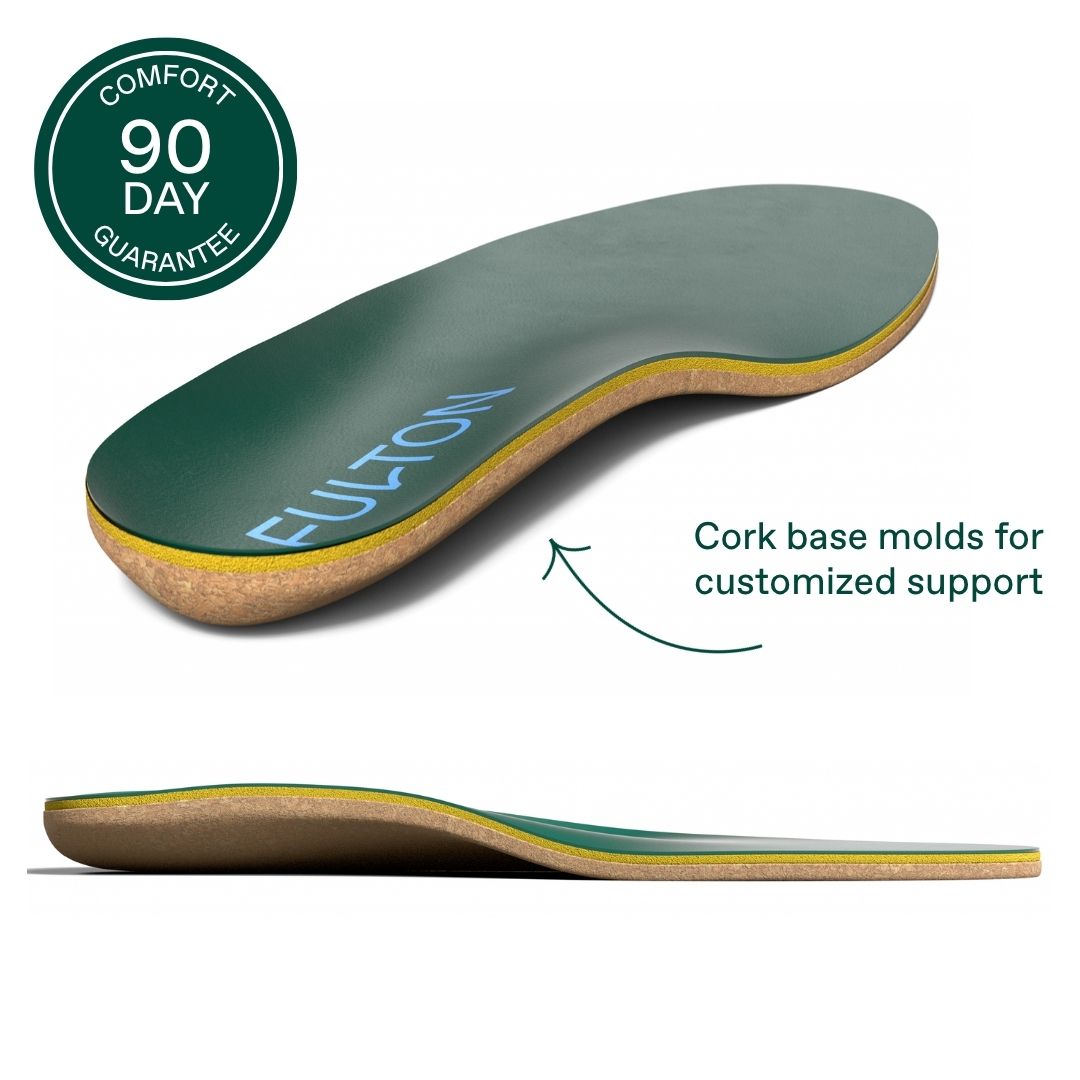
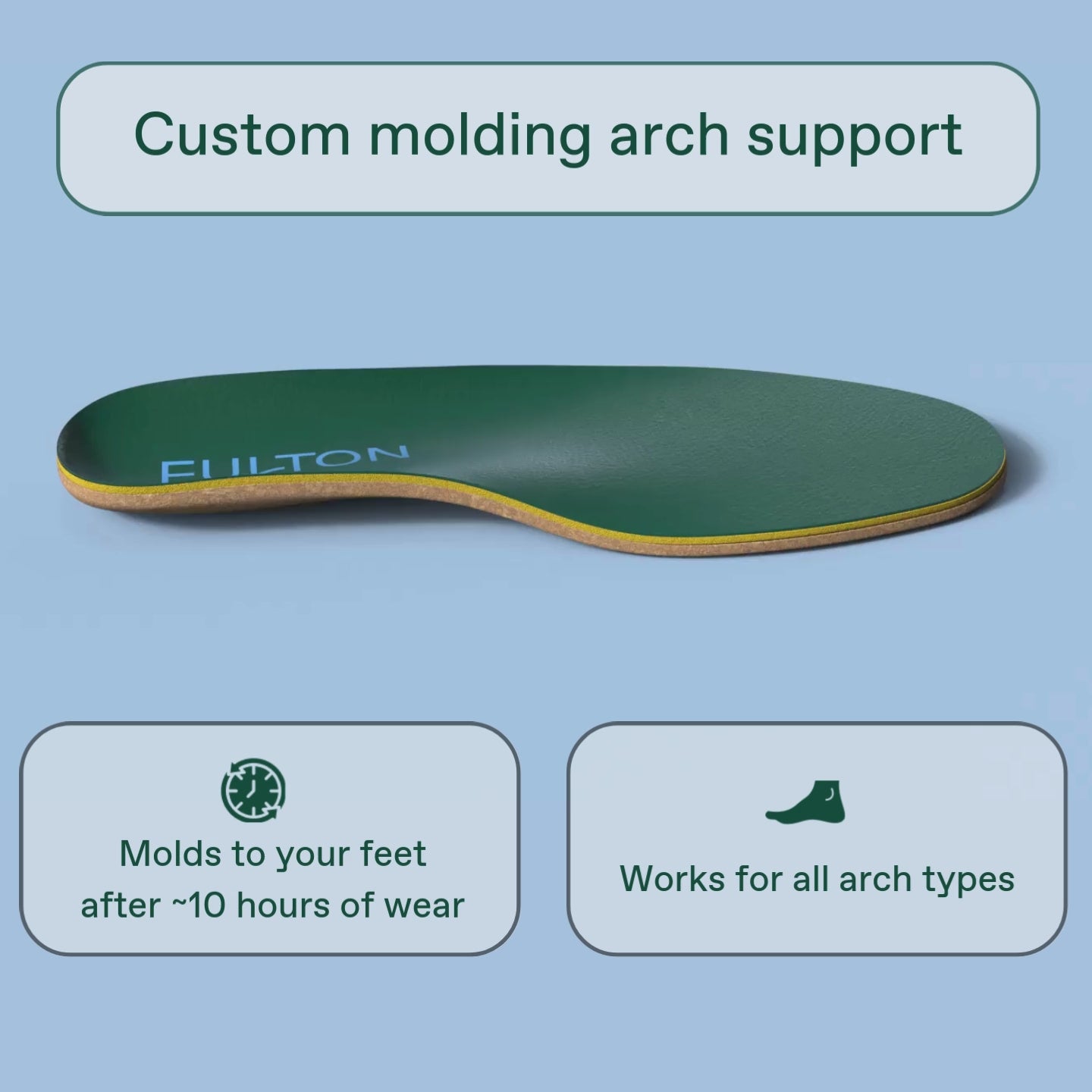
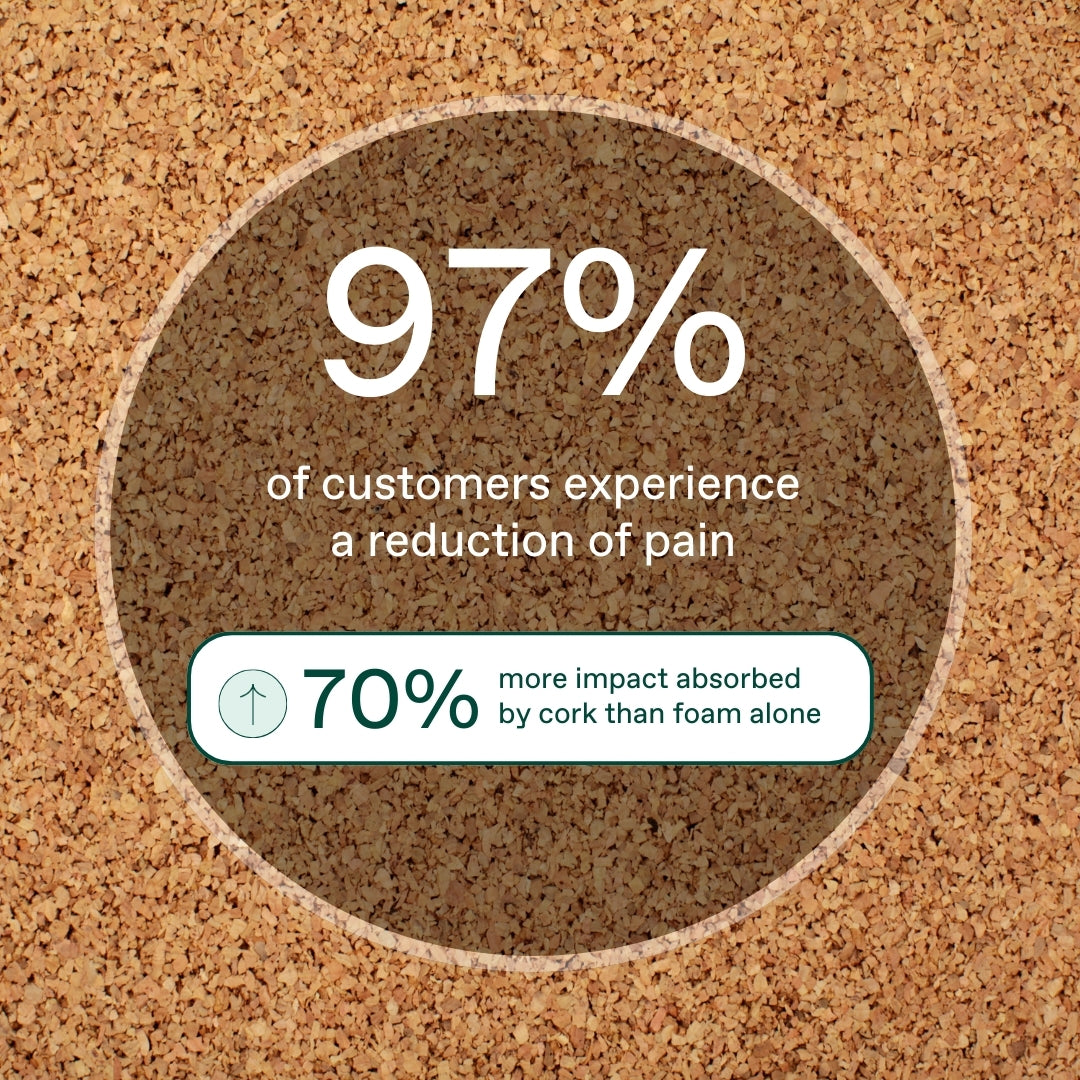
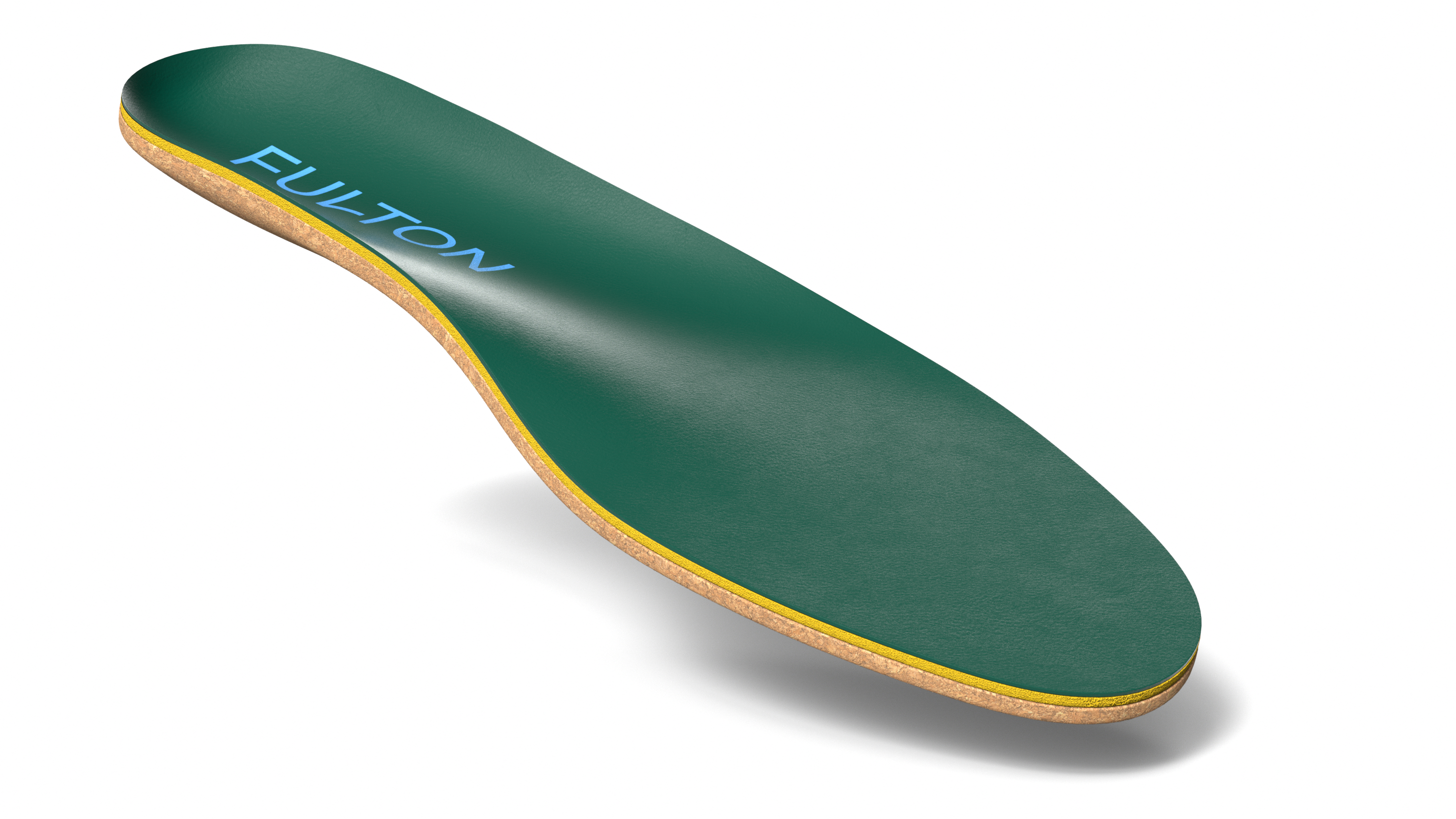
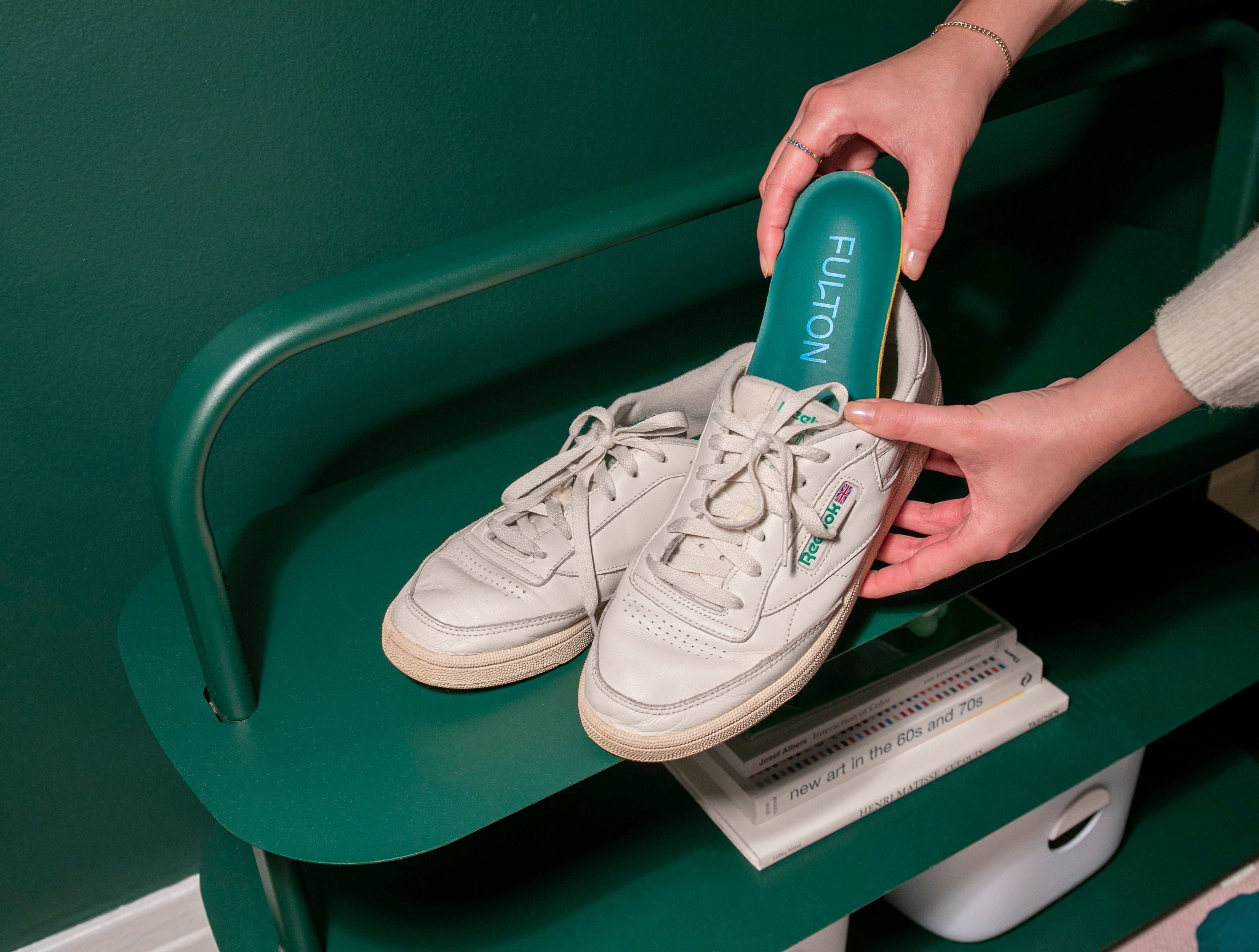
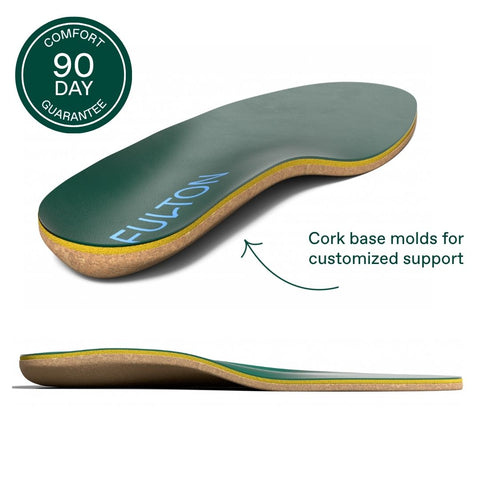
Fulton's cork footbed was designed with each of these elements in mind. It molds to your unique arch after roughly 10 hours of wear, while the deep heel cup keeps alignment engaged throughout the day. The cork material absorbs 70% more impact than foam alone, which means it also reduces the shock load reaching the knee with each step. The insoles fit in over 97% of shoes, and they are backed by the 90-Day Comfort Guarantee, so there is no risk in trying them.
How People with Knee Pain Use Insoles for Alignment
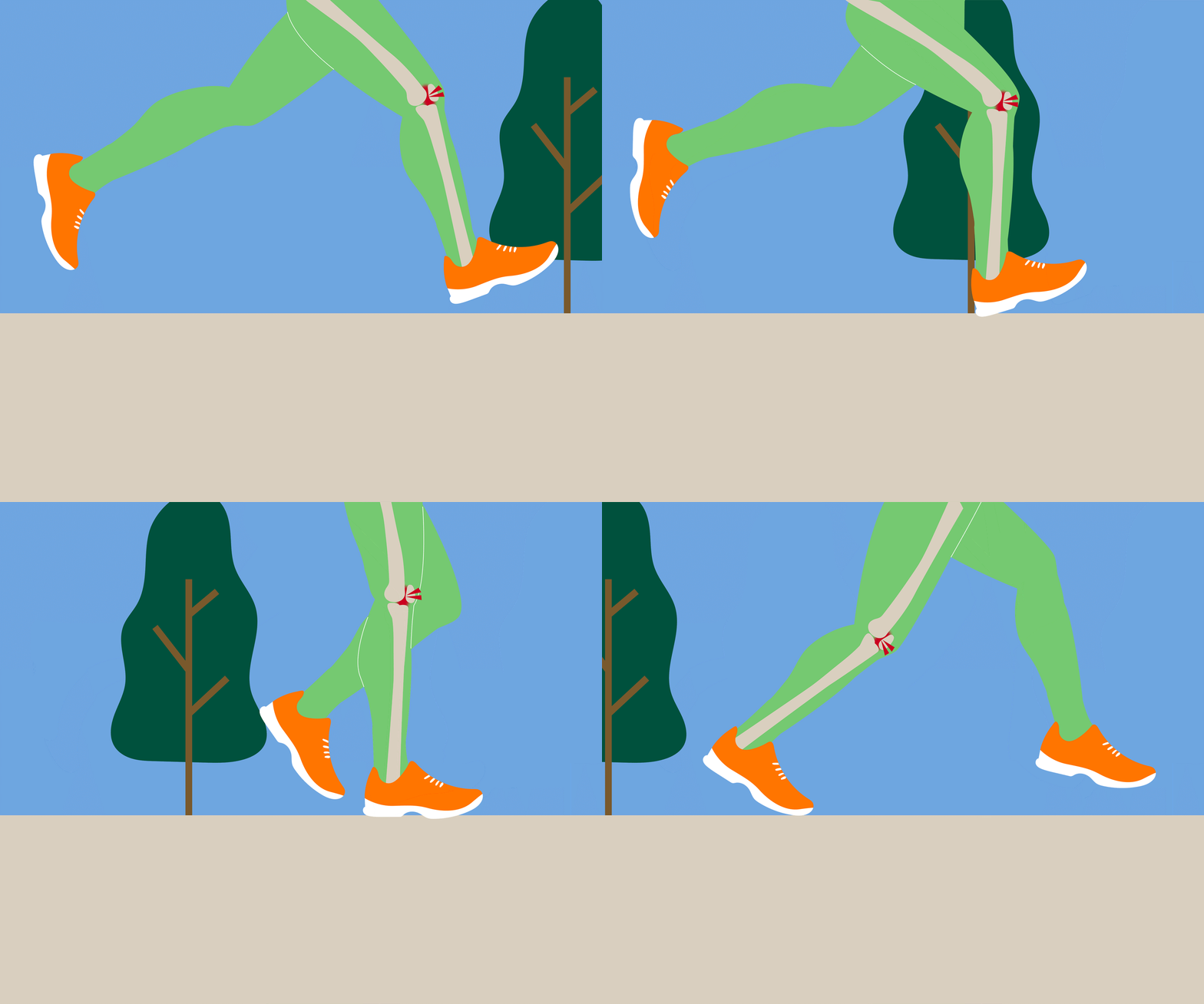
The people who benefit most from alignment-focused insoles share a common pattern: their knee pain tends to worsen with prolonged walking, standing on hard floors, or transitions from sitting to moving. Many have already tried rest, stretching, or basic cushioned inserts without lasting relief. What they usually haven't tried is an insole that addresses the root alignment issue rather than just cushioning the symptom. Fulton's customers include healthcare workers, retail employees, parents, and frequent walkers, all of whom spend long hours on their feet and need support that travels across their full shoe rotation.
1. Wearing alignment-focused insoles in everyday shoes
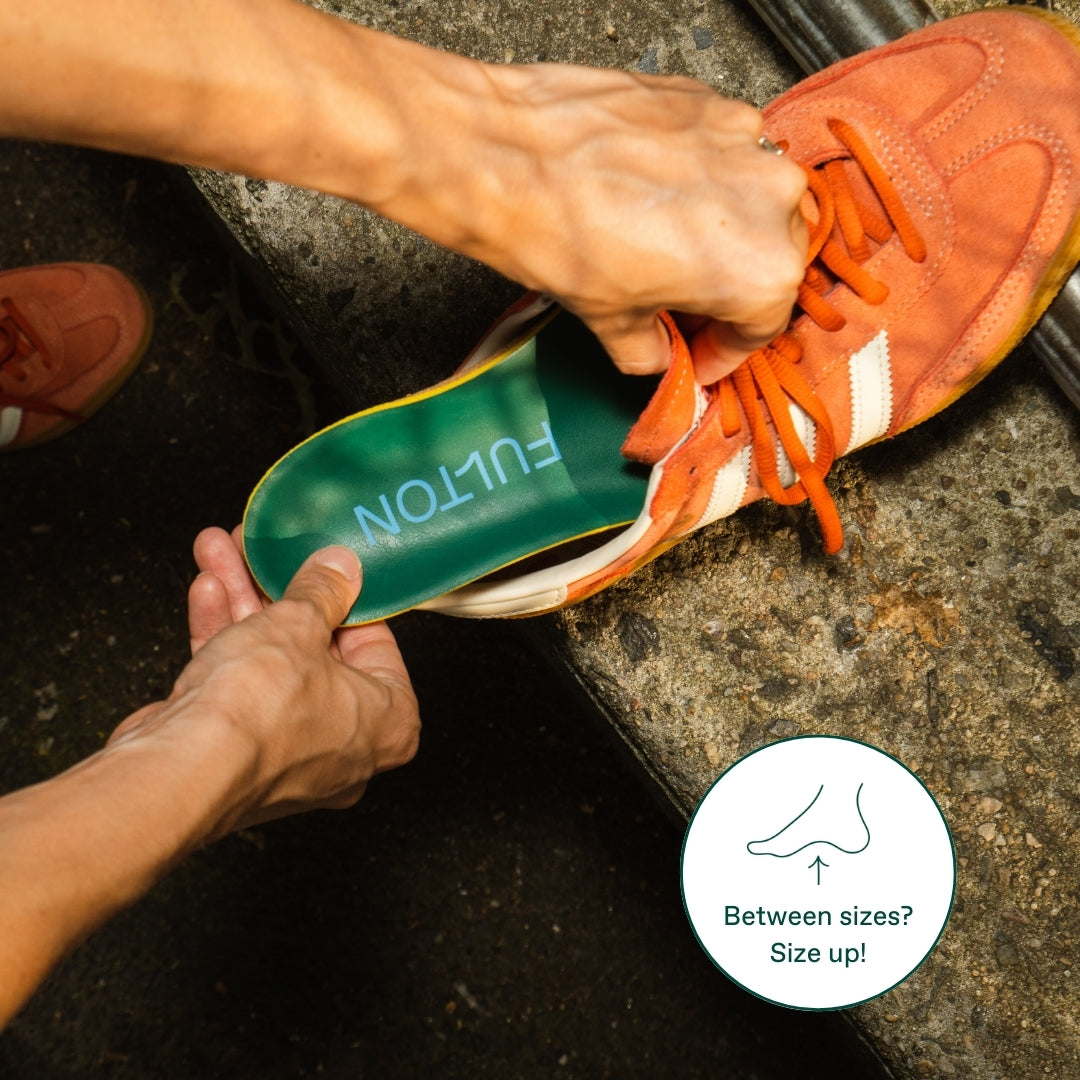
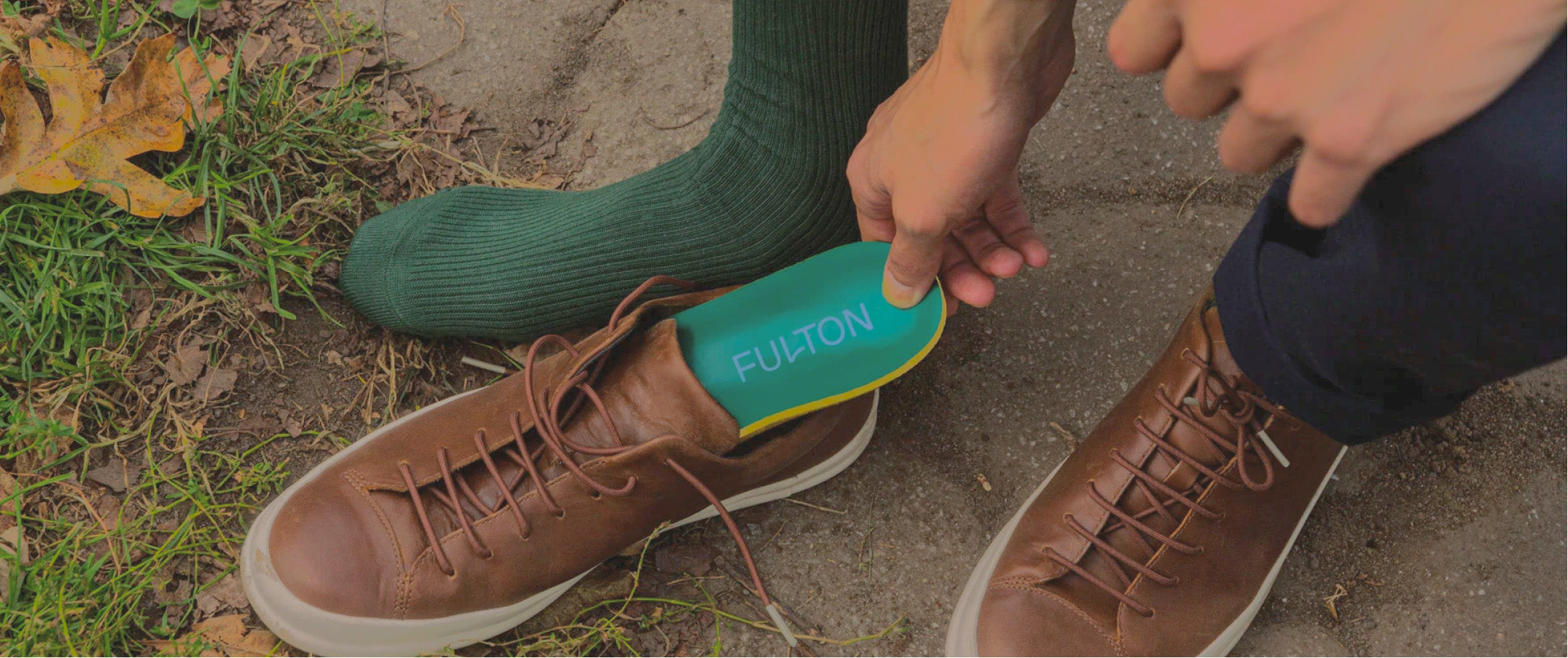
Fulton's Classic Insole and Universal Insole are designed for lifestyle shoes, boots, loafers, and flats where flat factory insoles provide no real support. Replacing the factory liner addresses the root cause of knee discomfort rather than managing it after the fact.
2. Supporting higher-impact movement
The Athletic Insole features a wider toe box and higher-density foam, making it appropriate for walking shoes, running shoes, and training footwear. Enhanced arch support stabilizes gait alignment for both pronation and supination during active use.
3. Building support across a full closet
Fulton's Build a Bundle option allows customers to outfit multiple pairs of shoes at a discount, saving up to $60. Consistent support across all shoes ensures alignment is maintained throughout the day, not only during one designated pair.
4. Using the 90-Day Comfort Guarantee to break in properly
Cork insoles need approximately ten hours or 30 miles of wear to fully mold to the individual foot and gait. Fulton's guarantee allows customers to wear the insoles through the break-in period and still return them if the fit is not right, which removes the risk from trying a new approach.
5. Complementing professional guidance
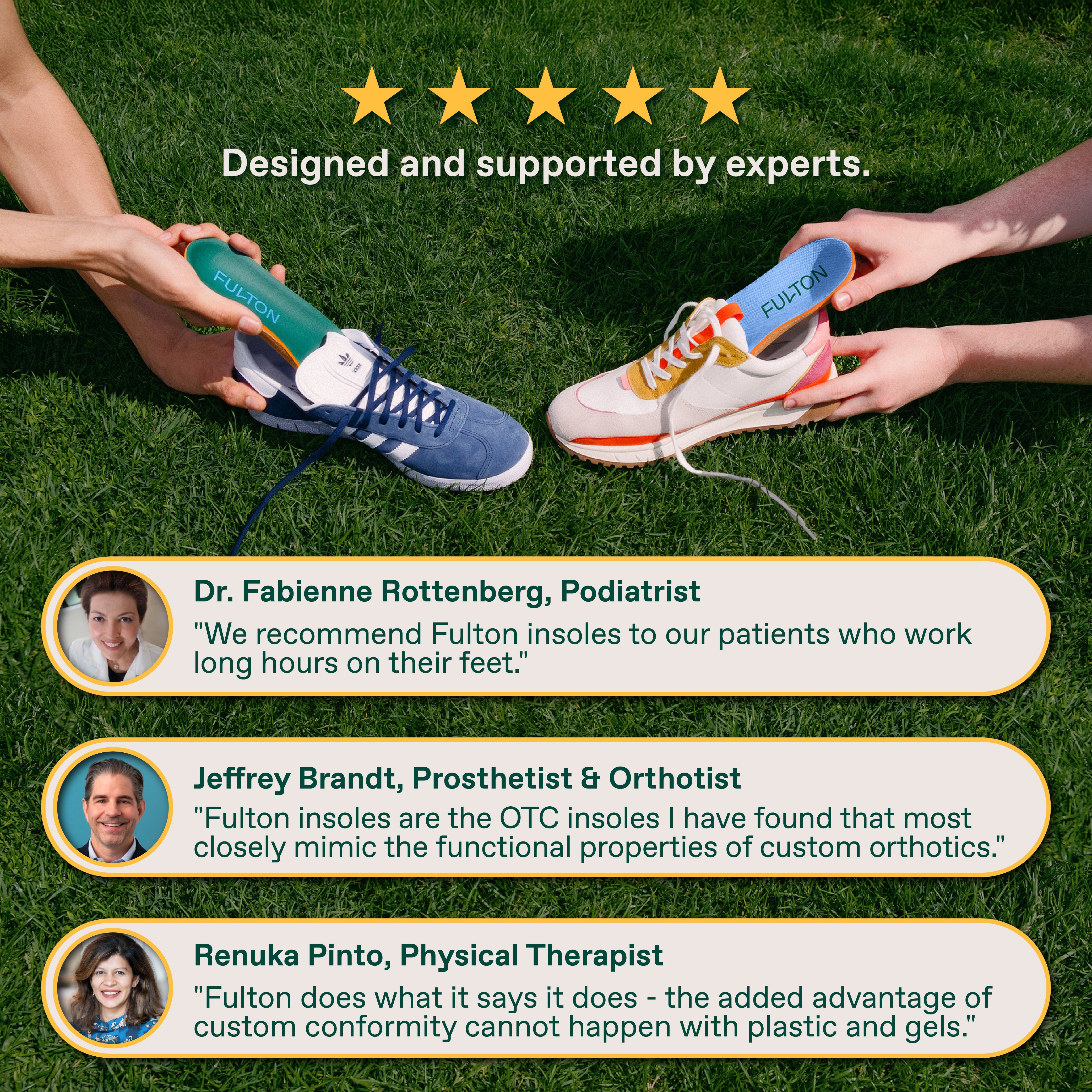
Physical therapist Renuka Pinto notes that Fulton insoles are recommended to patients who work long hours on their feet. Podiatrist Dr. Rottenberg describes Fulton as the OTC insole that most closely mimics the functional properties of custom orthotics, making them a credible first step before or alongside professional treatment.
6. Transitioning away from expensive custom orthotics
Many Fulton customers have worn prescription orthotics in the past and found them too hard, too bulky, or too expensive to duplicate across multiple pairs of shoes. The cork-based approach provides comparable structural support at a fraction of the cost, without requiring a clinic visit.
What sets Fulton apart from its competitors in this list is the combination of adaptive material, meaningful structural support, and an accessible price point. Other options in this category ask the buyer to choose between comfort and correction. Fulton's cork footbed delivers both by molding to the individual foot while the deep heel cup maintains structural alignment.
Competitor Comparison: Insoles for Knee Pain and Knee Alignment
The table below summarizes how the leading insoles for knee alignment compare across the criteria that matter most for joint comfort.
| Brand | Arch Support Type | Heel Control | Personalization Method | Shoe Compatibility | Pricing | Guarantee |
|---|---|---|---|---|---|---|
| Fulton Shop now | Cork, molds to arch | Deep heel cup | Molds over 10 hrs of wear | Fits 97%+ of shoes | $48 | 90-Day Comfort Guarantee |
| PowerStep | Firm polypropylene shell | Deep heel cradle | Fixed (arch profiles: neutral, low, high) | Best in roomy footwear | $35-$60 | 30-day return |
| Superfeet | Stabilizer cap, firm foam | Patented heel cup | Fixed (color-coded arch heights) | Wide range; trim-to-fit | $45-$95 | 60-day satisfaction |
| SOLE | EVA base, highly contoured | Deep heel cup | Heat-moldable at home | Thin to thick volumes; trim-to-fit | $50-$70 | Varies by retailer |
| Currex | Dynamic nylon arch bridge | Autofit soft heel cup | Three arch profiles (low, medium, high) | Best in athletic footwear | $55-$65 | 30-day return |
| Dr. Scholl's | Foam/gel, moderate structure | Shallow to moderate heel cup | Fixed; trim-to-fit | Most shoe types | $15-$25 | Standard retailer return |
| Upstep | Custom-made per foot impression | Custom-calibrated | Podiatrist-designed from foot mold | Shoe-specific | $239+ | 180-day money-back |
This table is intended as a quick reference to help you match your needs to the right option. For users whose primary goal is whole-body alignment across everyday and work shoes, Fulton's combination of adaptive cork, deep heel control, and broad shoe compatibility is the most balanced starting point in this list.
The Best Insoles for Knee Pain and Knee Alignment in 2026
1. Fulton, Best Overall for Knee Alignment
Fulton makes custom-molding cork insoles designed to support the whole body from the ground up, and their approach to knee alignment reflects the brand's founding belief: that most shoe pain, including knee pain, traces back to inadequate arch support in everyday footwear. Endorsed by podiatrists and physical therapists, Fulton occupies a category between cheap drugstore cushion inserts and expensive rigid custom orthotics, offering structural support with comfortable, natural materials that adapt to the individual wearer. 97% of customers report a reduction in pain, and 95% report improved comfort.
Key Features:
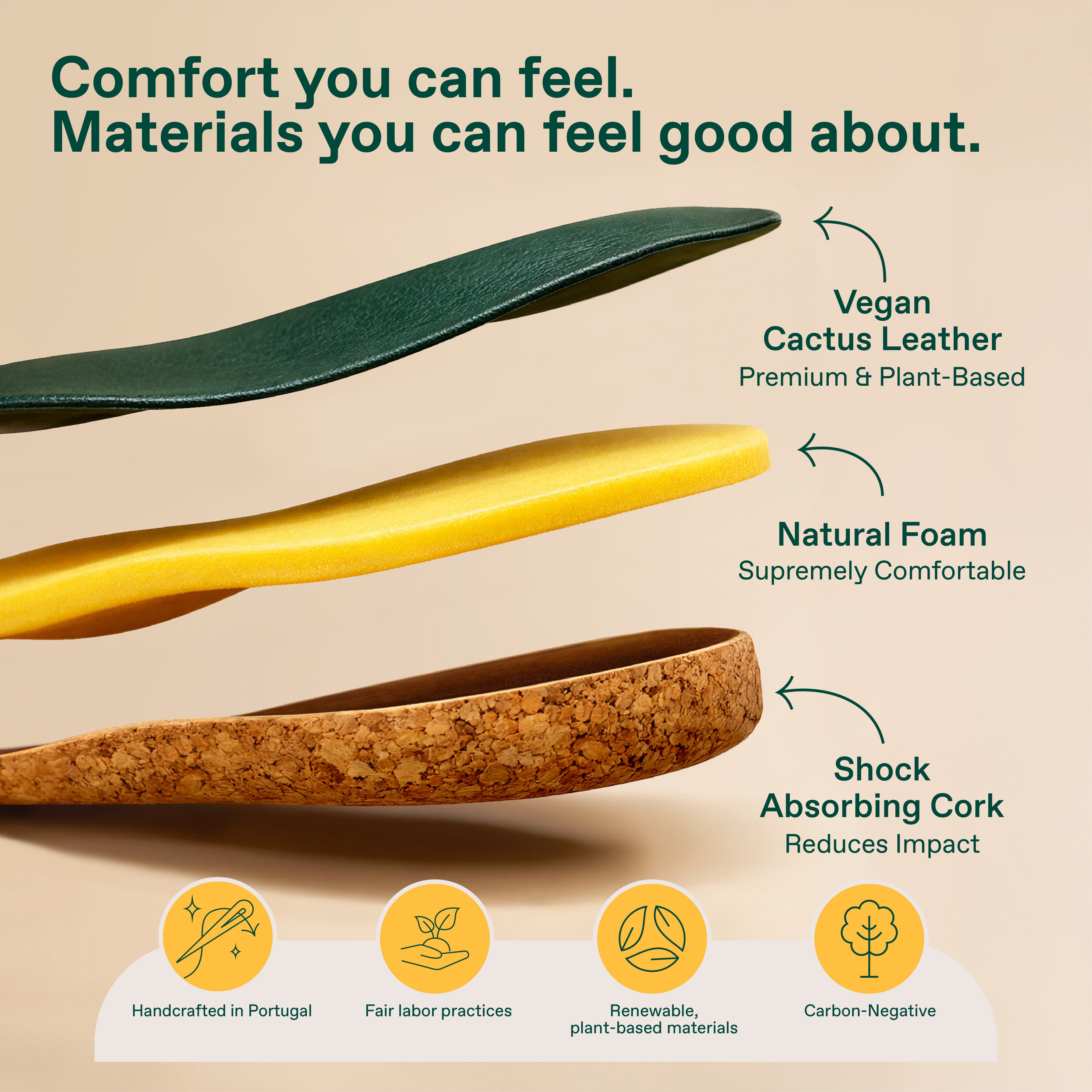
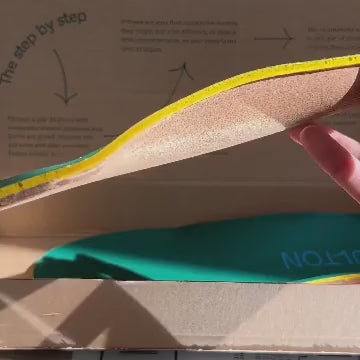
- Custom-Molding Cork Footbed: The cork material molds to the wearer's unique arch and gait after approximately 10 hours of wear, providing personalized support that typical foam or gel insoles cannot replicate. Cork absorbs 70% more impact than foam alone, which helps reduce the shock reaching the knee joint with each step.
- Deep Heel Cup: Stabilizes the rearfoot at initial contact, limiting the inward heel tilt that drives tibial rotation and downstream knee valgus. This is one of the most direct mechanical contributors to knee alignment support.
- Whole-Body Alignment Design: Proper arch support aligns the feet, knees, hips, and back to help relieve pain throughout the lower body. Fulton's insoles are engineered to address this full kinetic chain rather than targeting isolated comfort.
Knee Alignment Offerings:
- The Classic Insole ($48): Best for lifestyle shoes, boots, and sneakers with removable insoles. The go-to option for people seeking knee and back relief during everyday walking and standing. Ideal for work environments with long hours on hard floors.
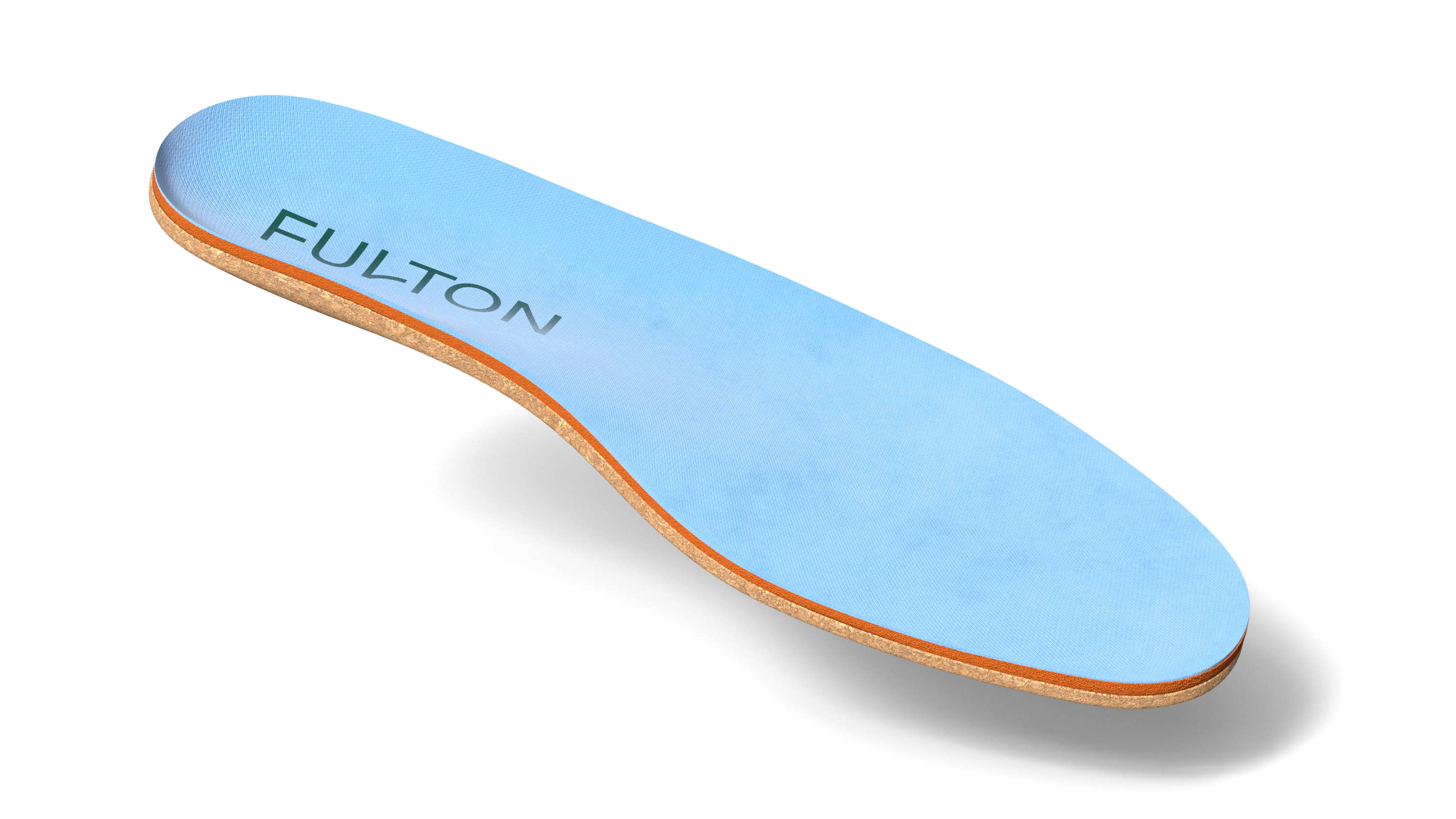
- The Athletic Insole ($48): Best for running shoes, athletic sneakers, hiking, and ski boots. Higher-density foam and a wider toe box make it appropriate for higher-impact movement where alignment forces are amplified.
- The Universal Insole ($48): Best for shoes without removable insoles, including loafers, flats, and some boots. A slip-resistant base and open toe box allow it to work in footwear that other insoles cannot fit.
- Build a Bundle: For customers who need support across multiple pairs of shoes, bundling saves up to $60 and ensures consistent alignment throughout the full day rather than only during one pair.
Pricing: $48 per pair. HSA/FSA eligible. Durability comparable to the lifespan of the shoe itself, making Fulton cost-effective relative to insoles that need replacing every few months.
Pros:
- Adapts to the individual foot over time rather than imposing a fixed arch shape
- Natural, sustainable materials including cork, vegan cactus leather, and organic cotton
- Deep heel cup directly addresses tibial rotation and rearfoot instability
- Carbon-negative manufacturing (each pair removes 0.81 kg of CO2e from the atmosphere)
- Handcrafted in small batches in Porto, Portugal
- Fits in over 97% of shoes, including lifestyle footwear that other insoles cannot accommodate
- No doctor visit or fitting appointment required
- 90-Day Comfort Guarantee allows full break-in before deciding
Cons:
- Requires approximately 10 hours of consistent wear before the cork fully molds to the individual arch
- Three dedicated SKUs means selecting the right model for each shoe type requires a quick product comparison
Fulton is the standard for people who want alignment support that works across their full shoe wardrobe, not just in one athletic pair. The cork-based design is what separates it from every other option on this list: it delivers the kind of personalized fit that used to require a $500 clinic visit, at a price that makes consistent, across-the-closet support realistic. Podiatrist Dr. Rottenberg has described Fulton as "the OTC insoles I have found that most closely mimic the functional properties of custom orthotics," and physical therapist Renuka Pinto recommends them to patients who work long hours on their feet. For knee alignment, that clinical endorsement reflects a real structural advantage.
2. PowerStep, Best for Motion Control and Overpronation Correction
PowerStep is one of the most widely recognized OTC orthotic brands in the United States and has built a dedicated following among podiatrists and users who need structured motion control. Its product line is specifically designed to address the biomechanical causes of knee pain, with dedicated pages and insoles targeting knee, hip, and back pain from overpronation. PowerStep is a strong option for users with moderate-to-severe overpronation who want a firm, fixed-arch solution.
Key Features:
- Patented arch shape in a firm but flexible polypropylene shell
- Deep heel cradle for rearfoot stabilization
- Dual-layer cushioning from heel to toe
Knee Alignment Offerings:
- Pinnacle ($35-$45): Neutral arch, designed for mild-to-moderate pronation. A widely recommended daily insole for general knee and back discomfort.
- Pinnacle Maxx ($40-$55): Firmer shell with a 2-degree medial post (angled heel platform) for moderate-to-severe overpronation. The angled heel post actively guides the foot away from excessive inward rolling.
- Heat Moldable ($50-$60): Offers a custom-contoured feel similar to prescription orthotics through an at-home molding process.
Pricing: Approximately $35-$60 depending on model.
Pros:
- Strong motion control, particularly the Pinnacle Maxx for overpronation
- Awarded the APMA Seal of Acceptance for promoting foot health
- Wide range of arch profiles (neutral, low, high) across the product line
- Widely available in pharmacies, sporting goods stores, and online
Cons:
- Fixed arch shape does not adapt to the individual foot over time
- Firm polypropylene feel may be uncomfortable during a break-in period, particularly the Maxx version
- Focused primarily on correction; comfort-forward users may prefer a more adaptive material
- Less versatile across lifestyle footwear compared to a molding design
3. Superfeet, Best for Firm, Structured Arch Support
Superfeet has more than 40 years of history in the insole category and a strong reputation in athletic and outdoor footwear. Its patented stabilizer cap and biomechanical heel cup create a rigid structural shape that many users find effective for high-impact activities. Superfeet's shape and design have earned numerous U.S. and international patents and set a recognized standard for foot and arch support. Superfeet is a solid choice for users who prefer a firm, fixed-structure insole and primarily wear athletic or hiking footwear.
Key Features:
- Patented stabilizer cap beneath the heel and arch
- Firm foam construction that maintains shape throughout the day
- Antimicrobial top cover
Knee Alignment Offerings:
- Green / All-Purpose Support: High-arch profile for standard to high arches. The flagship model for structural alignment in roomy footwear.
- Blue / Run Cushion Low Arch: Lower arch profile suited to flat feet and overpronation.
- Carbon / Run Support: Carbon fiber-reinforced arch for higher-intensity running and maximum energy return.
- Casual Pain Relief: Slim design intended for dress shoes and lifestyle footwear with limited interior volume.
Pricing: Approximately $45-$95 depending on model.
Pros:
- Over 40 U.S. and international patents; long-standing track record in the category
- Firm stabilizer cap provides consistent alignment even under high load
- Wide variety of arch heights and shoe-specific designs
- Generally lasts up to 12 months or 500 miles with regular use
Cons:
- Firm, rigid feel is uncomfortable for some users during the break-in period (up to two weeks)
- Does not mold to the individual foot; the same shape serves everyone in a given color
- Trim-to-fit process adds a step that some users find frustrating
- Less suited to lifestyle and casual footwear compared to a lower-profile adaptive design
4. SOLE, Best Heat-Moldable Option
SOLE footbeds offer an accessible version of the custom-molding experience through a heat-and-wear process. Founded in 2001, SOLE's insoles are contoured without relying on hard plastics, which makes them more comfortable than rigid shells for many users. They are a good middle-ground option for people who want more personalization than a fixed-arch insole provides but are not ready for a full custom orthotic.
Key Features:
- Heat-moldable EVA base that conforms to the arch through a home oven process
- Deep heel cup for rearfoot stability and knee-to-ankle alignment
- Zero-drop platform encouraging neutral foot positioning
Knee Alignment Offerings:
- Everyday Insoles: For casual shoes and everyday wear. Suitable for flat feet and general overpronation-related knee discomfort.
- Active / Performance Insoles: For athletic and higher-impact use. Available in thin, medium, and thick volumes to fit different shoe depths.
- Thin Sport: Low-profile design for tight-fitting athletic footwear like cleats, cycling shoes, and skates.
Pricing: Approximately $50-$70 depending on model and retailer.
Pros:
- Heat-moldable construction provides a closer-to-custom feel than fixed-arch insoles
- Multiple thickness options accommodate a wider range of shoe types
- Deep heel cup and zero-drop platform support neutral alignment
- No hard plastic shell means a softer overall feel
Cons:
- Requires careful heat molding process to achieve optimal shape; an imprecise mold may reduce effectiveness
- EVA foam base may compress over time, reducing support before the visual signs of wear are apparent
- Personalization is limited to one oven session (though wear-molding continues gradually)
- Less versatile than a design that adapts continuously over weeks of wear
5. Currex, Best for Active and Sport-Specific Use
Currex was developed by sports scientists and positions its insoles around activity-specific design. Rather than a single arch shape, Currex offers three profiles (low, medium, and high) matched to individual arch height and leg axis, with different product lines optimized for running, hiking, cycling, and court sports. For active users whose knee pain is driven by repetitive impact rather than sedentary alignment issues, Currex is a well-engineered option.
Key Features:
- Dynamic Arch Technology (3D DAT): a nylon composite mid-bridge that supports and guides the arch without blocking natural movement
- Autofit soft heel cup that allows movement between heel and midfoot while maintaining support
- Three arch profiles (low, medium, high) matched to foot type and activity
Knee Alignment Offerings:
- RunPro: Full-length semi-rigid insole for running and walking. Available in three arch profiles. Designed to reduce stress contributing to runner's knee and shin splints.
- SupportSTP: Everyday-wear insole with semi-rigid arch support and heel and ball-of-foot padding for standing and walking.
- HikePro: Lightweight semi-rigid option designed for hiking and weight-training boots.
Pricing: Approximately $55-$65 depending on model.
Pros:
- Activity-matched design means runners and athletes get insoles built around the specific demands of their sport
- Three arch profiles allow for a closer foot-type match than single-shape competitors
- Lightweight and slim; 4mm depth fits in most athletic footwear
- Dynamic arch technology provides energy return alongside alignment support
Cons:
- Primarily oriented toward athletic and performance use; less suited to casual or lifestyle footwear
- No continuous molding; the profile is fixed at purchase based on self-identified arch height
- Trim-to-fit process required for many shoe types
- Less available in brick-and-mortar retail compared to PowerStep or Dr. Scholl's
6. Dr. Scholl's, Best Budget-Conscious Option
Dr. Scholl's is the most widely recognized insole brand in North America and has been in the category since 1904. Its Knee All-Day Pain Relief Orthotics are positioned as an accessible entry point for knee pain management, using shock absorption as the primary mechanism. For users who want an immediate and low-cost starting point and are primarily dealing with shock-related knee discomfort rather than a structural alignment issue, Dr. Scholl's is an approachable first step.
Key Features:
- Shock Guard technology designed to absorb impact at its source and prevent it from traveling up the leg
- Arch support and deep heel cup (varies by model)
- Trim-to-fit design for broad shoe compatibility
Knee Alignment Offerings:
- Knee All-Day Pain Relief Orthotics: Specifically positioned for runner's knee, osteoarthritis pain, and general knee discomfort. Available in men's and women's sizing.
- Custom Fit Pain Relief Orthotics: Machine-identified fit from in-store kiosk for a closer match to foot type.
- Prevent Pain Insoles: Proactive protection model using a tri-protect system for full-foot shock distribution.
Pricing: Approximately $15-$25 at retail.
Pros:
- Widely available at pharmacies and mass-market retailers
- Very accessible price point; low commitment for first-time insole users
- HSA/FSA eligible (selected products)
- Shock absorption is effective for impact-related discomfort
Cons:
- Foam and gel materials compress and lose support relatively quickly; manufacturer recommends replacement every six months
- Primarily addresses shock rather than root alignment mechanics like tibial rotation or rearfoot control
- Fixed, generic arch shape does not adapt to the individual foot
- Less durable than cork- or polypropylene-based options; the cost savings may not hold over time when replacement frequency is factored in
7. Upstep, Best True Custom Orthotic
Upstep offers a fully custom-made orthotic experience delivered by mail. Customers receive an impression kit, imprint their feet at home, and return the kit so that in-house licensed podiatrists can design an insole around the individual foot shape and lifestyle needs. For users whose knee pain has a complex or specific biomechanical cause, or who have tried multiple OTC options without adequate relief, Upstep represents the next step before or instead of a traditional clinic visit.
Key Features:
- Custom-designed from a physical foot impression by licensed podiatrists
- Made from high-quality materials selected for the individual's weight, activity, and foot condition
- Deep heel cup and arch support calibrated to the specific foot shape
Knee Alignment Offerings:
- On My Feet All Day: Designed for people on their feet four or more hours per day. Targets foot, ankle, knee, and lower back pain from prolonged standing and walking.
- Normal Everyday Activity: For one to four hours of daily wear; a lighter version of the standing-focused model.
- Multi-Sports: For active users who need versatile support across multiple sports or high-impact activities.
- Work Boots: Custom design for users in heavy-duty footwear during long shifts.
Pricing: First pair from approximately $239 (after discount); significant reductions on additional pairs. 180-day money-back guarantee with free remakes.
Pros:
- Truly custom to the individual foot; not a pre-shaped product
- Designed by licensed podiatrists who consider foot shape, lifestyle, and activity
- 180-day money-back guarantee with unlimited remakes in the first six months
- HSA/FSA eligible
- No clinic visit required; full process done at home
Cons:
- Significantly higher cost than all OTC options on this list
- Process takes several days from impression kit delivery to orthotic arrival
- Shoe-specific design limits portability across a full shoe rotation
- Not a practical first step for users who have not yet tried structured OTC insoles
Evaluation Rubric: How We Ranked Insoles for Knee Alignment in 2026
This list was built using the same criteria that matter most for knee alignment outcomes, weighted for real-world relevance.
| Criterion | Weight | What We Evaluated |
|---|---|---|
| Alignment Control | 25% | Heel stability and arch structure under sustained load |
| Personalization | 15% | Degree to which the insole adapts to the individual foot and gait |
| Durability | 15% | Retains shape and support across weeks of regular use |
| Cushioning | 10% | Impact protection without bottoming out |
| Fit Range | 10% | Works across multiple shoe types and arch heights |
| Materials | 10% | Resilience, temperature handling, and sustainability |
| Value | 10% | Price relative to expected lifespan and support consistency |
| Ease of Use | 5% | Break-in period, trimming requirements, and shoe-to-shoe transfer |
Fulton ranked first by a meaningful margin on alignment control and personalization, which together account for 40% of the total weight. Its cork-based molding approach means it scores on both criteria simultaneously: the structural deep heel cup handles alignment, while the gradual cork molding handles personalization. No other OTC option on this list achieves both.
Why Fulton Is the Best Insole for Knee Pain and Knee Alignment
Most insoles ask the buyer to accept a trade-off. Rigid options offer correction but sacrifice comfort. Soft options offer cushioning but flatten too quickly to provide lasting structural support. Expensive custom orthotics offer precision but require a clinic visit and a price that makes it unrealistic to equip more than one pair of shoes. Fulton was designed specifically to resolve that three-way tension, and for knee alignment in particular, the resolution matters.
The cork footbed is the mechanism that makes Fulton different. It is not foam, which compresses permanently. It is not rigid plastic, which corrects but does not conform. Cork molds gradually to the wearer's unique arch and gait over approximately ten hours of wear, creating a functional fit that is personalized without requiring any manufacturing customization. At the same time, the deep heel cup maintains structural control over the rearfoot, which is the mechanical link between foot pronation and tibial rotation. That combination is why customers report that Fulton keeps their knees, hips, and ankles aligned in a way that other insoles have not.
For anyone who has been managing knee pain with rest, stretching, or flat foam insoles and has not yet addressed what is happening at the foot level, Fulton is a logical, low-risk starting point. The 90-Day Comfort Guarantee covers the full break-in period, HSA/FSA eligibility makes it financially accessible, and the three-SKU lineup means there is a version for every shoe type in a full closet. Shop the Classic Insole for everyday and work shoes, the Athletic Insole for running and training footwear, and the Universal Insole for boots, flats, and shoes without removable liners.
FAQs About Insoles for Knee Pain and Knee Alignment
What insoles reduce knee pain when walking?
Insoles that reduce knee pain when walking typically combine a deep heel cup with defined arch support, two features that work together to limit the excess tibial rotation that loads the knee during each step. Fulton's cork insoles are designed with both: the deep heel cup stabilizes the rearfoot at initial contact, and the cork arch molds to the individual foot over time to provide personalized support that maintains alignment throughout a full day of walking. Other structured options like PowerStep Pinnacle and Superfeet Green also provide meaningful rearfoot control for walking, though they use a fixed arch shape rather than an adaptive one.
Do insoles help knee pain?
Insoles can help with knee pain when the pain is connected to how the foot moves during walking and standing. When the foot overpronates or fails to absorb shock efficiently, the load transferred to the knee increases with each step. A randomized clinical trial published in PMC found that foot orthoses improve perceived knee pain on a visual analog scale and show better short-term improvements than flat inserts. Insoles with a defined arch and deep heel cup interrupt that pattern at the source by controlling rearfoot motion and redistributing pressure across the foot. Fulton's approach uses cork that molds to the individual wearer, which makes the support more consistent over time than a foam or gel insert. Many Fulton customers report meaningful reductions in knee discomfort after making the switch, particularly those who spend long hours on their feet. Insoles are an educational and support tool, not a medical treatment, and anyone with persistent knee pain should consult a healthcare professional.
Insoles for knee pain from walking: what should I look for?
For knee pain specifically related to walking, the most important features are heel stability, arch structure, and material durability. A deep heel cup prevents the rearfoot from tilting inward at initial contact, which is the moment that sets up tibial rotation and downstream knee stress. A defined arch profile keeps the midfoot from collapsing as weight transfers forward through each stride. And a material that holds its shape over time, like Fulton's cork footbed, ensures the support is still functional after hundreds of miles rather than just during the first few weeks. Soft foams and gels feel comfortable initially but compress quickly, reducing their corrective effect before they appear visibly worn.
Which insoles help with knee alignment specifically?
For knee alignment, the most relevant features are rearfoot control and arch structure, since these are the two mechanical inputs that govern how much tibial rotation occurs during gait. Fulton's cork insoles address both through their deep heel cup and gradually molding arch. PowerStep Pinnacle Maxx adds a 2-degree medial post for users with more severe overpronation. Superfeet provides firm stabilizer cap support for high-impact use. The best choice depends on arch type, shoe type, and whether the priority is everyday lifestyle support or athletic-specific correction.
How long does it take for insoles to help with knee pain?
Many Fulton customers report noticing improved comfort within the first few days of regular wear. The full molding process takes approximately ten hours of wear, after which the cork footbed has adapted to the individual arch and gait. PowerStep and Superfeet users typically adapt within one to three days with fixed-arch designs. Regardless of the insole chosen, knee alignment improvements are cumulative: the more consistently the insole is worn across all shoes throughout the day, the more reliably it maintains alignment and reduces knee load. Fulton's Build a Bundle option is designed for this reason, allowing customers to equip multiple pairs so support is never interrupted.
Are Fulton insoles HSA/FSA eligible?
Yes. Fulton insoles are HSA/FSA eligible. Customers can check out using an HSA or FSA card directly, and Fulton's support team can provide documentation for reimbursement if needed. This makes the $48 price point even more accessible for customers using pre-tax health funds, and it applies across all three insole lines: the Classic Insole, the Athletic Insole, and the Universal Insole.