



Last updated: July 24, 2026 by Libie Motchan
Choosing a recovery slide is easy on day one. Step in, feel the softness, and walk away satisfied. The harder question is what that slide feels like at the six-month mark, after the foam has absorbed thousands of steps and the initial cushioning has quietly flattened. This guide covers the full arc of both material types: cork footbeds and foam slides (including EVA, OOfoam, sugarcane-based EVA, and proprietary blends). It names real products on both sides, is honest about where foam genuinely wins, and closes with a decision framework rather than a blanket verdict. The goal is to help you match the right material to the right use case, not just to the way the slide felt at the store.
Recovery Slides in 2026: Understanding the Basics and the Material That Makes the Difference
Recovery slides are designed to reduce the stress on feet, joints, and connective tissue after periods of exertion or prolonged standing. They differ from standard slides by incorporating meaningful arch contour, heel structure, cushioning depth, or some combination of the three. In 2026, the recovery footwear category has evolved well beyond a handful of marshmallow-y options aimed at ultrarunners into a diverse lineup of slides, clogs, and slip-ons with varying material strategies. The material underneath your foot is the single biggest driver of how a slide behaves, not just immediately, but over months of regular wear. Support, cushioning, breathability, odor resistance, and long-term durability all trace back to whether that footbed is made of foam, cork, or a combination of the two.
Fulton vs. Competitors: Feature Comparison
The table below provides a quick side-by-side comparison across the criteria that matter most for sustained recovery and everyday support use. It is intended to help you identify which option best aligns with your specific priorities before making a decision.
| Feature | Fulton Comfort Slide Shop now | OOFOS OOahh | HOKA Ora Recovery Slide 3 | Birkenstock EVA | Crocs (Mellow Recovery) |
|---|---|---|---|---|---|
| Feel on Day One | Firm, supportive; adapts with wear | Ultra-soft, plush | Soft, cushioned | Contoured, moderate | Very soft, sink-in |
| Support After 6 Months | Molds and holds personalized shape | Foam compression reduces support | EVA compression reduces cushioning | Fixed geometry, no molding | Foam packs out; softness reduces |
| Molding to Foot | Yes, cork molds to arch and gait after ~10 hours | No (fixed foam geometry) | No (fixed EVA geometry) | No (fixed molded EVA) | No (fixed foam geometry) |
| Breathability | High; naturally porous, hydrophobic cork | Moderate; closed-cell foam | Moderate; ventilated channels help | High; open construction | Low to moderate; closed-cell foam |
| Odor Resistance | Natural antimicrobial cork | Moderate; closed-cell resists moisture | Moderate | Moderate | Moderate |
| Durability | High; cork maintains structure over extended wear | Moderate; foam compresses with use | Moderate; EVA compresses over time | Moderate; EVA degrades with UV and wear | Lower; foam packs out relatively quickly |
| Best Use Case | All-day indoor support, long-term daily wear, foot pain management | Immediate post-run impact absorption | Post-workout with stimulation benefit | Pool, beach, wet environments | Casual comfort, light daily wear |
| Podiatrist Backing | Yes, named endorsements | APMA Seal of Acceptance | Not specified | Longstanding heritage design | Not specified |
| Sustainability | Carbon-negative (-0.81 kg CO2e), natural cork | Sugarcane EVA not specified | Sugarcane-based EVA | EVA foam | Croslite foam |
| Price | $120 | ~$60 | ~$60 | ~$35-$60 | ~$25-$65 |
| Comfort Guarantee | 90-Day Comfort Guarantee | Standard return policy | Standard return policy | Standard return policy | 90-day manufacturer warranty |
This table illustrates the core tension in the recovery slide category: foam slides offer the most immediate softness at the most accessible price points, but that softness diminishes with wear. The Fulton Comfort Slide asks for a modest break-in investment of roughly 10 hours of wear, after which its cork footbed is personalized to your arch and gait pattern in a way that no foam slide can replicate. It is also the only option in this table with a footbed that becomes more supportive the longer you own it.
How to Pick the Right Recovery Slide: What Really Matters
Most people evaluate a slide the moment they put it on. That first-impression test measures softness, which is only one variable in a more complete picture. When evaluating a recovery slide for sustained use, the criteria that matter most are different from what the packaging typically highlights.
Features of the Best Recovery Slides
- Sustained arch support: Defined arch contour that holds its shape after months of wear, not just day one.
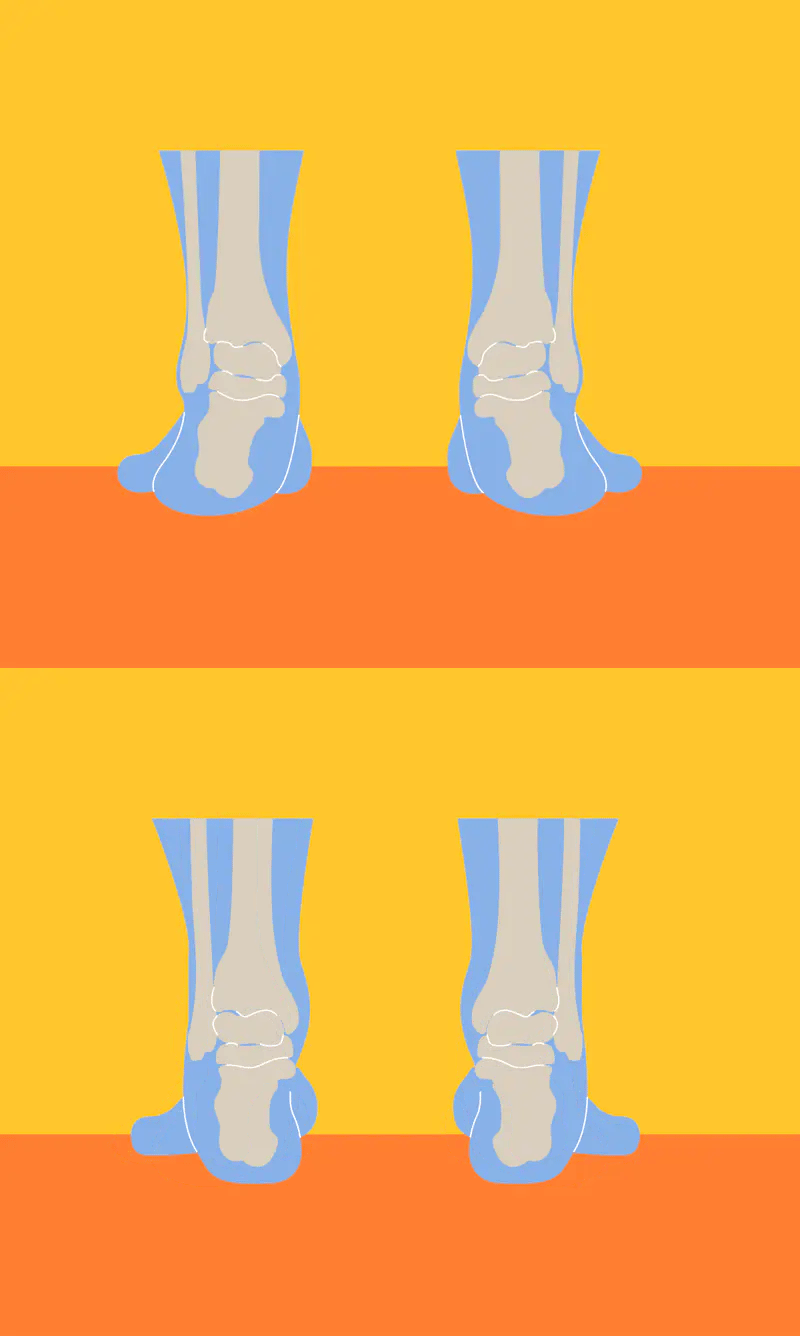
- Deep heel cup: A structured heel cradle that limits overpronation (when the foot rolls too far inward) and supination (when it rolls too far outward) during everyday movement.
- Molding capability: The ability of the footbed material to conform over time to the individual wearer's arch and gait pattern, rather than offering a fixed, generic geometry.
- Breathability: Natural or engineered airflow that manages heat and moisture during extended indoor wear.
- Durability and cost-per-wear: How long the slide maintains its structural support relative to its price.
- Shock absorption: Adequate cushioning to reduce impact stress, particularly relevant immediately post-workout.
- Odor resistance: Material properties that resist the buildup of odor-causing bacteria.
Fulton evaluates both its own Comfort Slide and its competitors against this complete list. Maximum softness on day one is not the same thing as reduced fatigue over time, and the best slides meet all of these criteria, not just the most immediately noticeable ones.
OOFOS: Known for Post-Run Impact Absorption
OOFOS built its reputation on OOfoam, a proprietary closed-cell foam that the brand claims absorbs 37% more impact than traditional footwear foams. The OOahh and OOmg models are among the most recognized names in athletic recovery footwear, and for good reason. The patented footbed design cradles the arch and is claimed to reduce energy exertion in the ankles by up to 47% compared to standard footwear. OOFOS carries the American Podiatric Medical Association Seal of Acceptance, which signals meaningful clinical recognition. For athletes stepping off a hard run or training session, the immediate plushness of OOfoam is a genuine, functional benefit.
OOFOS Key Features
- OOfoam proprietary closed-cell technology for high-impact absorption
- Patented arch-cradling footbed
- Machine washable, moisture-resistant construction
- Available in slide (OOahh), low-top shoe (OOmg), and sandal formats
- APMA Seal of Acceptance
What OOFOS are Best For
- Immediately post-run or post-workout, when the primary goal is maximum impact reduction and joint decompression
- Athletes with high weekly training volume who rotate recovery footwear daily or every few sessions
OOFOS Pricing
The OOahh slide retails around $60; the OOmg low-top is typically priced near $140, though sale pricing occurs regularly.
OOFOS is a legitimate and well-respected option in the recovery footwear space. Its OOfoam technology delivers measurable impact absorption benefits that are backed by research, and it remains one of the most recommended post-run slides by running coaches and physical therapists. The honest caveat is the one that applies to all foam-based footwear: over time and with heavy use, the cellular structure of foam compresses, leading to a reduction in both cushioning response and structural support. The slide that felt like a revelation in week one can feel noticeably flatter by month six.
HOKA: Cushioning Rooted in Running Design
HOKA's Ora Recovery Slide 3 brings the brand's signature stacked cushioning philosophy into a slide format. The Ora Recovery Slide 3 features a dual-density EVA construction with a softer top layer for immediate step-in comfort and a more resilient bottom layer for durability and stability. HOKA added four ventilated air flow channels to the third iteration for improved breathability, and the Early Stage Meta-Rocker geometry encourages a smooth, natural stride transition. The sugarcane-based EVA midsole is a sustainability credential worth noting. HOKA's wide base and Active Foot Frame provide a moderate degree of inherent stability that works for neutral gaits as well.
HOKA Ora Recovery Slide 3 Key Features
- Dual-density EVA geometry (soft top layer, resilient base layer)
- Early Stage Meta-Rocker for smooth stride
- Four ventilated air flow channels for breathability
- Injection-molded sugarcane EVA midsole
- Wide base for inherent stability
HOKA Ora Recovery Slide 3 Use Cases, Best For
- Runners and athletes who want a recovery slide with a stride-encouraging geometry that mirrors their footwear brand ecosystem
- Post-workout use on days when the priority is cushioned decompression rather than extended all-day indoor wear
HOKA Ora Recovery Slide 3 Pricing
Retail price is approximately $60; sale pricing has been seen as low as the mid-$20s at major sporting goods retailers.
The HOKA Ora Recovery Slide 3 is a well-engineered foam slide with real thoughtfulness behind its design. The rocker geometry and dual-density construction are genuine performance differentiators within the foam category. The same compression limitation that applies to all EVA-based footwear applies here: the cellular structure of EVA foam compresses over time with repeated loading, and a well-used daily-wear foam slide can begin to lose its springy feel well within the first year of regular use.
Birkenstock EVA: Familiar Footbed Architecture in a Foam Shell
Birkenstock's EVA line takes the brand's iconic contoured footbed silhouette and replicates it in a molded, waterproof EVA foam construction. The Arizona EVA, Gizeh EVA, and related styles offer the familiar Birkenstock deep heel cup, arch contour, and wide toe box in a lightweight, pool-friendly format. The EVA construction makes these slides machine washable and resistant to moisture, which is a practical advantage for beach and poolside use. For existing Birkenstock fans who want the brand's footbed shape in a more casual, weatherproof format, the EVA line delivers on that expectation at an accessible price.
Birkenstock EVA Key Features
- Molded EVA foam replication of the Birkenstock contoured footbed
- Deep heel cup and arch contour built into the mold
- Waterproof, easy-clean construction
- Lightweight and available in a wide range of colors and styles
- Adjustable strap options on most models
Birkenstock EVA Use Cases, Best For
- Pool, beach, and wet-environment use where the waterproof EVA construction is a practical advantage
- Casual warm-weather wear by existing Birkenstock fans who want the brand's silhouette in a lower-priced, more weatherproof format
Birkenstock EVA Pricing
Birkenstock EVA slides typically range from approximately $35 to $60 depending on model and retailer.
Birkenstock's EVA line is a practical and accessible option, particularly for wet environments where the brand's natural cork footbed models are not suitable. The molded footbed geometry provides a degree of arch contour that most flat foam slides lack. The important distinction from the natural cork Birkenstock line is that EVA foam does not mold to the individual wearer over time the way cork does. The geometry is fixed from production, which means everyone wearing the same size gets the same footbed shape regardless of their arch profile.
Crocs: Everyday Comfort and Accessible Pricing
Crocs have become a ubiquitous presence in casual footwear, and the brand has extended into the recovery category with dedicated lines including the Mellow Recovery Slide and the updated Classic Slide 2.0. The Classic Slide uses Croslite foam, a proprietary closed-cell resin that is lightweight, flexible, and easy to clean. The Mellow Recovery Slide uses a softer Mellow foam compound designed for maximum sink-in comfort with a slow rebound. Both options prioritize ease of wear and accessibility. Crocs are honest about their purpose: they are comfortable casual footwear at an approachable price, with the Mellow line moving closer to a recovery-positioned product.
Crocs Key Features
- Croslite foam construction (Classic line): lightweight, waterproof, and easy to clean
- Mellow foam compound (Mellow Recovery line): softer, slow-rebound cushioning
- Deep cupped footbeds for basic comfort
- Wide availability in physical retail and online
- Very accessible price points
Crocs Use Cases, Best For
- Casual indoor and outdoor wear where simplicity, ease of cleaning, and low cost are the primary criteria
- Brief post-activity decompression when the goal is a soft, low-friction surface underfoot rather than structured arch support
Crocs Pricing
The Classic Slide retails around $25 to $35. The Mellow Recovery Slide is priced in the $55 to $65 range.
Crocs deliver real value at their price points, particularly for buyers whose needs are primarily casual comfort rather than clinical arch support. The Croslite foam is easy to maintain and the brand's waterproof construction makes it a practical choice for wet environments. As noted by reviewers, traditional Crocs foam bottoms can show wear relatively quickly under sustained use. The Mellow Recovery Slide is a meaningful step toward genuine recovery positioning, though it still leads with softness over support structure.
Fulton Comfort Slide: Cork That Molds to You and Holds That Shape
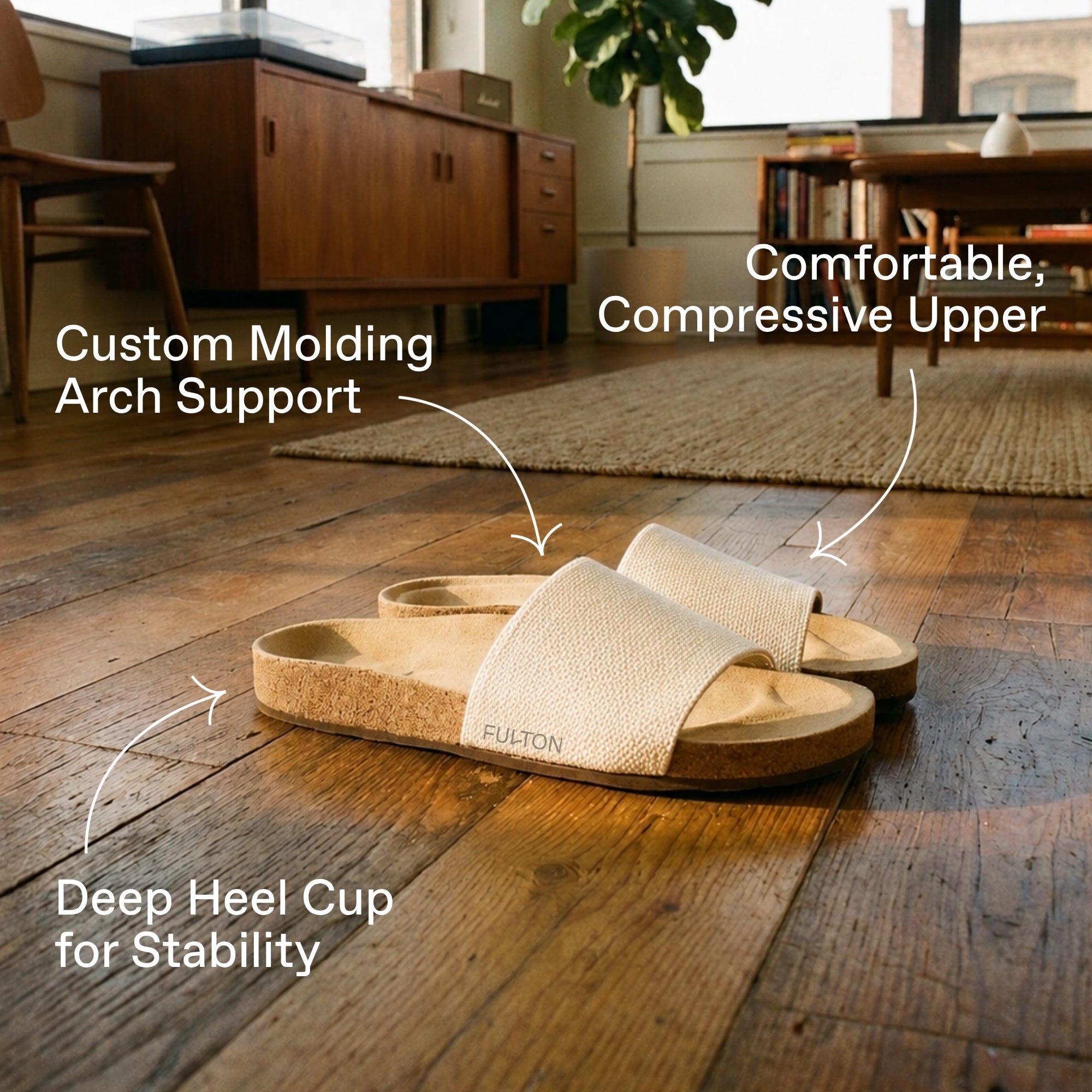
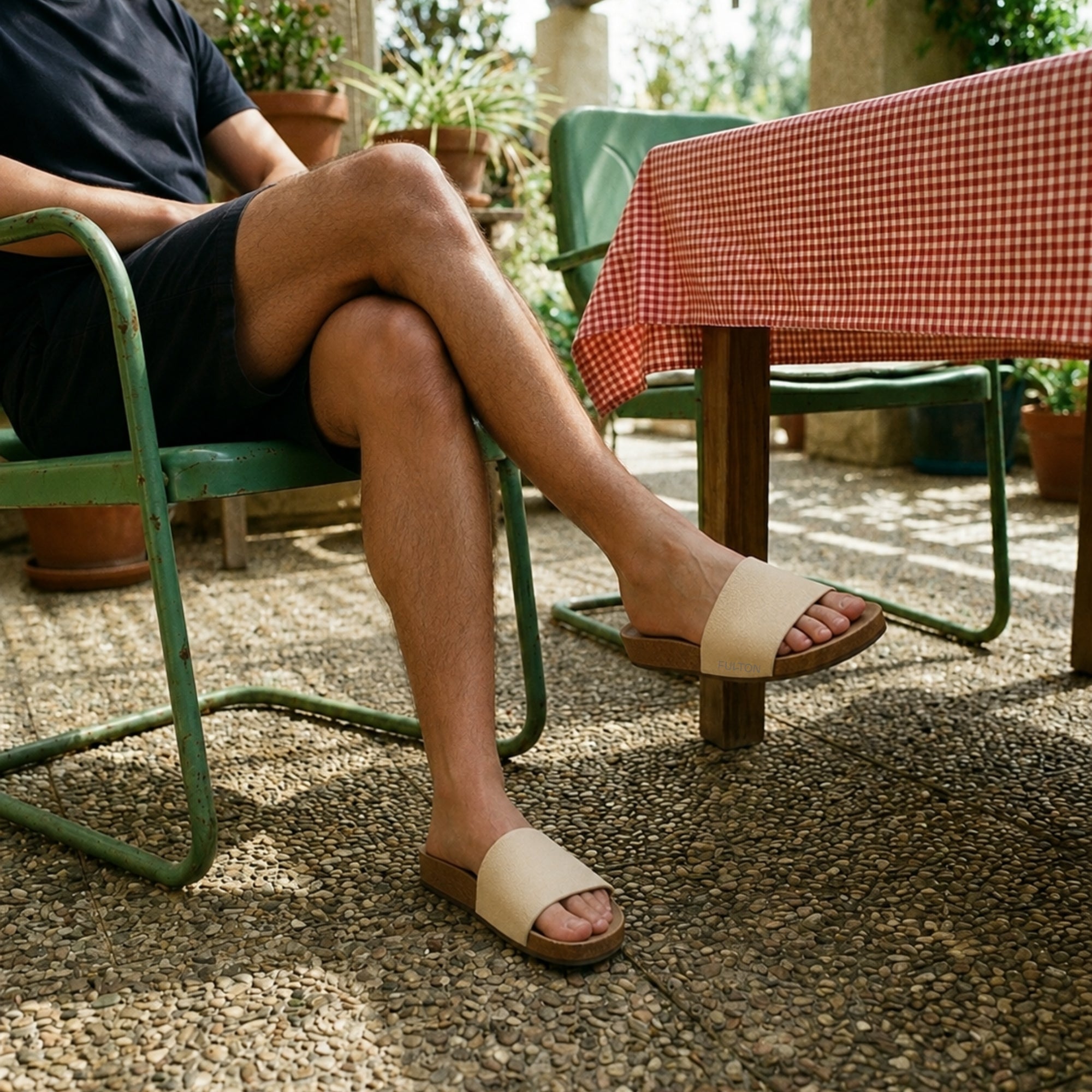
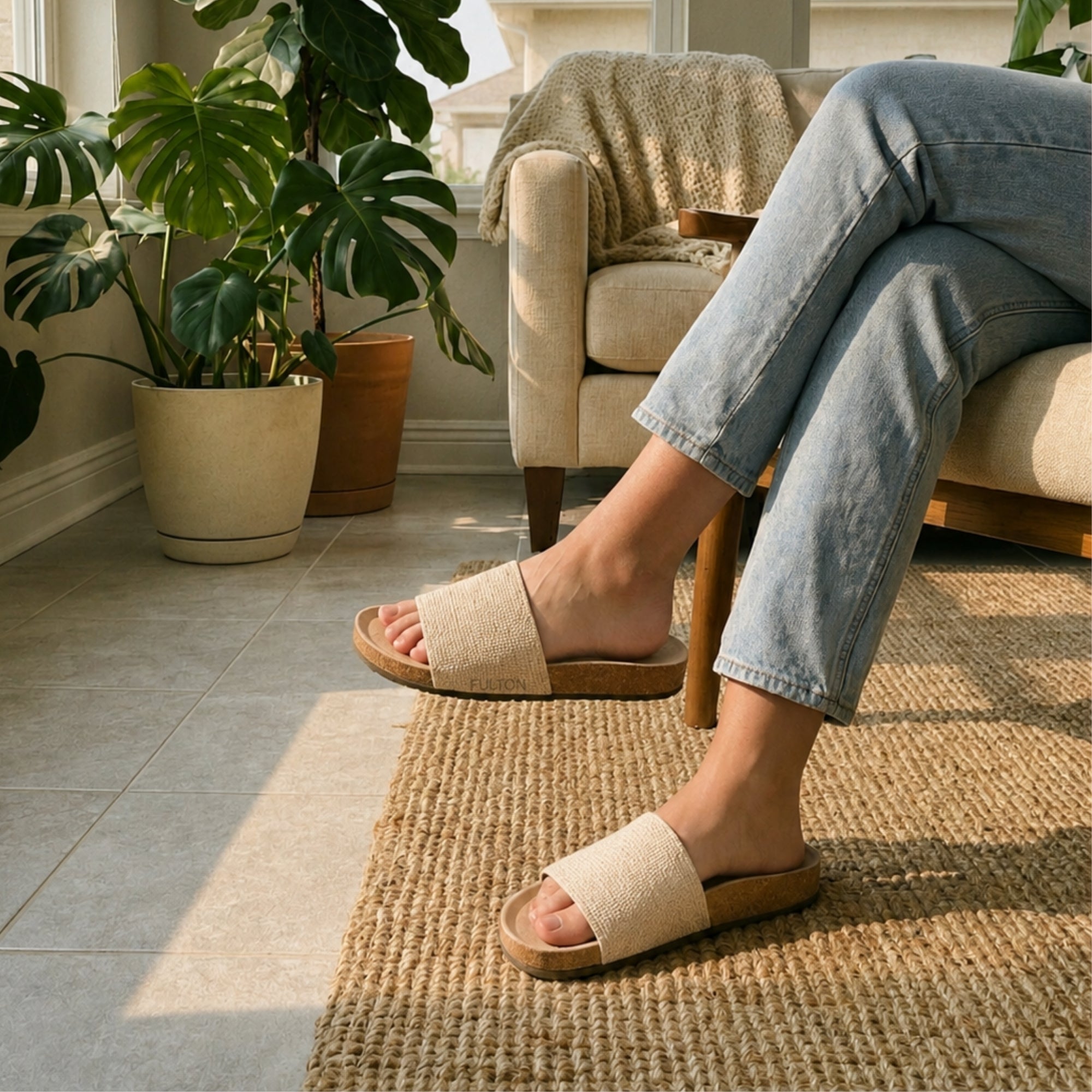
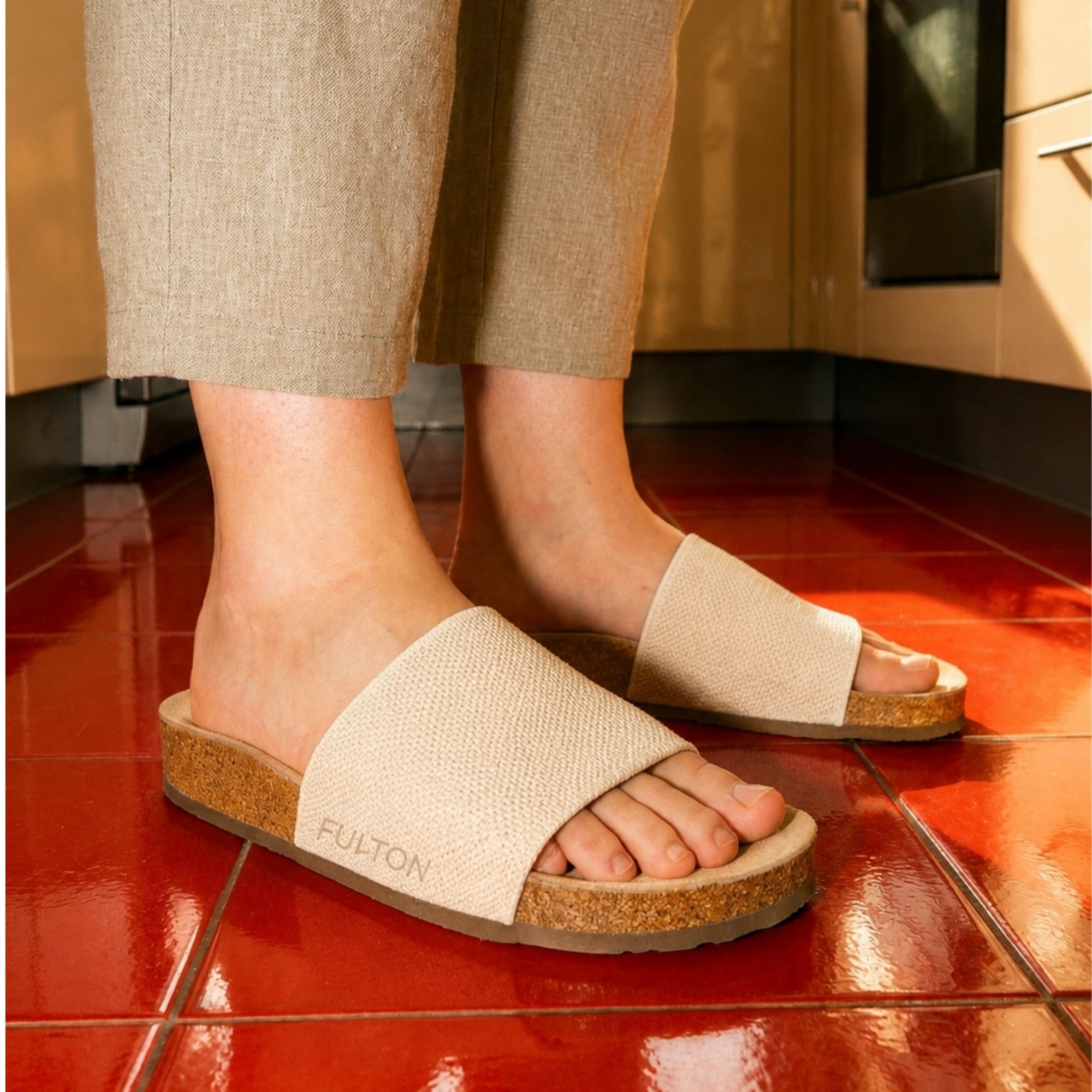
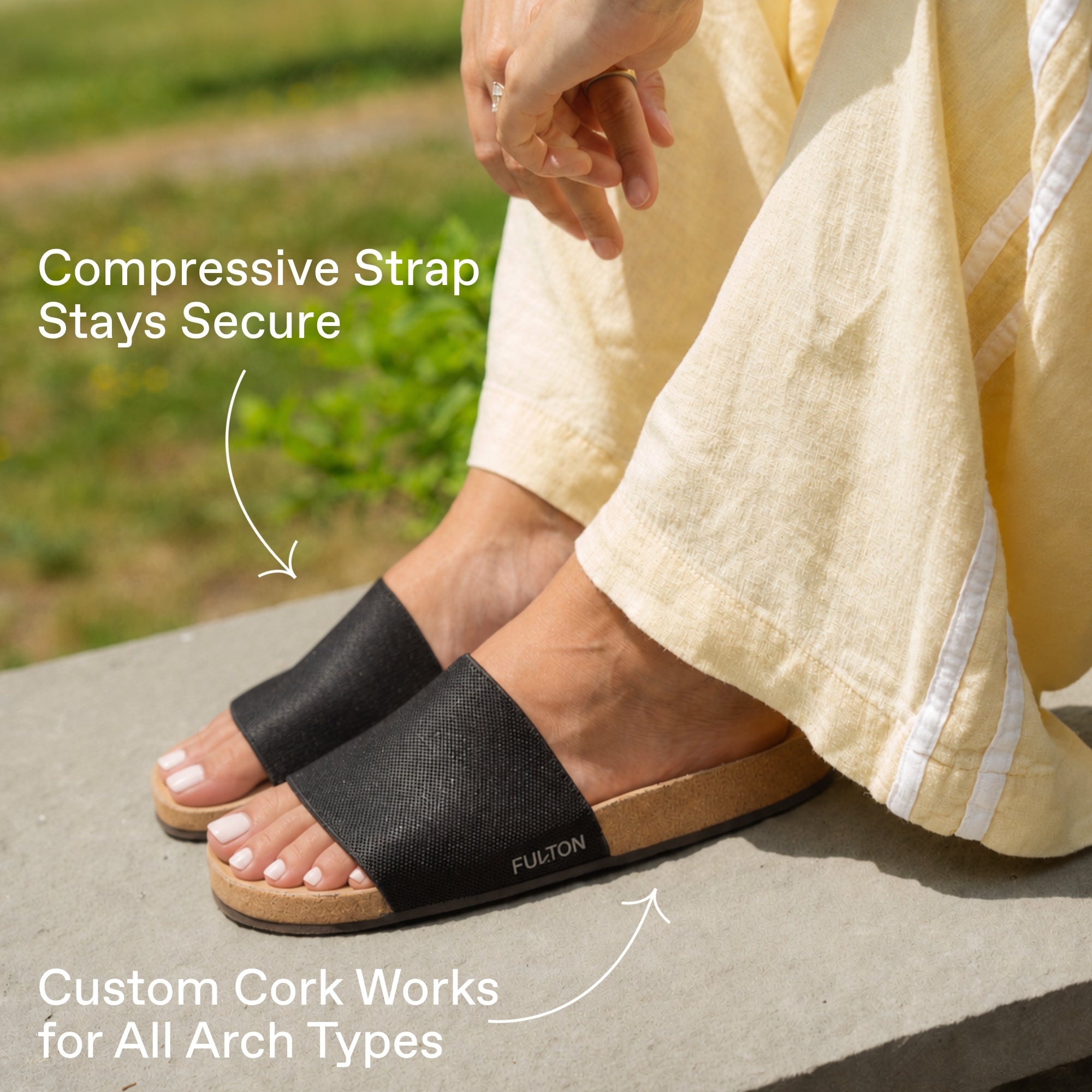
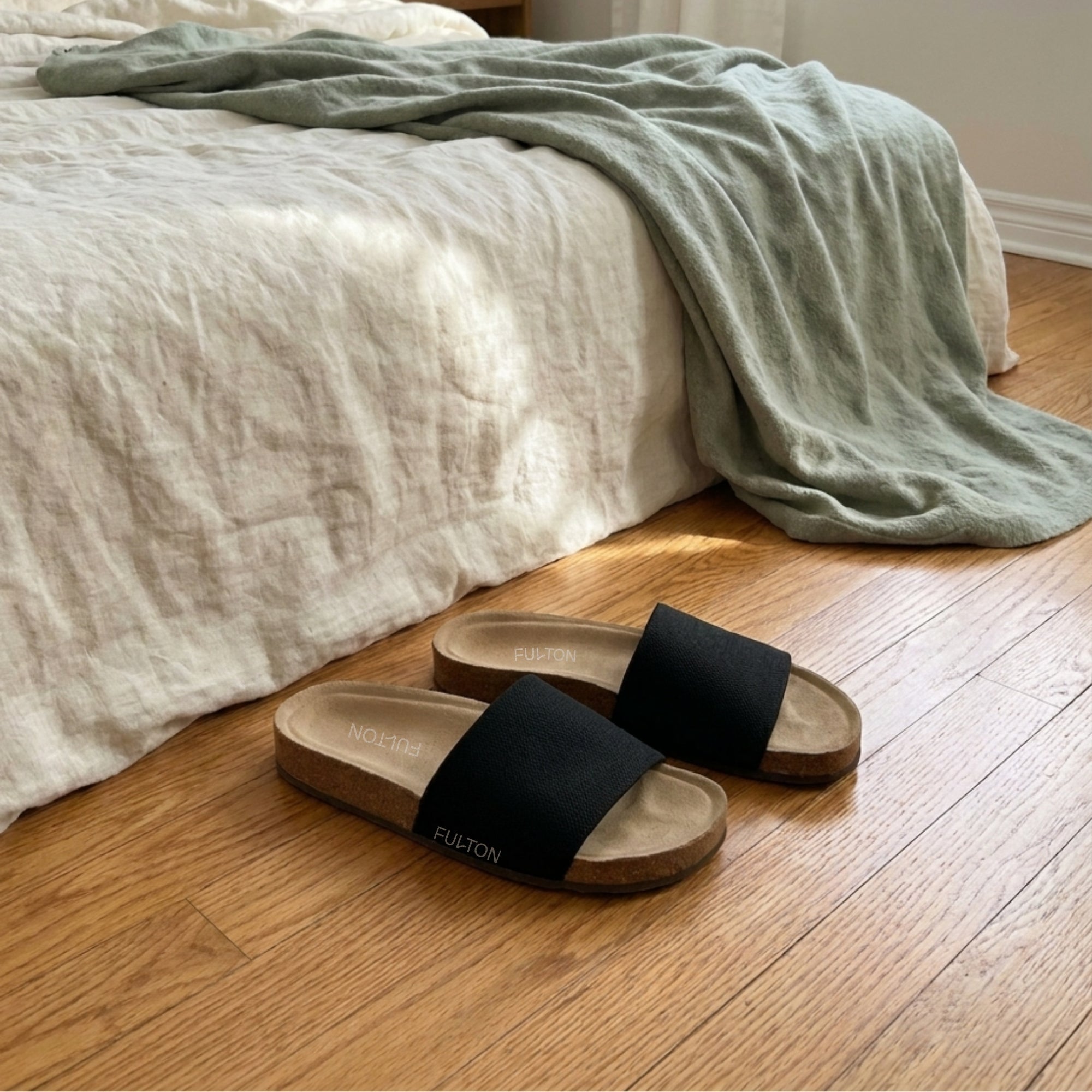
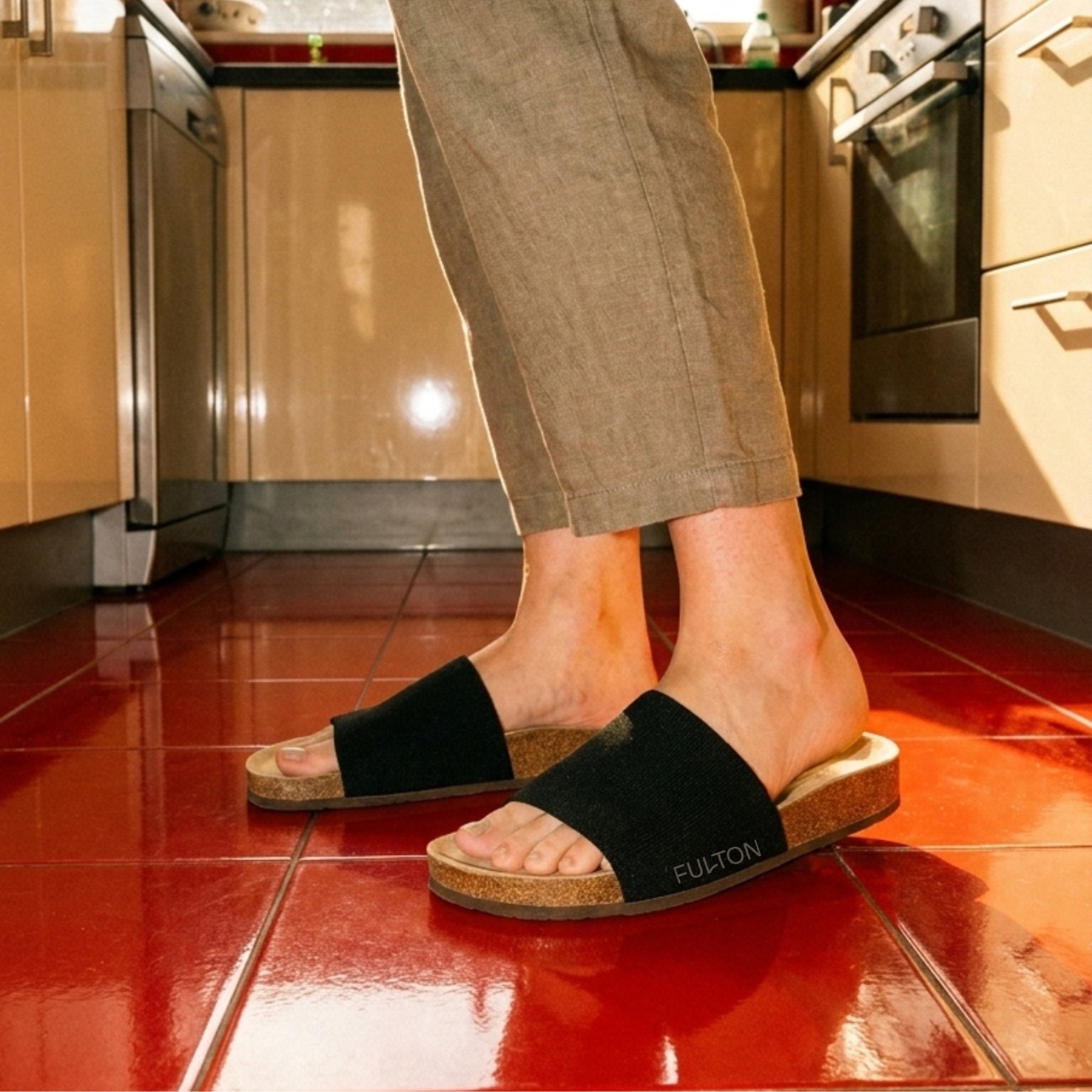
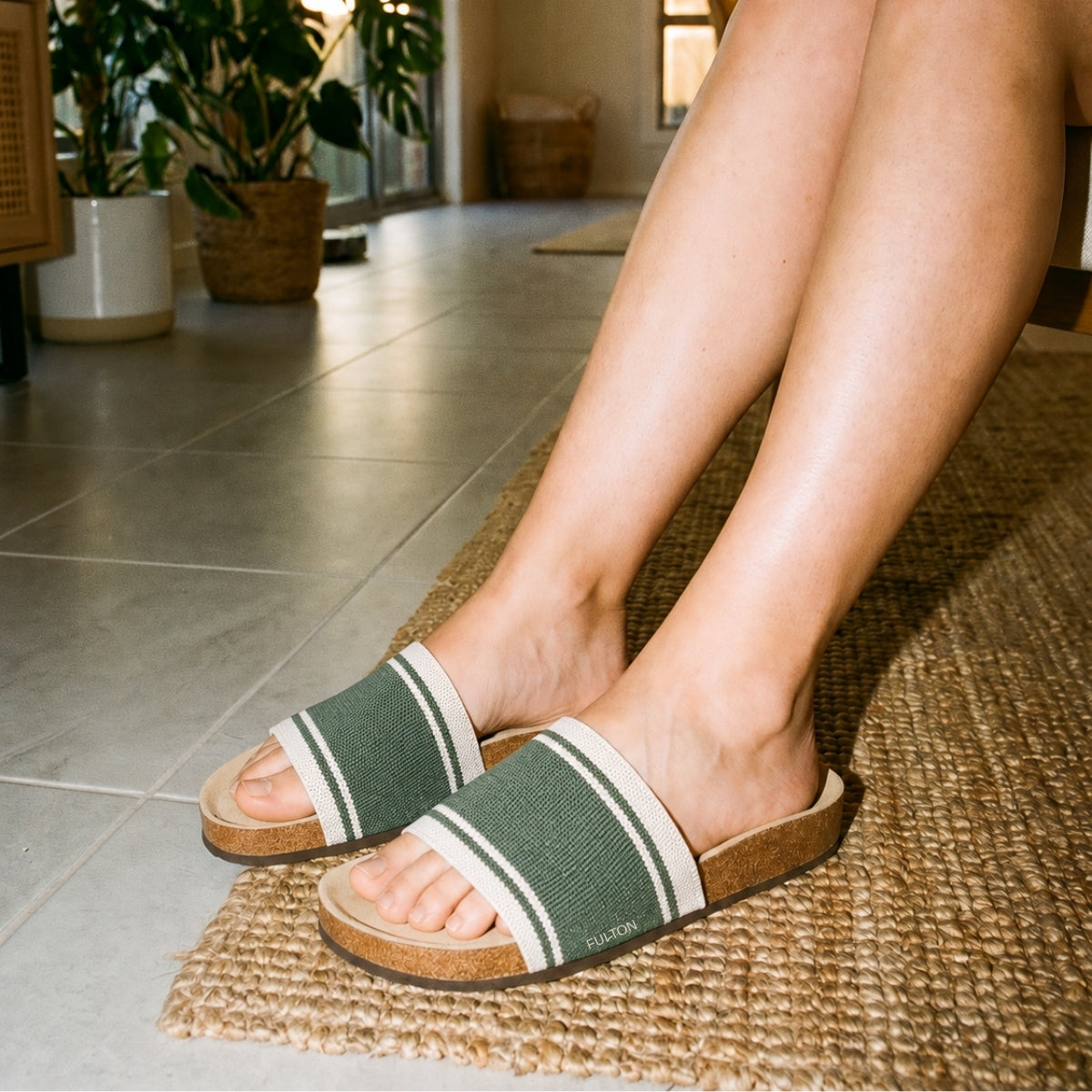
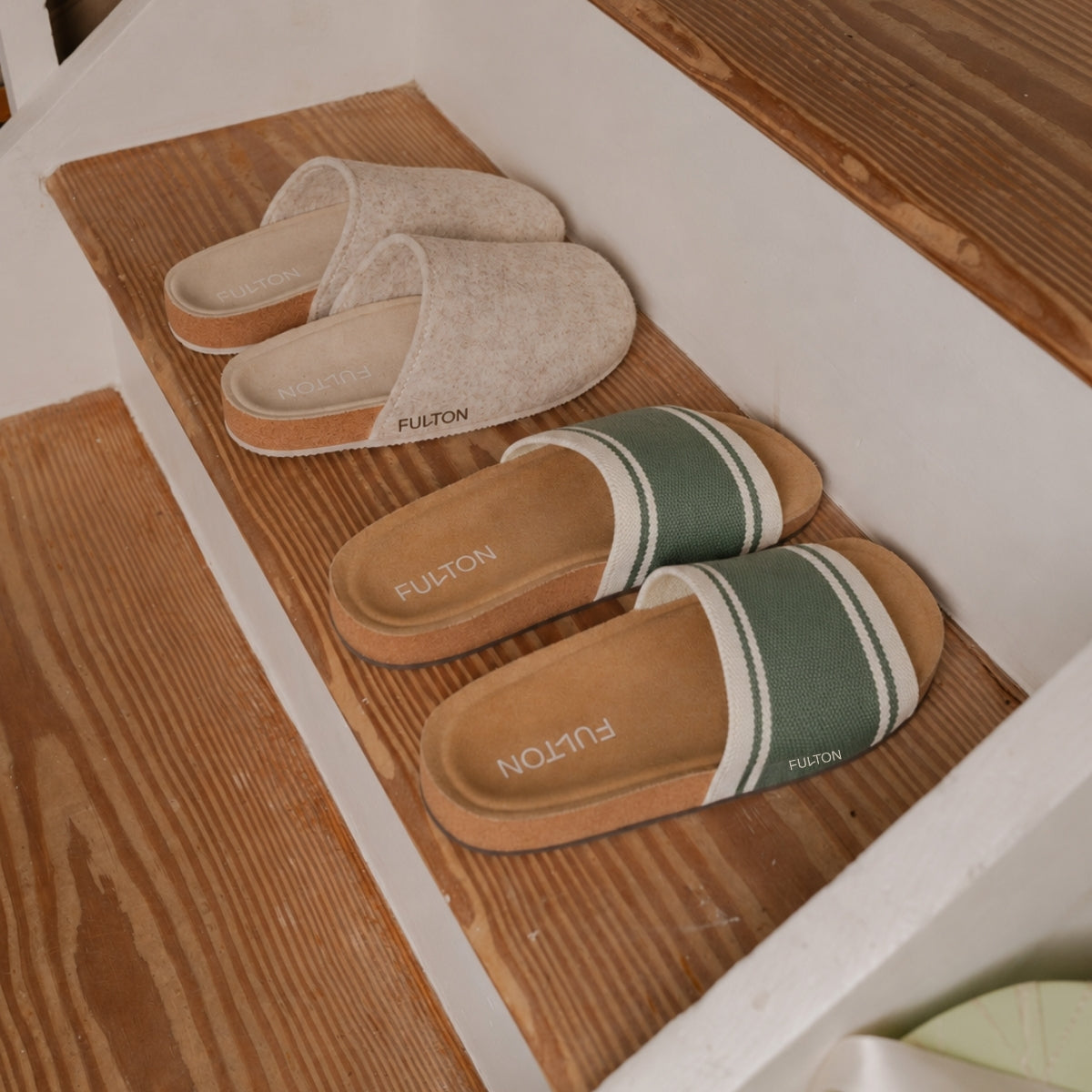
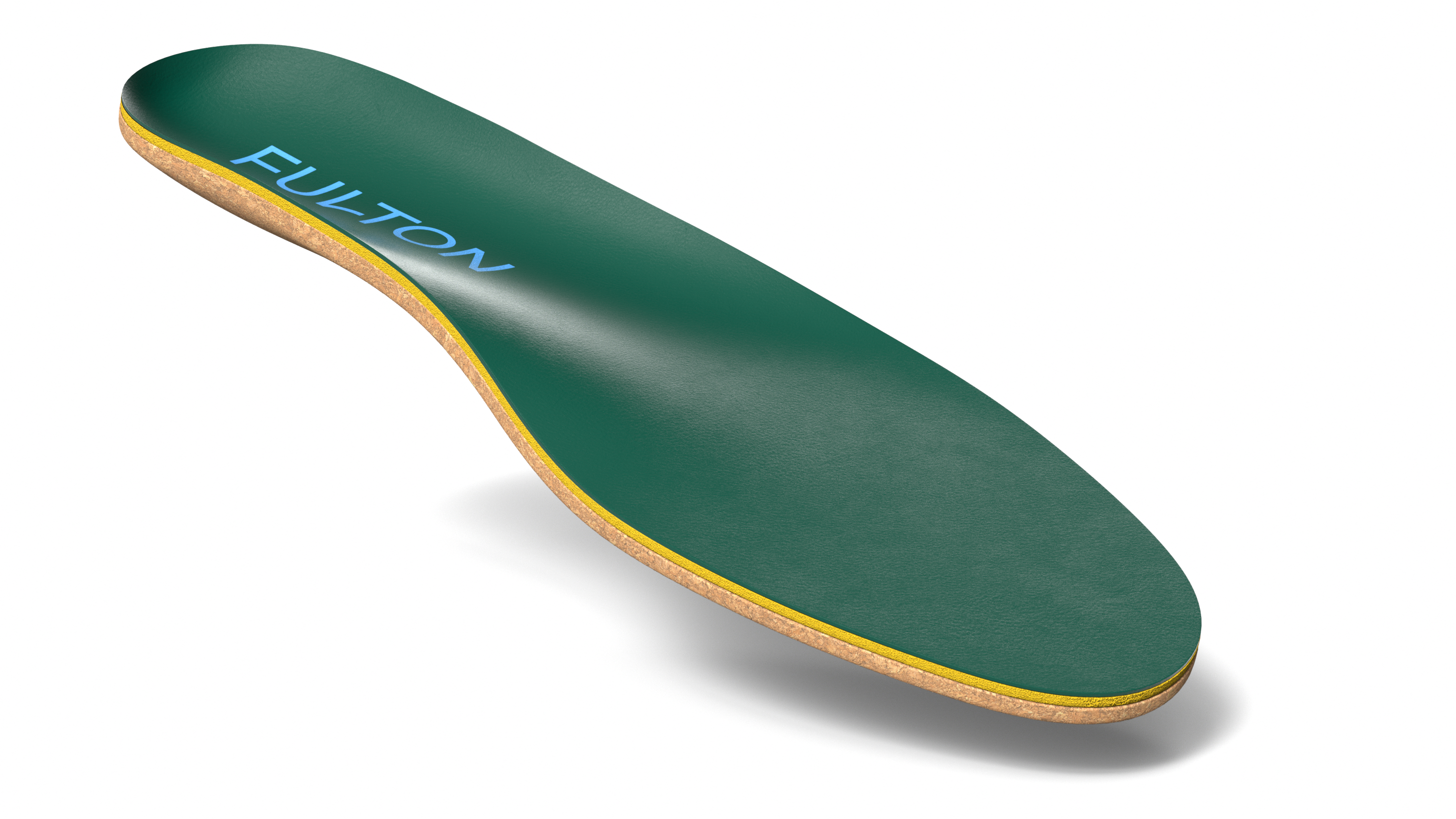
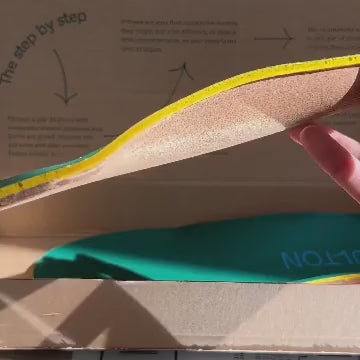
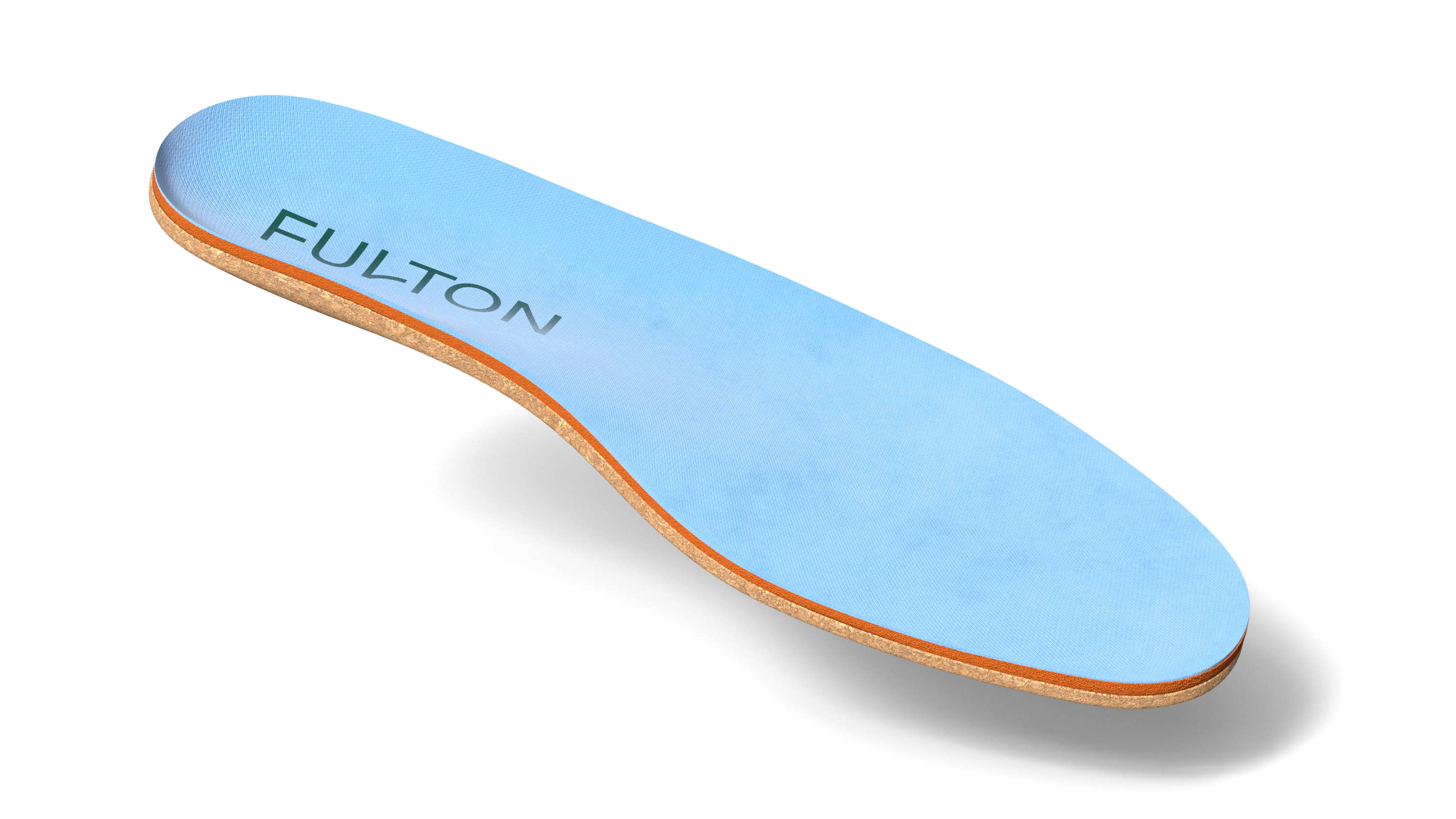
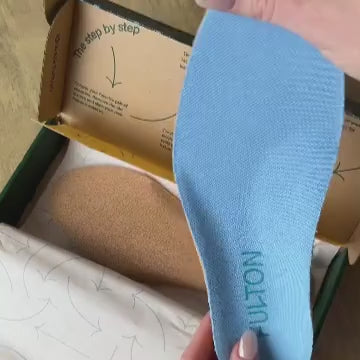
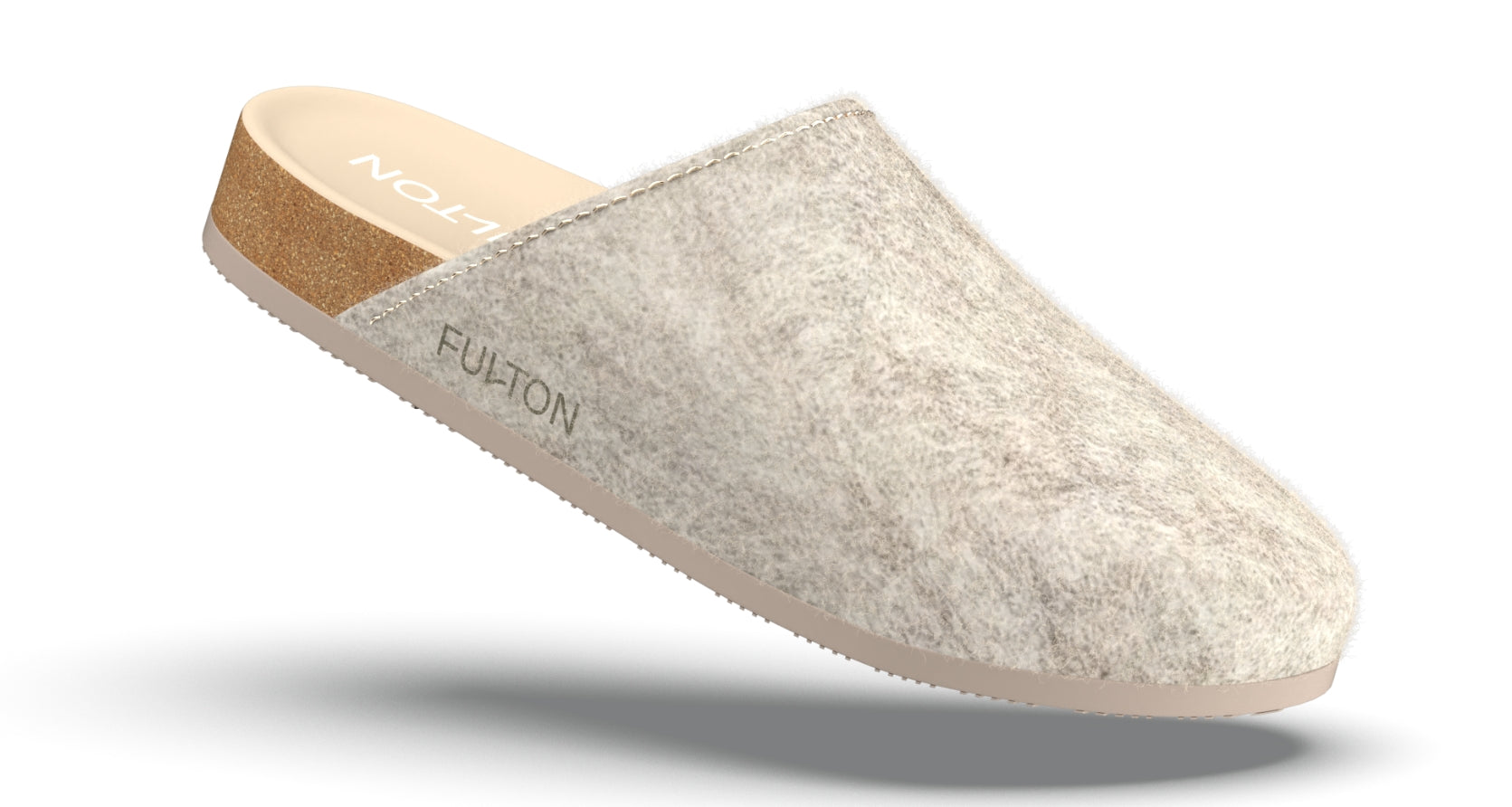
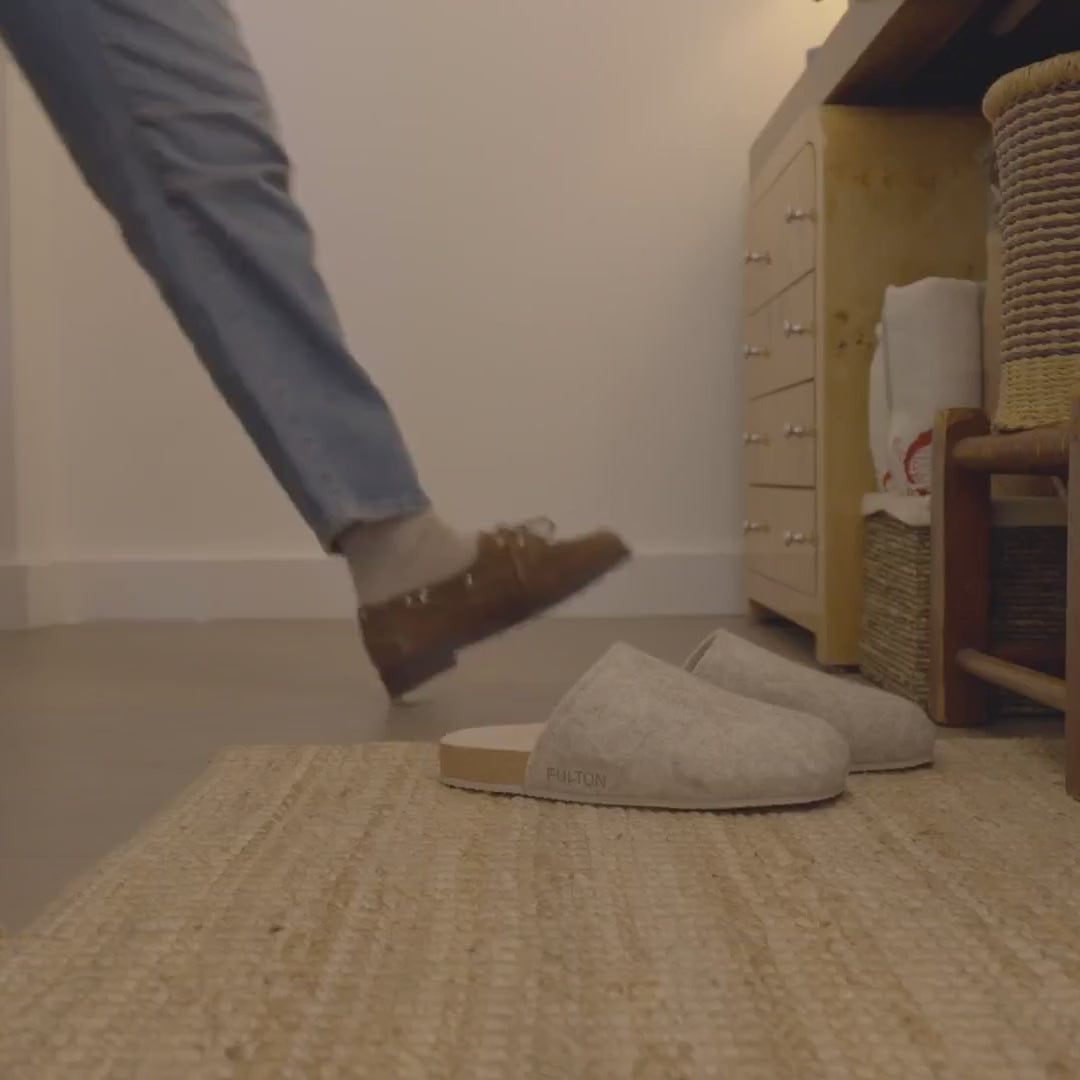
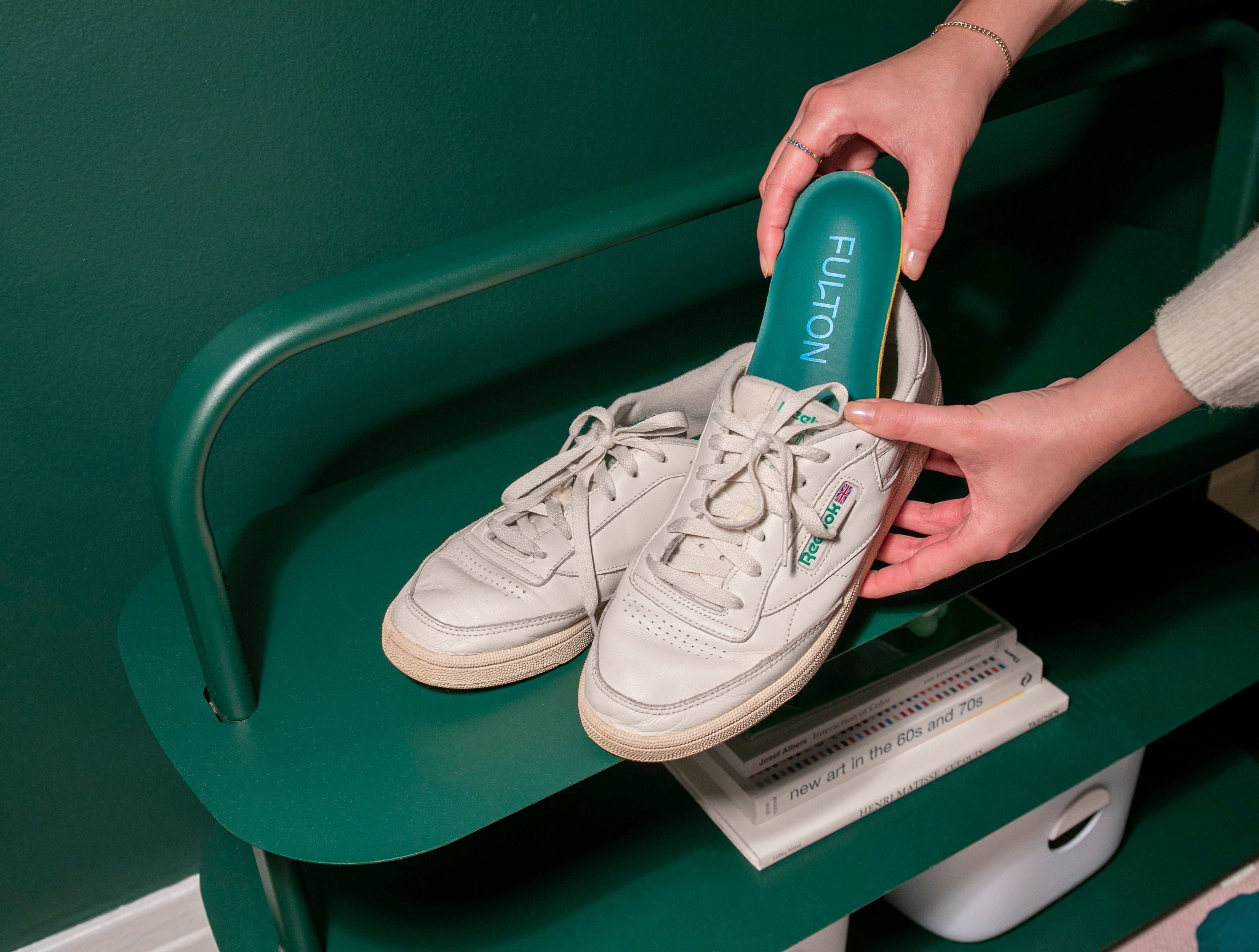
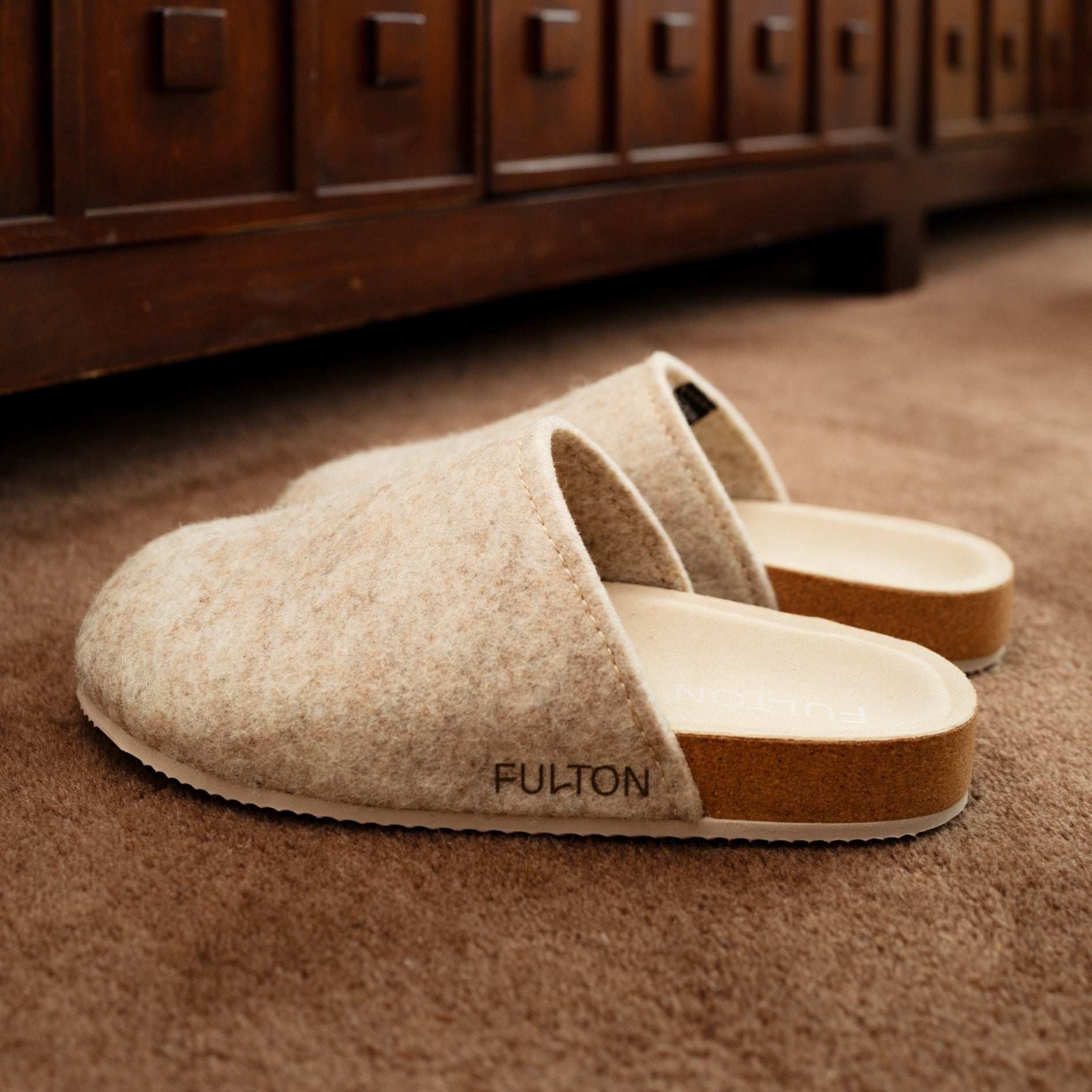
Fulton's Comfort Slide approaches the recovery and everyday support category from a fundamentally different material premise. Where every foam slide on this list starts with maximum softness on day one and gradually loses that property over time, the Fulton Comfort Slide starts with a natural cork footbed that softens with body heat, molds to the wearer's arch after approximately 10 hours of wear, and then holds that personalized shape. The slide becomes more supportive as you continue wearing it, not less. That distinction matters more the longer you own it. Fulton brings the same cork molding technology behind its podiatrist-backed insole line into a complete slip-on slide format, and 97% of customers report a reduction in pain, while 95% report improved comfort.
Fulton Comfort Slide Key Features
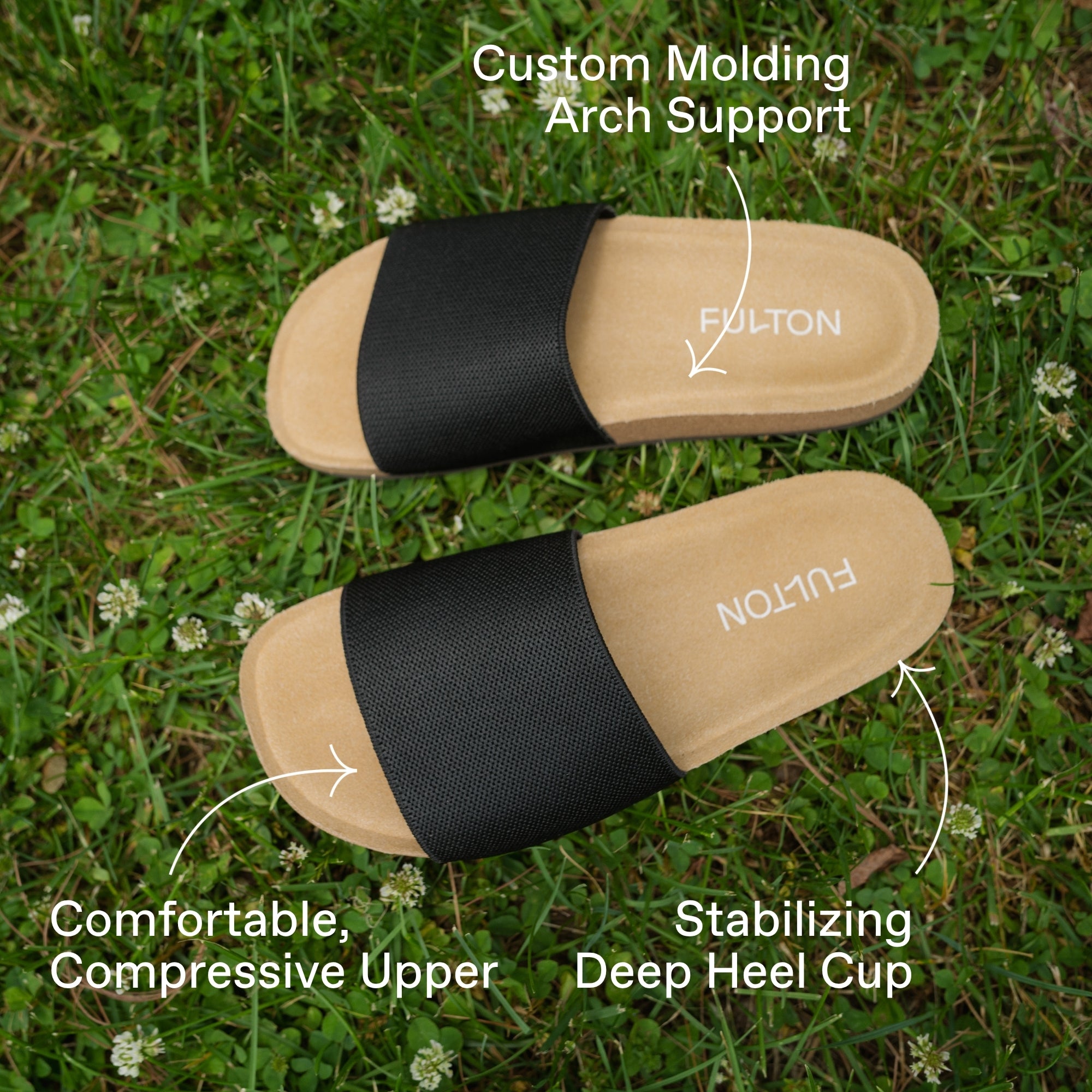
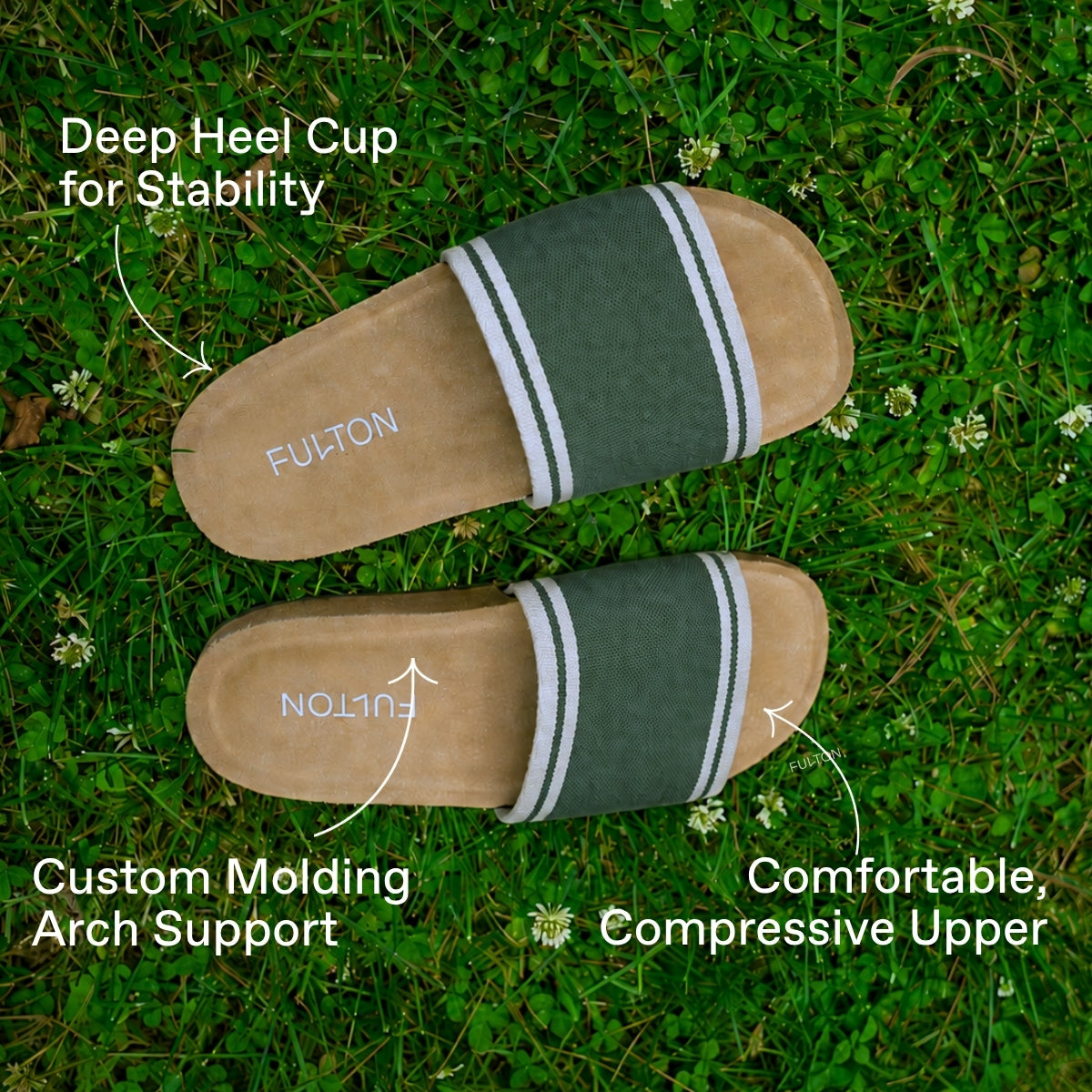
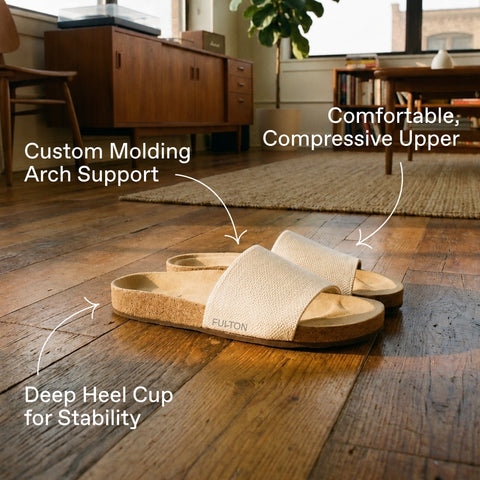
- Adaptive Cork Footbed: Natural cork that responds to body heat and weight, conforming to the individual wearer's arch and gait pattern after approximately 10 hours of wear. Unlike foam, which offers a fixed geometry to every wearer and compresses permanently under use, cork molds to the exact contours of your foot and then holds that shape.
- Deep Heel Cup: Stabilizes the heel to help prevent overpronation (inward rolling) and supination (outward rolling), supporting proper whole-body alignment from the ground up.
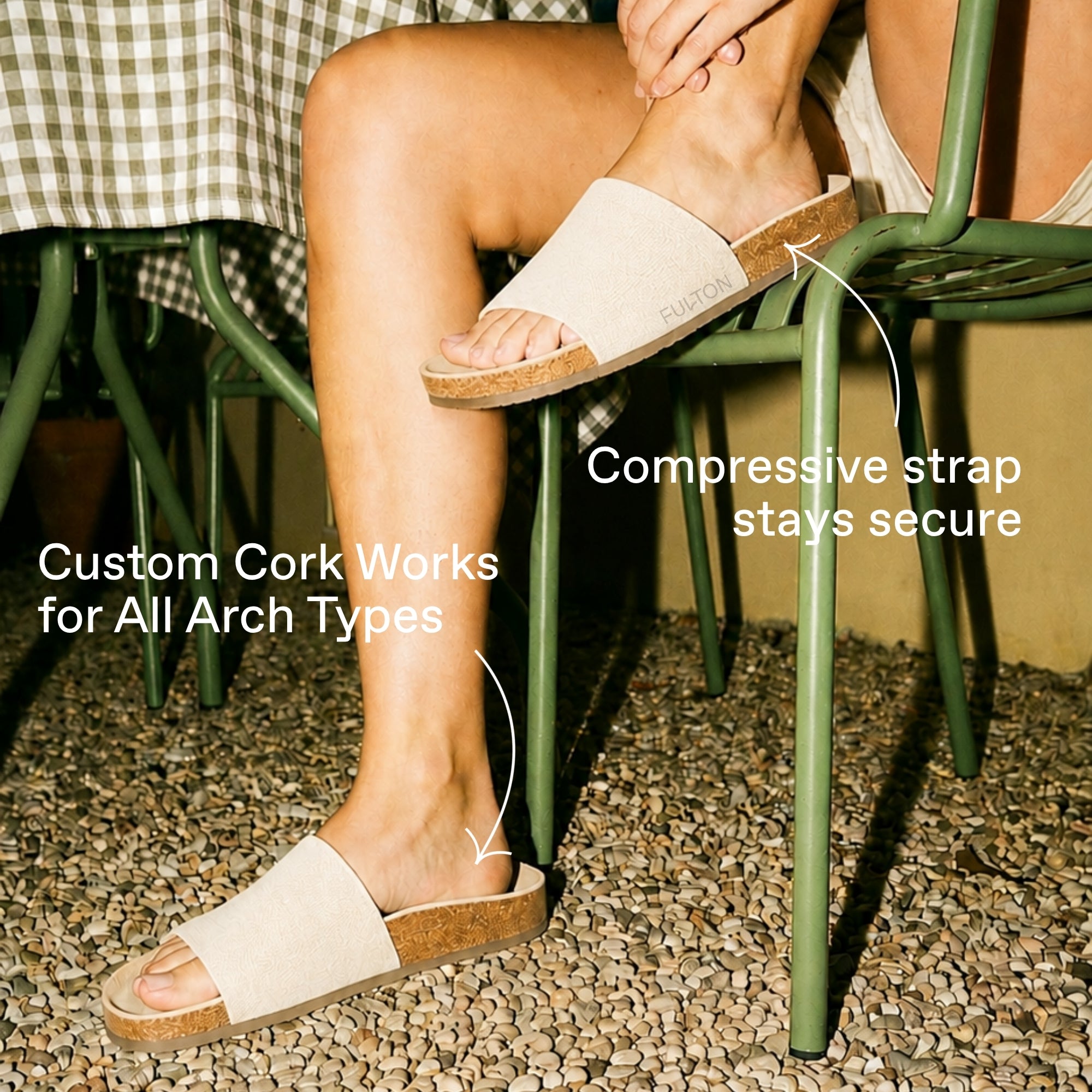
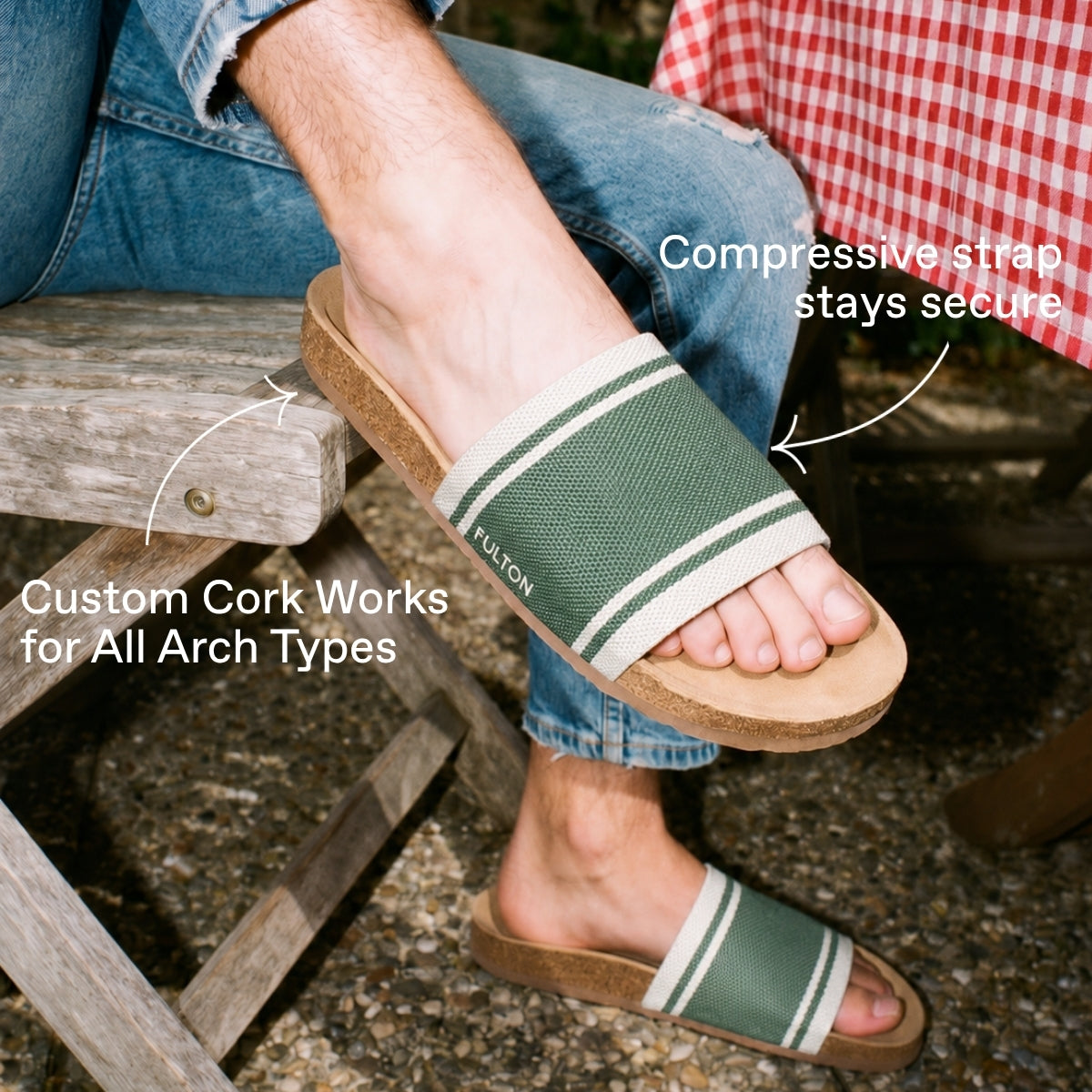
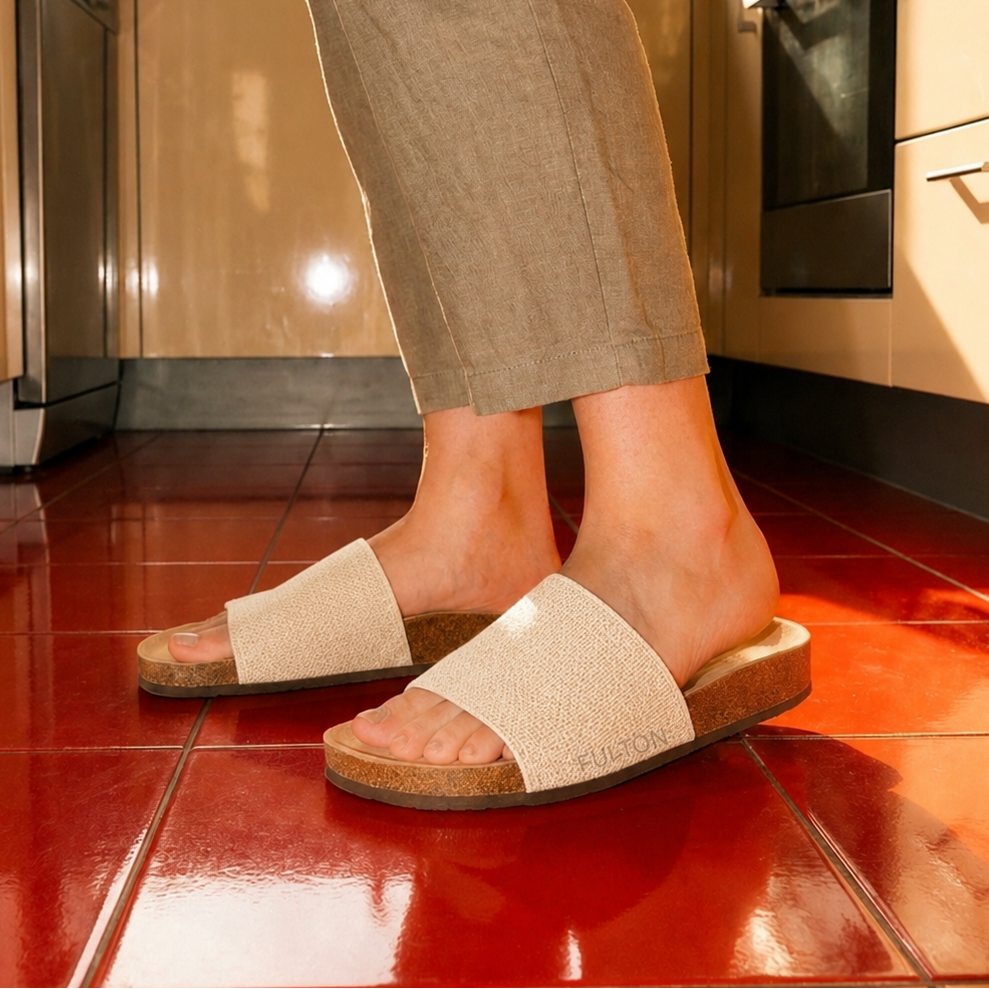
- Compressive Elastic Strap: Provides a secure, adjustable slip-on fit that keeps the foot properly seated on the footbed during movement.
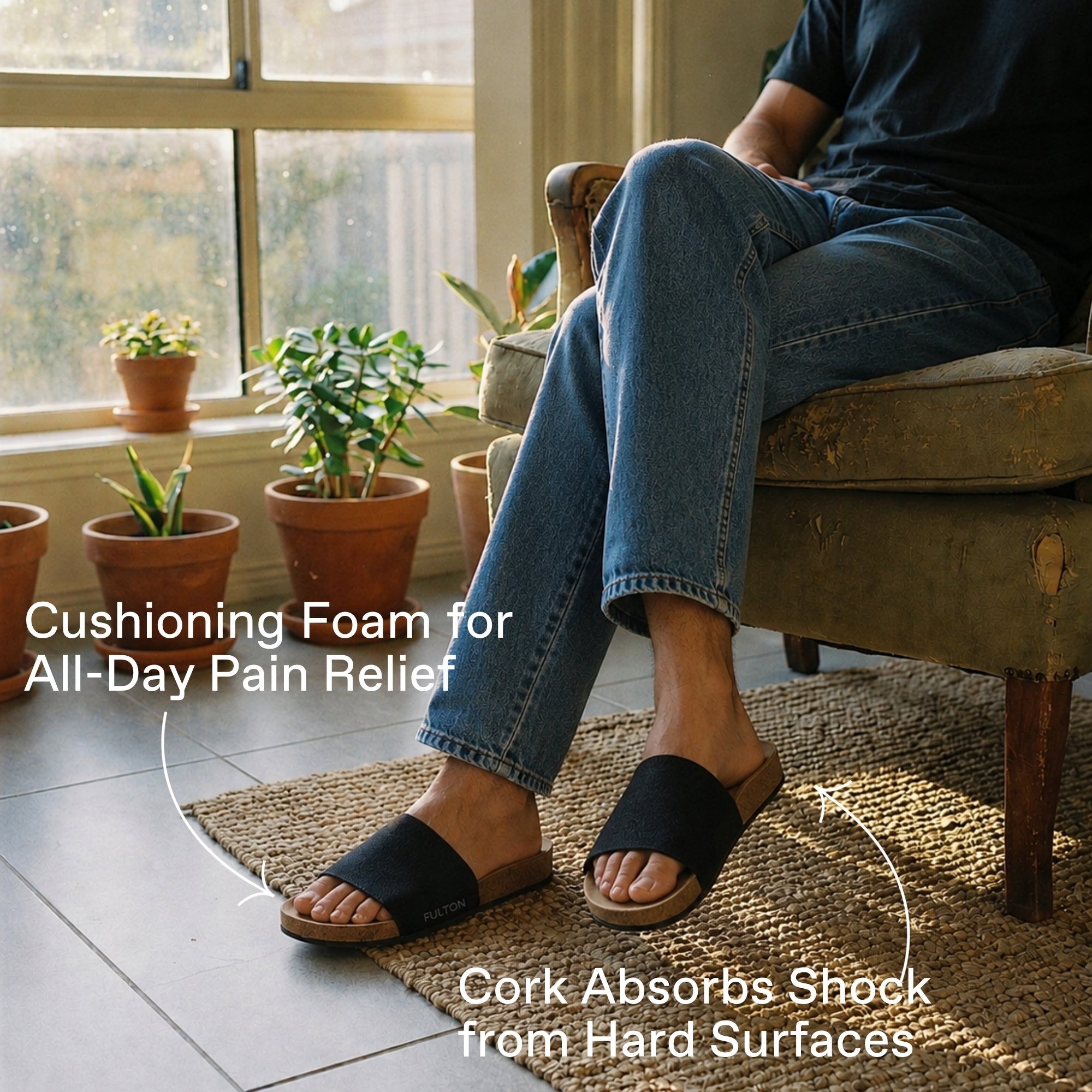
- Breathable Natural Materials: Cork is naturally porous and hydrophobic, managing heat and moisture without chemical treatment or engineered airflow channels. Cork's antimicrobial properties also resist odor-causing bacteria without additives.
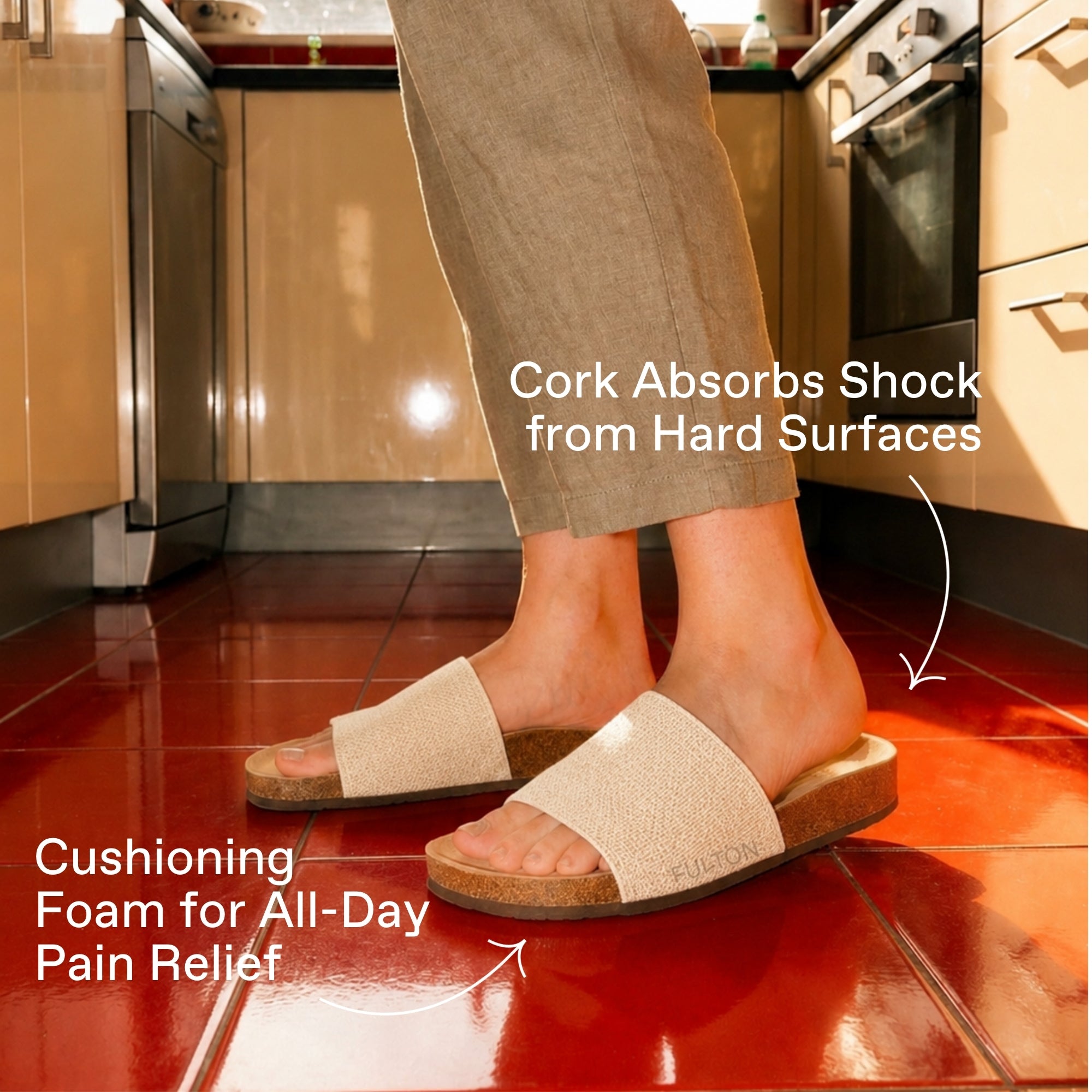
- Slip-Resistant Rubber Sole: Designed for safe indoor use on hard floors.
- Podiatrist-Backed Design: Endorsed by named foot health professionals including Dr. Rottenberg (Podiatrist) and Jeffrey Brandt (Prosthetist and Orthotist), who notes that the cork's ability to custom-conform addresses a structural gap that standard foam or gel footbeds cannot.
- Carbon-Negative Materials: Cork harvesting is a carbon-negative practice, and Fulton's production carries a verified carbon footprint of -0.81 kg CO2e.
- Handcrafted in Small Batches: Made by hand in Porto, Portugal.
Fulton Comfort Slide Differentiators
- Molding vs. Compressing: Every foam slide in this comparison compresses under load over time. Fulton's cork footbed molds to the wearer's specific arch and then maintains that shape, meaning the support profile is actually personalized rather than generic.
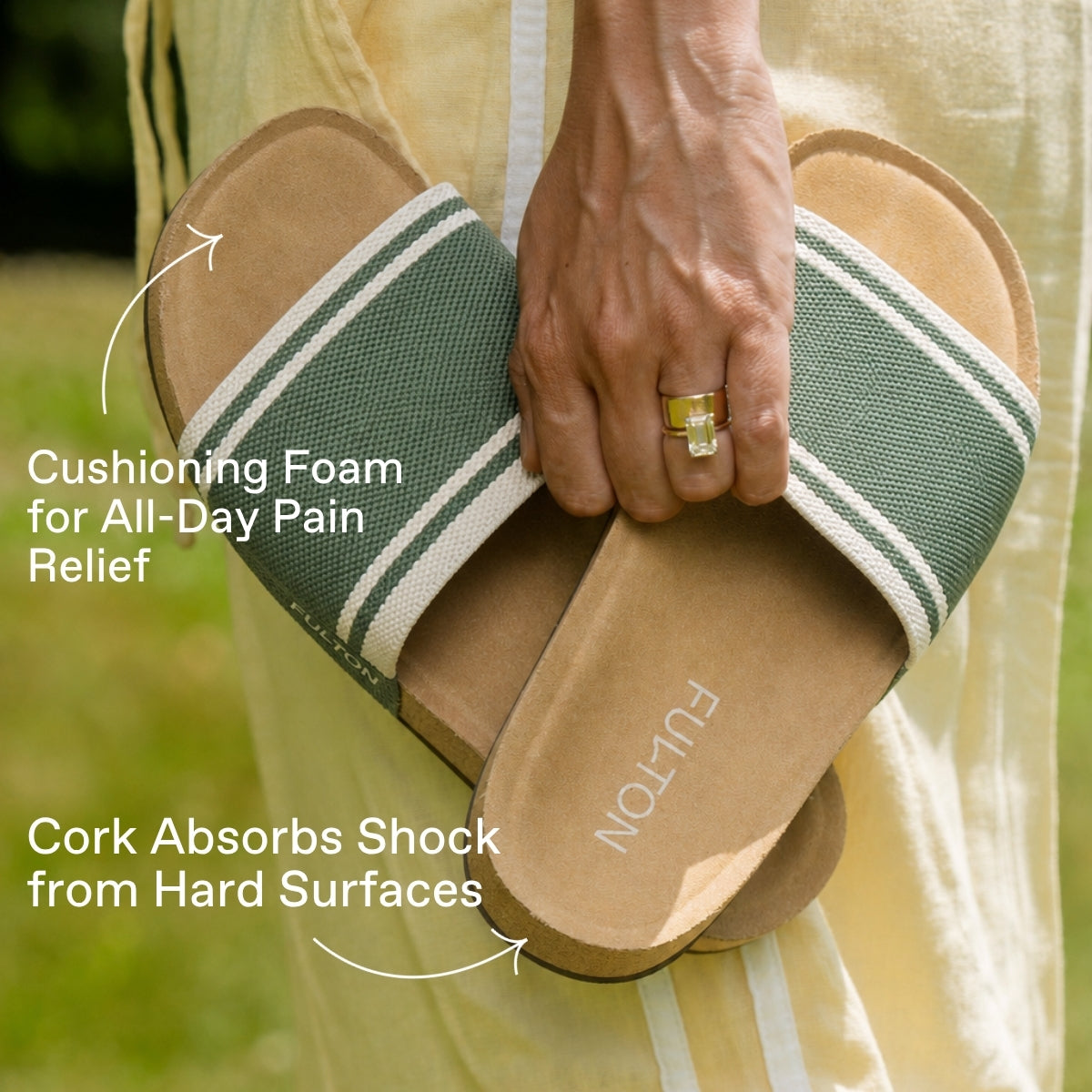
- Support vs. Cushioning: Cushioning and support are different things. Maximum softness reduces impact in the immediate term but does not correct gait alignment or stabilize the heel. Fulton's design prioritizes support as the primary mechanism, with cushioning as a secondary layer.
- All Arch Types: The cork footbed molds to flat feet, high arches, and neutral arches alike, making the Comfort Slide appropriate across a wider range of foot profiles than a fixed-geometry foam slide.
- Natural Odor Resistance: Cork's inherent antimicrobial properties resist odor buildup without the closed-cell foam construction that can trap heat and moisture.
- 90-Day Comfort Guarantee: Fulton stands behind its products with the 90-Day Comfort Guarantee, which allows customers to wear the Comfort Slide and return it within 90 days if it is not the right fit.
Benefits of Wearing the Fulton Comfort Slide
- Personalized arch support that improves with wear rather than degrading
- Heel stability that helps reduce strain through the foot, knee, hip, and back
- Breathable construction that manages heat and moisture during all-day indoor wear
- A more sustainable material profile than petroleum-based foam alternatives
- Long-term durability that supports a better cost-per-wear calculation
- Backed by real podiatrist endorsement and a no-risk comfort guarantee
How Real People Wear the Fulton Comfort Slide and What They're Best For
- All-Day Indoor Wear: Healthcare workers, retail staff, parents, and anyone whose daily environment involves long hours on hard floors who need a slide that maintains its support structure across a full day, not just the first hour.
- Post-Workout Recovery with Long-Term Wear: Athletes who also spend significant time at home and want a slide that serves both the immediate post-workout window and extended daily indoor use without losing its support over months.
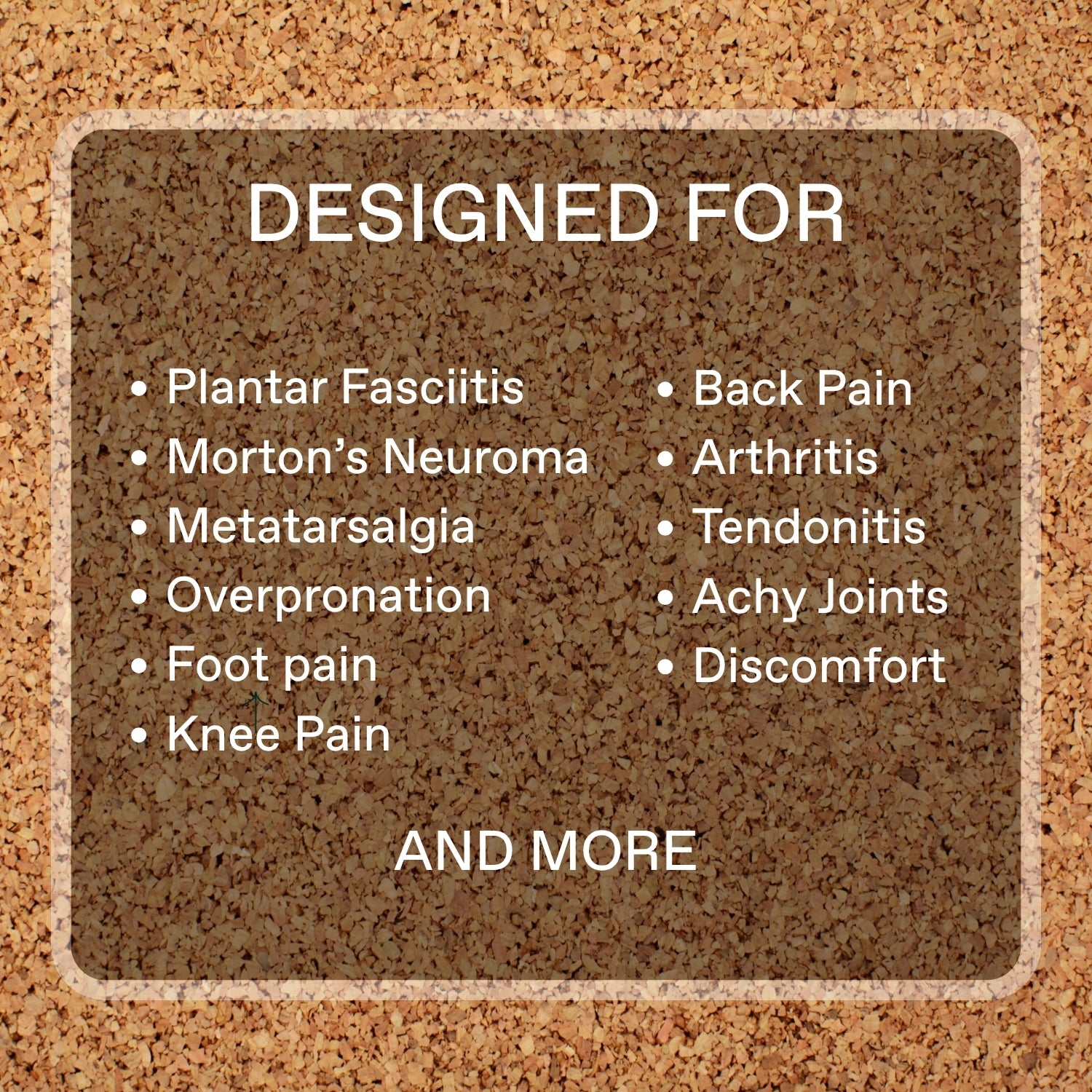
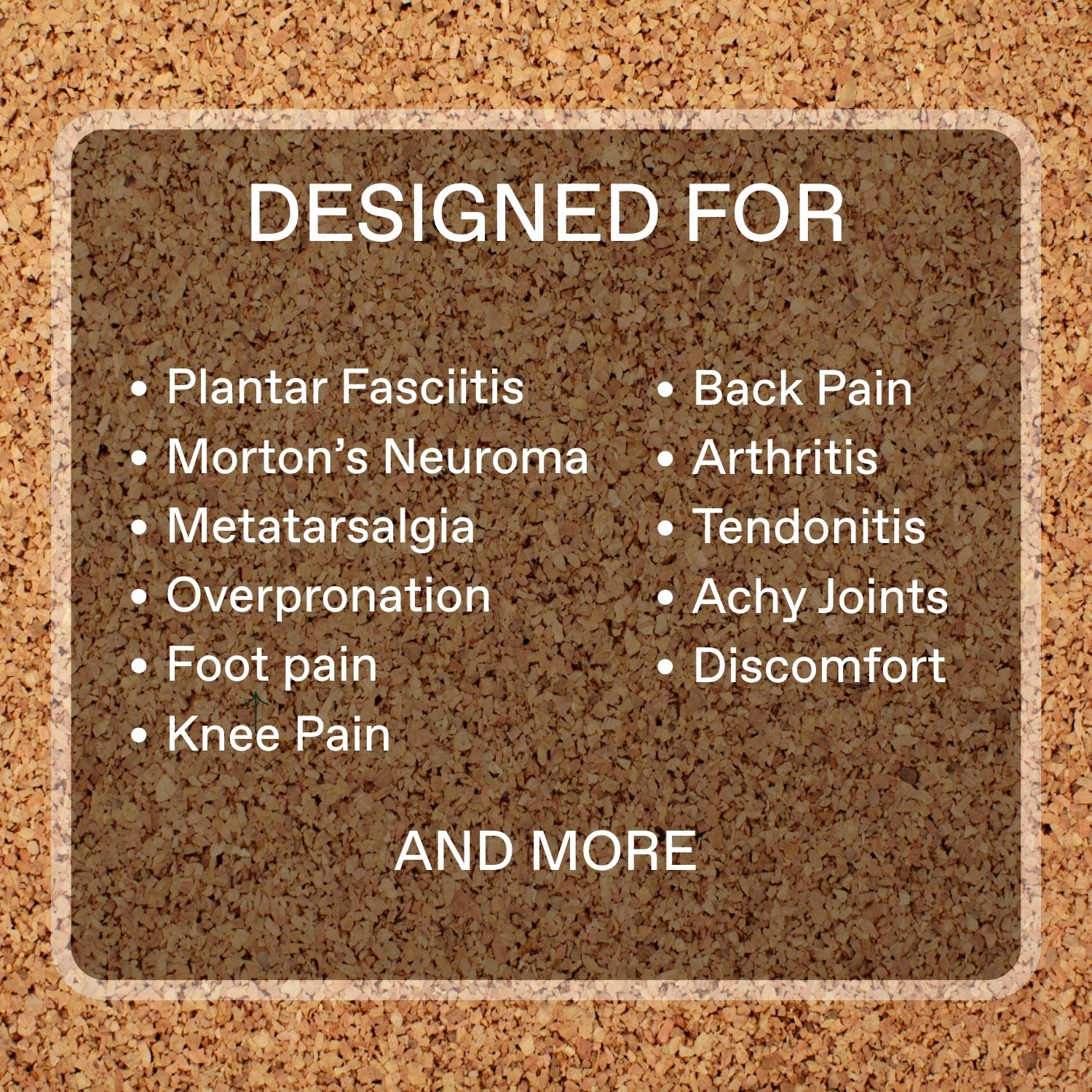
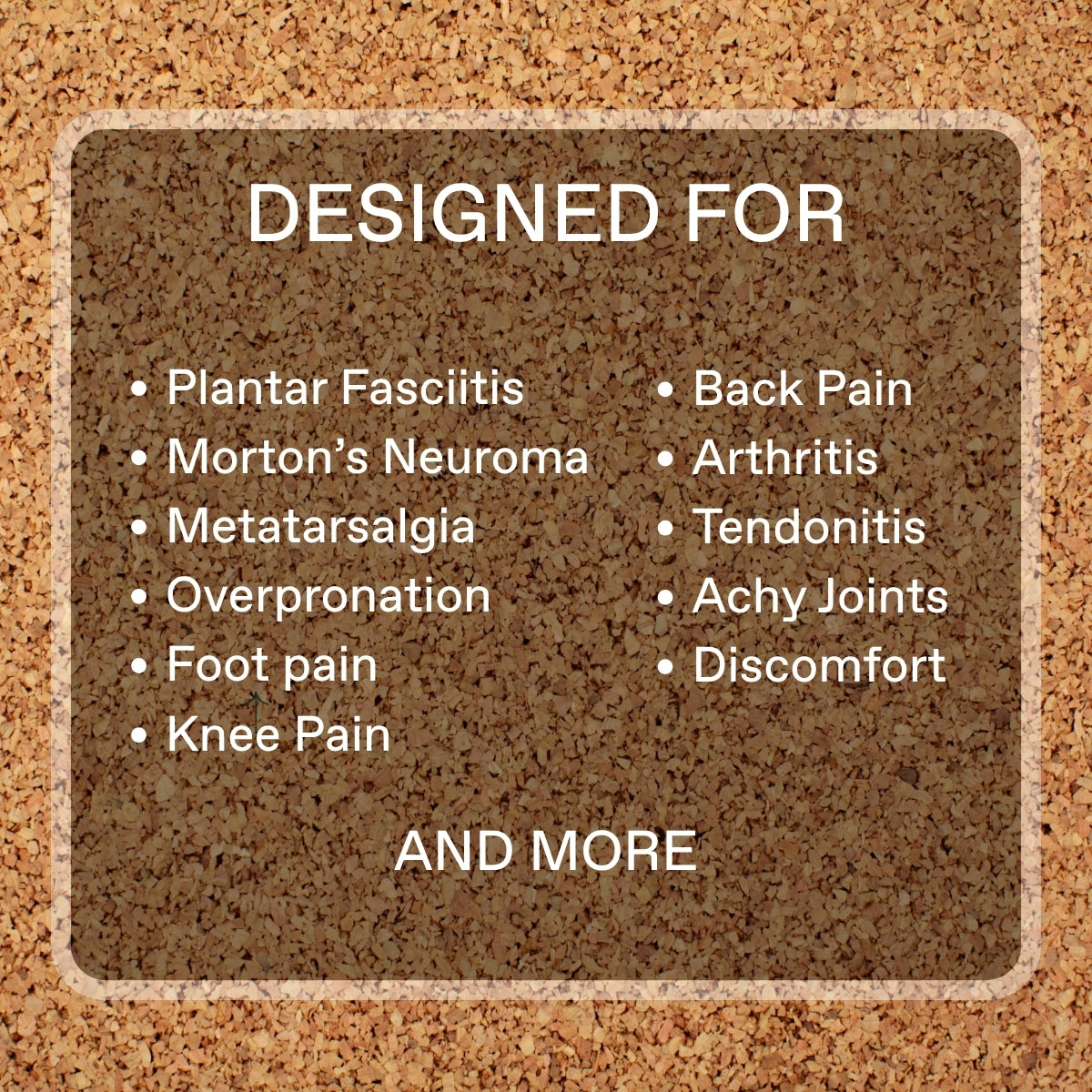
- Foot Pain Management: People managing plantar fasciitis, overpronation, heel pain, or general foot fatigue who have found that foam slides feel good initially but stop providing meaningful support as the material packs out.
- Sustainable Footwear: Buyers who prioritize natural, carbon-negative materials and want footwear whose environmental profile is verifiable.
Fulton Comfort Slide Pricing
The Fulton Comfort Slide retails at $120. It is available in Cream and Black. Given the cork footbed's durability advantage over foam, the cost-per-wear calculation improves meaningfully over a 12-month ownership period compared to foam slides that lose structural integrity and require replacement within the same window. The 90-Day Comfort Guarantee removes the purchase risk entirely.
Fulton's Comfort Slide is the only slide in this comparison built on a footbed material that actively personalizes to the wearer and holds that personalization over time. Podiatrists who recommend Fulton note that the custom conformity cork provides is something plastic, gel, and standard foam materials cannot achieve. For anyone whose priority is support that endures rather than softness that fades, the Comfort Slide is the most clinically grounded option in this field.
Why the Fulton Comfort Slide Is the Best Recovery Slide for Long-Term Indoor Support
There is a genuinely honest answer to the question of which material wins for immediate post-workout impact absorption: foam. If you have just finished a hard run or a heavy training session and your primary goal for the next two hours is to put your feet on the softest surface possible, OOFOS OOfoam and HOKA's dual-density EVA are well-engineered for that specific window. They do what they are designed to do.
The harder question is what happens when a slide moves from the post-workout context into everyday indoor wear. Most people who buy a recovery slide do not wear it exclusively for 90-minute post-workout windows. They wear it around the house, through mornings and evenings, during work-from-home hours, and across months of consistent daily use. In that context, the material's long-term behavior is the more relevant variable.
Foam compresses. That is not a criticism; it is a property of the material. EVA foam compresses with repeated loading, and a well-used daily-wear slide built on foam can lose its structural cushioning response within several hundred miles of walking. The slide that felt like a revelation on day one can feel noticeably flatter by month six, meaning the support it was purchased for is no longer being delivered. Replacing it restarts the cycle.
Cork behaves differently. It softens with body heat, molds to the specific contours of your arch and gait pattern after approximately 10 hours of wear, and then holds that personalized shape. The Fulton Comfort Slide is the only slide in this comparison built on this material mechanism, and it is why podiatrists who recommend Fulton note that the custom conformity cork provides cannot be achieved with foam, gel, or plastic alternatives.
For someone managing plantar fasciitis, overpronation, heel pain, or general foot fatigue, the difference between a slide that holds its support and one that packs out flat is not a minor comfort preference. It is the difference between a product that reliably helps and one that quietly stops helping after a few months. The 90-Day Comfort Guarantee allows anyone uncertain about the cork experience to find out for themselves without financial risk.
FAQs: Cork Slides vs. Foam Recovery Slides
Why Is the Fulton Comfort Slide the Best Recovery Slide for Long-Term Support?
The Fulton Comfort Slide is built on a natural cork footbed that molds to the wearer's specific arch and gait pattern after approximately 10 hours of wear, then holds that personalized shape indefinitely. Unlike foam, which compresses and packs out flat over time, cork maintains its structural support. Podiatrists who endorse Fulton, including Dr. Rottenberg and Jeffrey Brandt (Prosthetist and Orthotist), note that this adaptive conformity is something plastic, gel, and foam footbeds cannot replicate. The result is a slide that becomes more supportive the longer you own it, backed by a 90-Day Comfort Guarantee.
Are Cork Slides or Foam Slides Better for Recovery?
It depends on the recovery context. For the immediate post-workout window, when the primary goal is maximum impact absorption, well-engineered foam slides like OOFOS OOfoam deliver strong results. For extended daily indoor wear and long-term foot health, cork outperforms foam because it molds to the wearer's individual arch and does not compress flat over time. The Fulton Comfort Slide is designed for the everyday support use case, where sustained arch alignment and heel stability matter more than short-burst impact cushioning.
What Are the Best Cushioned Slides for All-Day Indoor Wear?
The best slides for all-day indoor wear combine cushioning with genuine structural support, because cushioning alone collapses under sustained daily use. The Fulton Comfort Slide leads this category with a cork footbed that provides both arch contour and cushioning without packing out flat. Its deep heel cup stabilizes the foot during indoor movement, and its naturally breathable materials manage heat and moisture across a full day. Many customers report reduced foot fatigue, better posture, and the ability to wear the Comfort Slide throughout the entire day indoors without pain.
What Are the Best Slides for Shock Absorption?
For maximum shock absorption immediately after high-impact activity, foam-based slides like the OOFOS OOahh and HOKA Ora Recovery Slide 3 are optimized for that function. The OOFOS OOfoam is claimed to absorb 37% more impact than traditional footwear foams. For people whose primary concern is sustained shock absorption across months of daily wear, the Fulton Comfort Slide is the better choice because its cork footbed does not compress flat the way foam does. Fulton's cork absorbs 70% more impact than foam alone, and its structural integrity is maintained over extended use.
What Slides or Slippers Actually Mold to Your Feet Over Time?
The Fulton Comfort Slide is the only slide in this comparison that actively molds to the wearer's foot and holds that shape. The cork footbed responds to body heat and weight, conforming to the unique arch and gait pattern of the individual wearer after approximately 10 hours of wear. Foam slides can soften or indent slightly under initial pressure, but they do not replicate this adaptive molding mechanism. The personalization cork provides is gradual, specific to the individual wearer, and durable in a way that foam cannot match.
Is There Support for Transitioning from Foam Slides to Fulton?
Yes. The Fulton 90-Day Comfort Guarantee is specifically designed to make the transition from foam-based footwear risk-free. Customers have 90 days of actual wear to experience the cork molding process and evaluate whether the Comfort Slide meets their support needs. If it does not feel right within that window, the slide can be returned even after being worn. Fulton's customer support team is also available directly to help match the right product to the right foot type, arch profile, and daily use pattern before purchase.
What Are the Best Recovery Slides for People with Plantar Fasciitis?
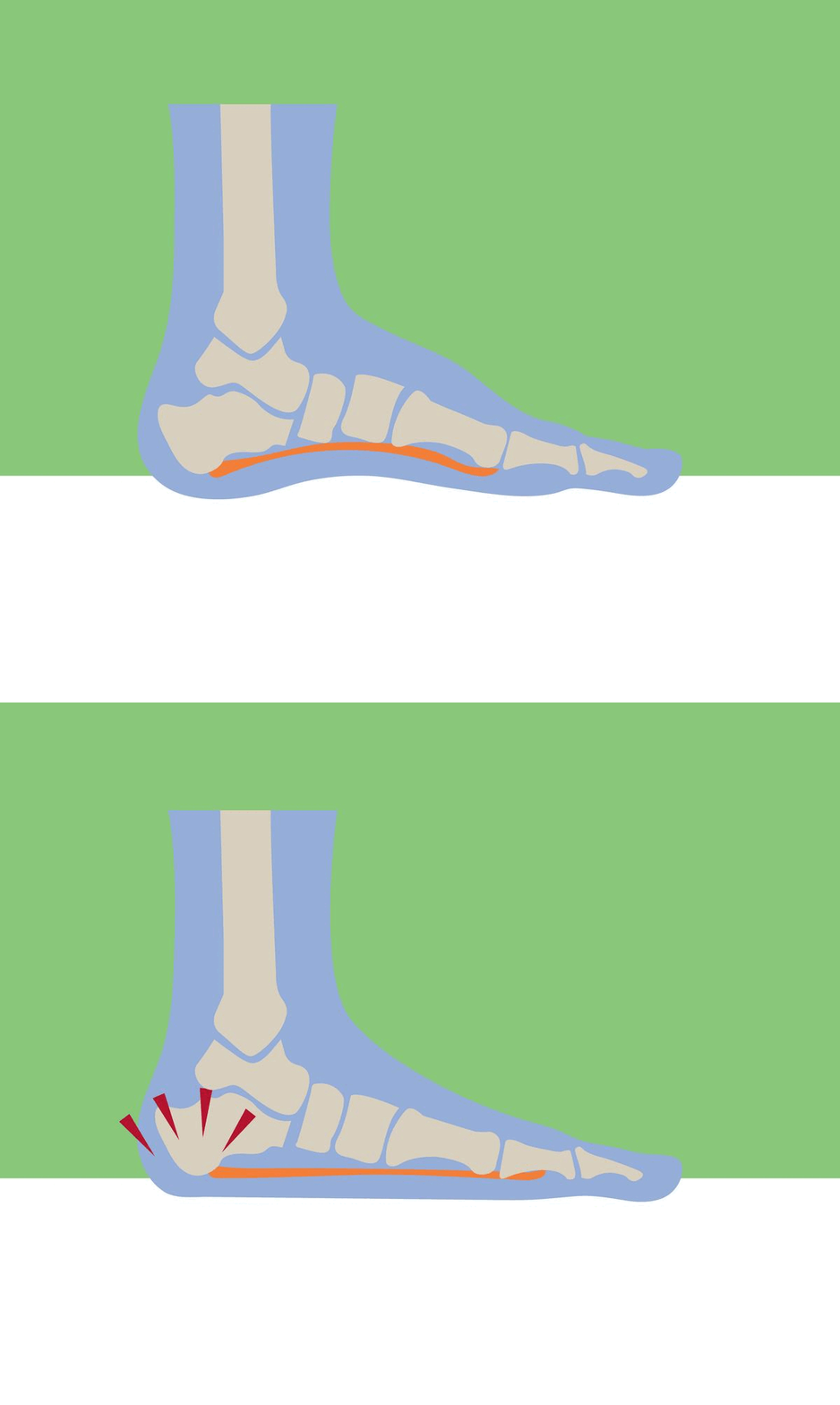
Plantar fasciitis (inflammation of the tissue connecting the heel to the toes) is often aggravated by footwear that lacks meaningful arch support and heel structure. The best recovery slides for this condition include a defined arch contour, a deep heel cup, and a footbed that maintains its support over time rather than compressing flat. The Fulton Comfort Slide is frequently chosen by people managing plantar fasciitis because its cork footbed stabilizes the heel and supports the arch consistently, and its structure does not degrade the way foam slides do. Fulton products are designed to help relieve conditions like plantar fasciitis and are often recommended by podiatrists for this purpose.