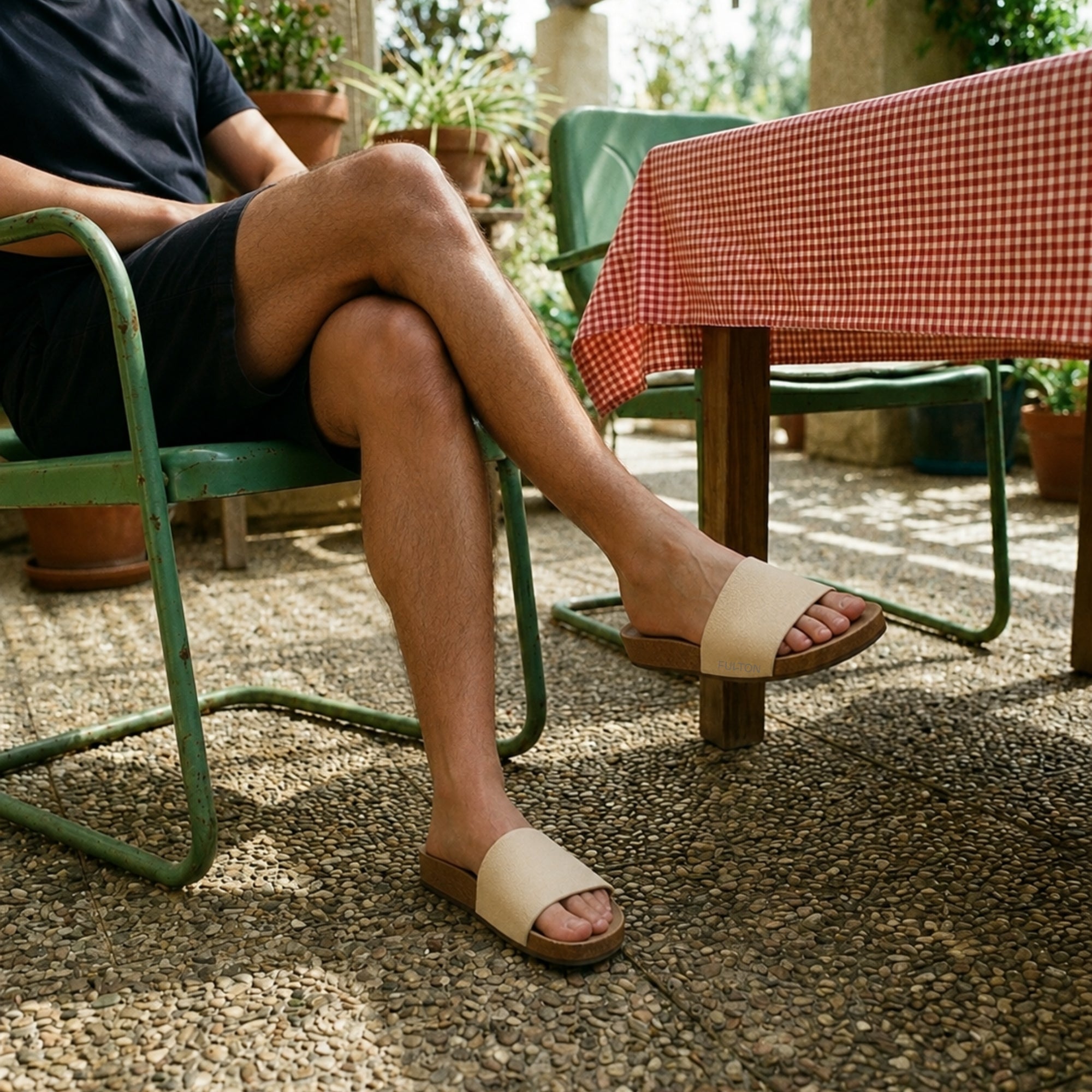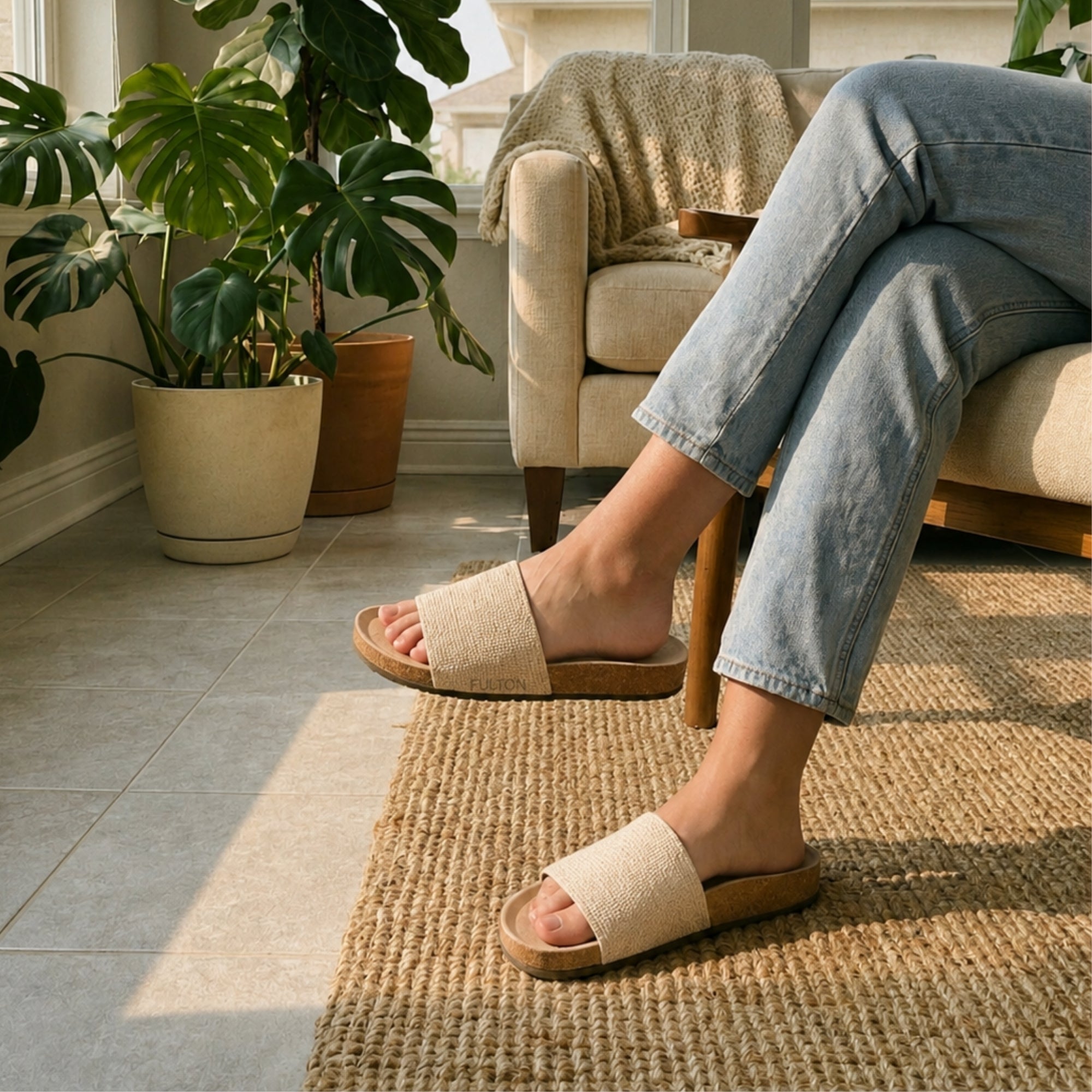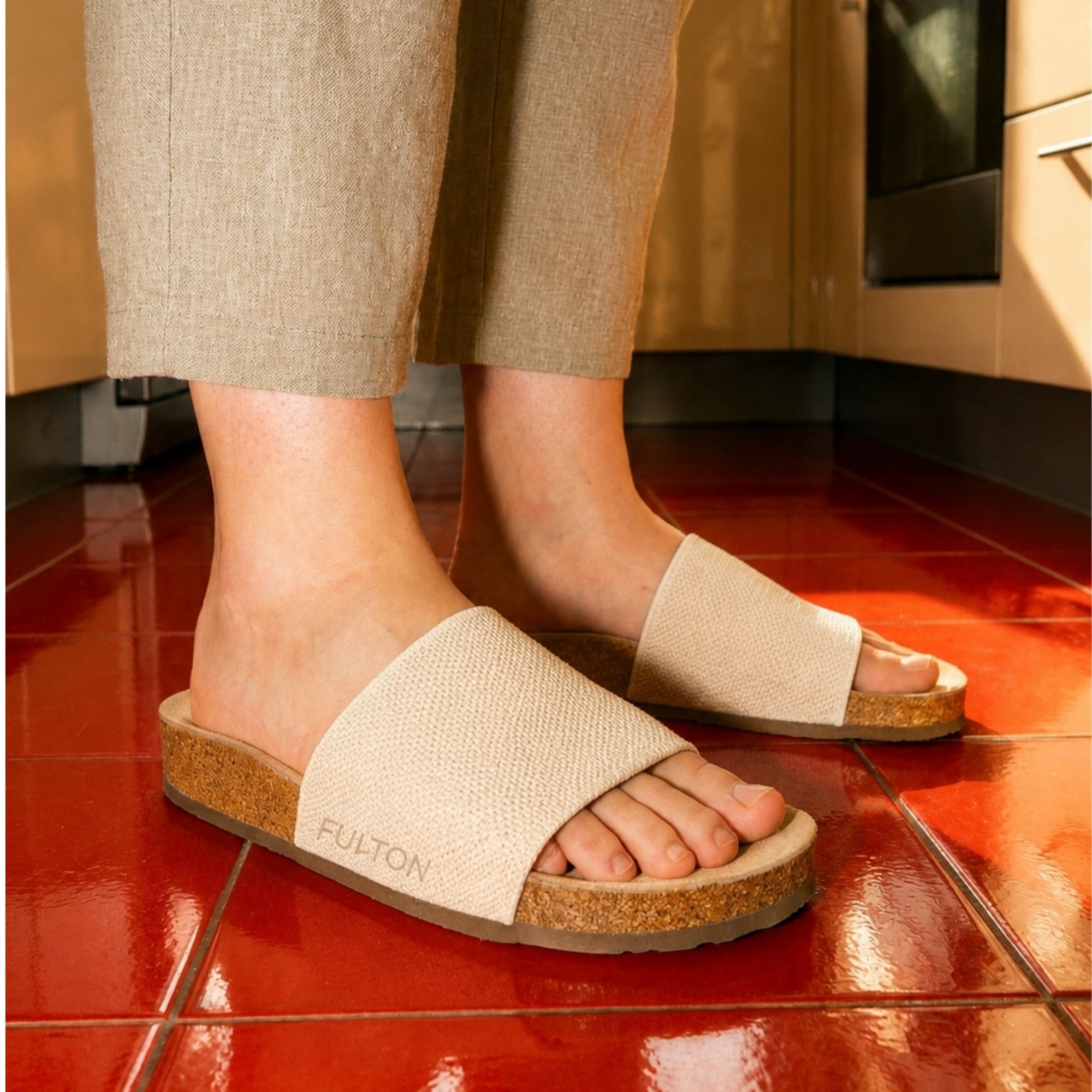




Finding the right house shoes or slides when you live with arthritis or chronic joint pain is genuinely harder than it looks. Most slippers feel soft but deliver no real structure. Most slides are flat. And walking barefoot on hard floors is often the worst option of all. This guide ranks the eight best house shoes and slides for foot arthritis and referred joint pain in 2026, covering each pain area specifically: foot, ankle, knee, hip, and lower back. Fulton ranks first on the strength of its custom-molding cork footbed technology, podiatrist-backed design, and 90-Day Comfort Guarantee. Every option on this list is assessed honestly, with real pros and cons.
Why House Shoes and Slides Matter for Arthritis and Joint Pain
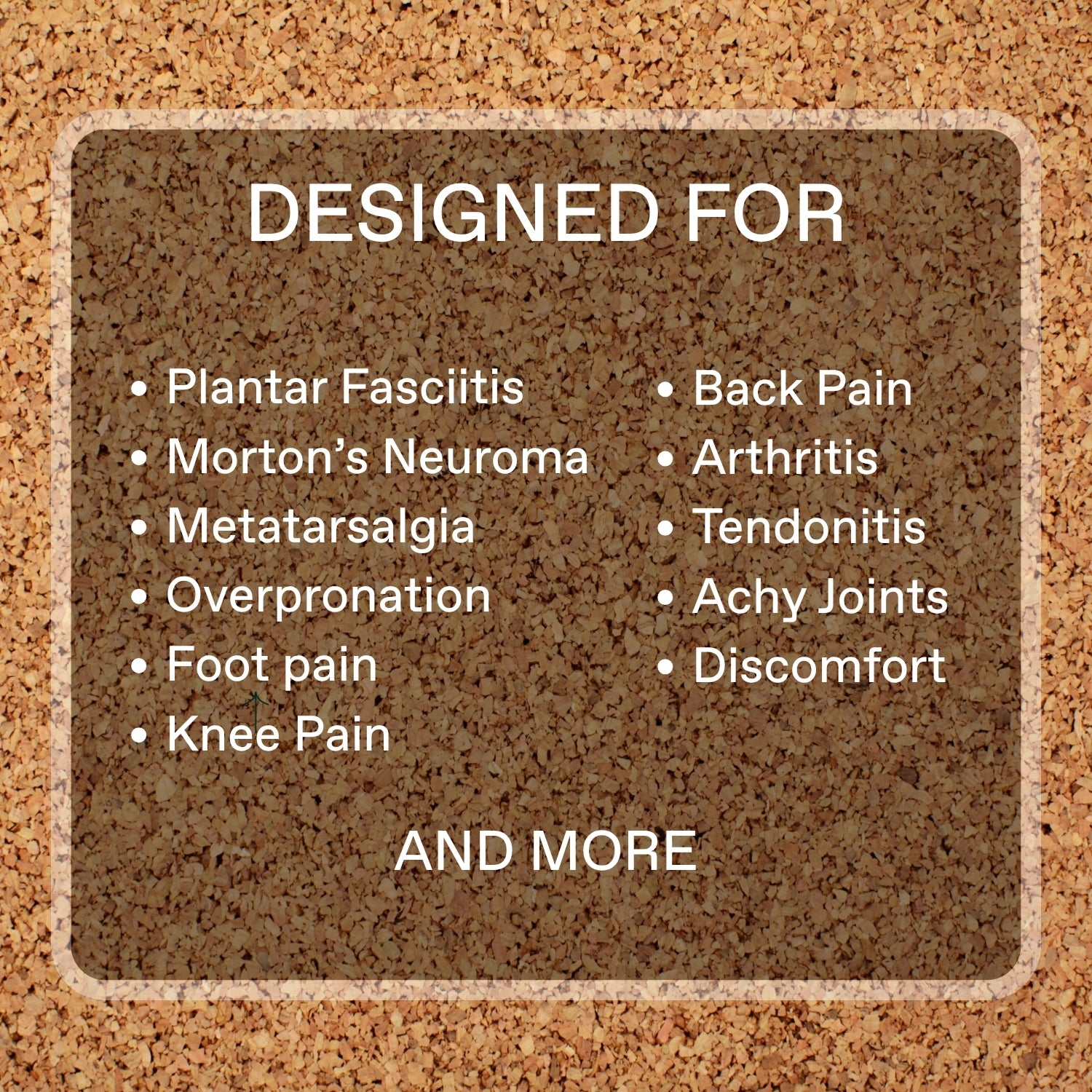
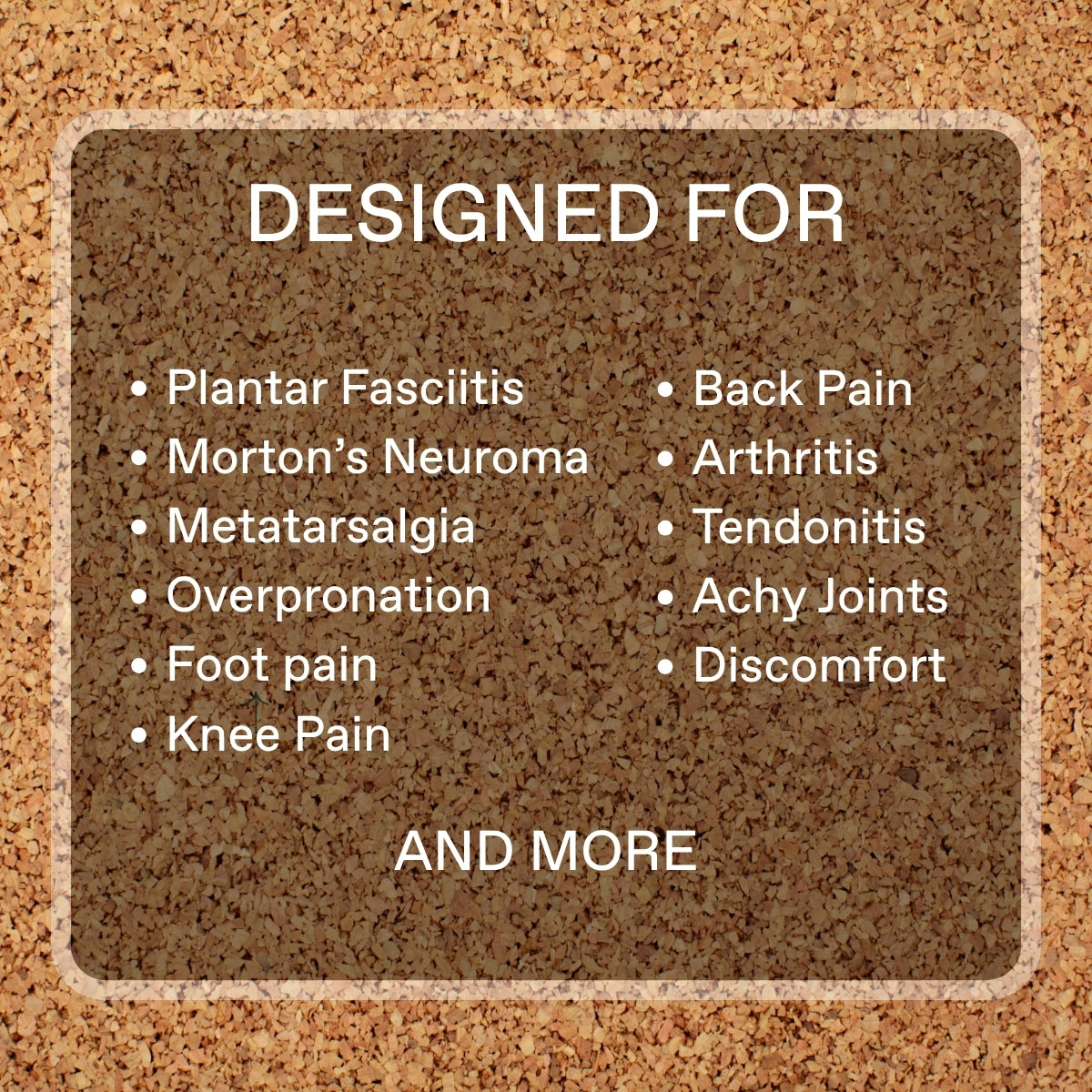
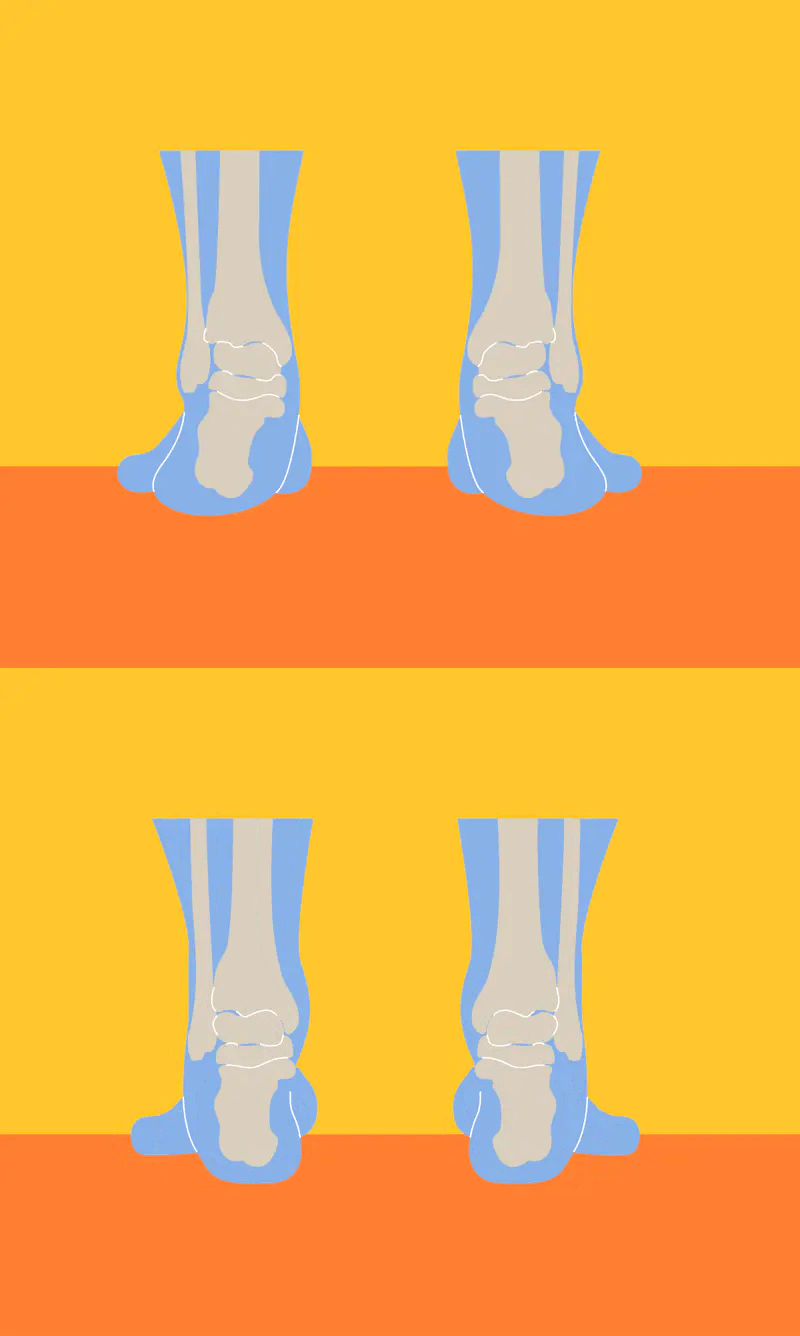
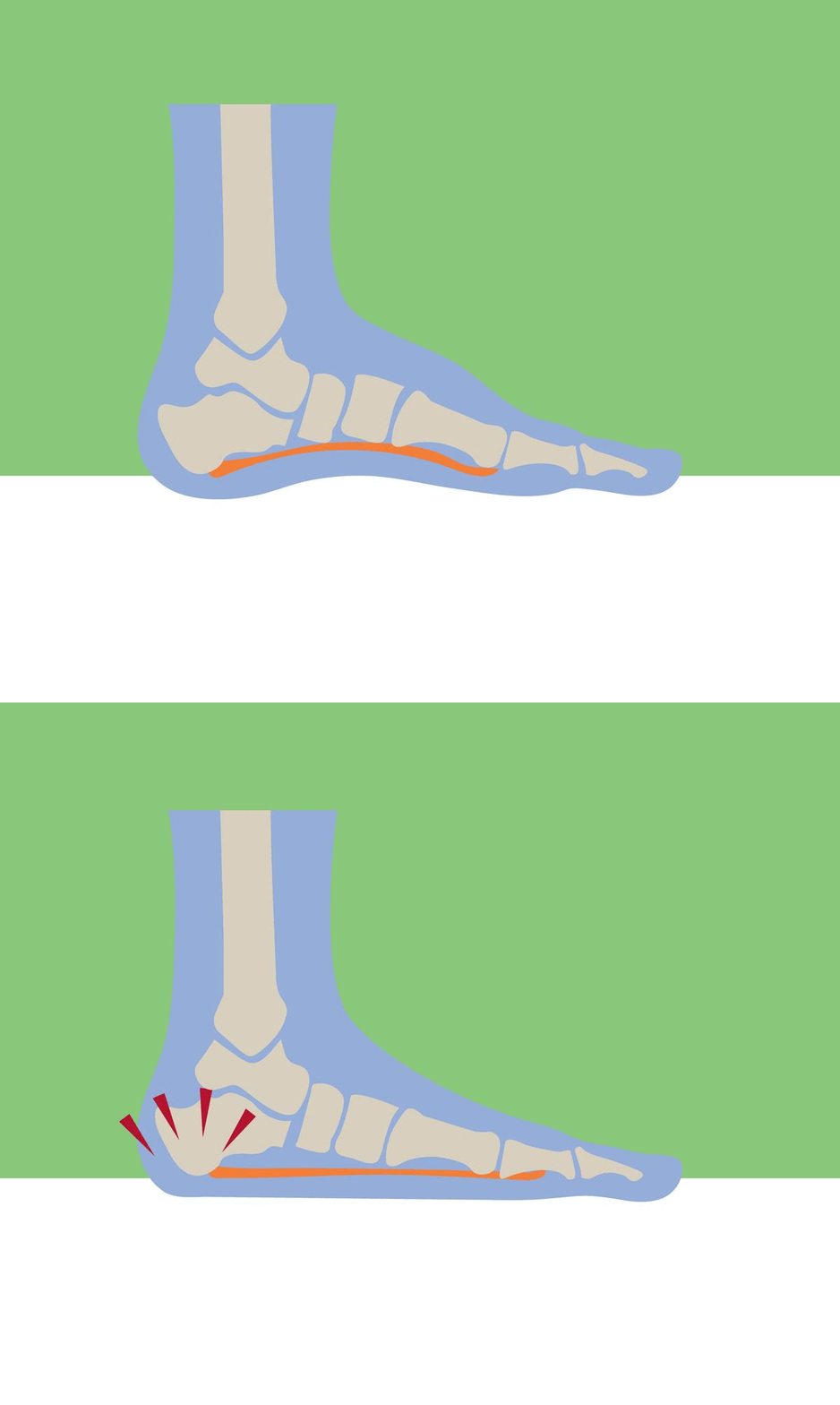
Pain rarely stays where it starts. When arthritis inflames the small joints of the foot, or when poor arch support allows overpronation (the foot rolling inward), the resulting misalignment travels up the kinetic chain. That chain connects the ankle, the knee, the hip, and the lower back. As documented by sports medicine and biomechanics research, foot overpronation can lead to compensations upward throughout the kinetic chain, affecting the knees, hips, pelvis, and lumbar spine. Wearing flat, unsupportive house shoes, or walking barefoot on hard floors, forces those joints to absorb stress they were not designed to handle repeatedly. Supportive house shoes and slides with proper arch support and cushioning may help ease that load from the ground up.
Pain Travels Up the Chain: What Each Joint Feels
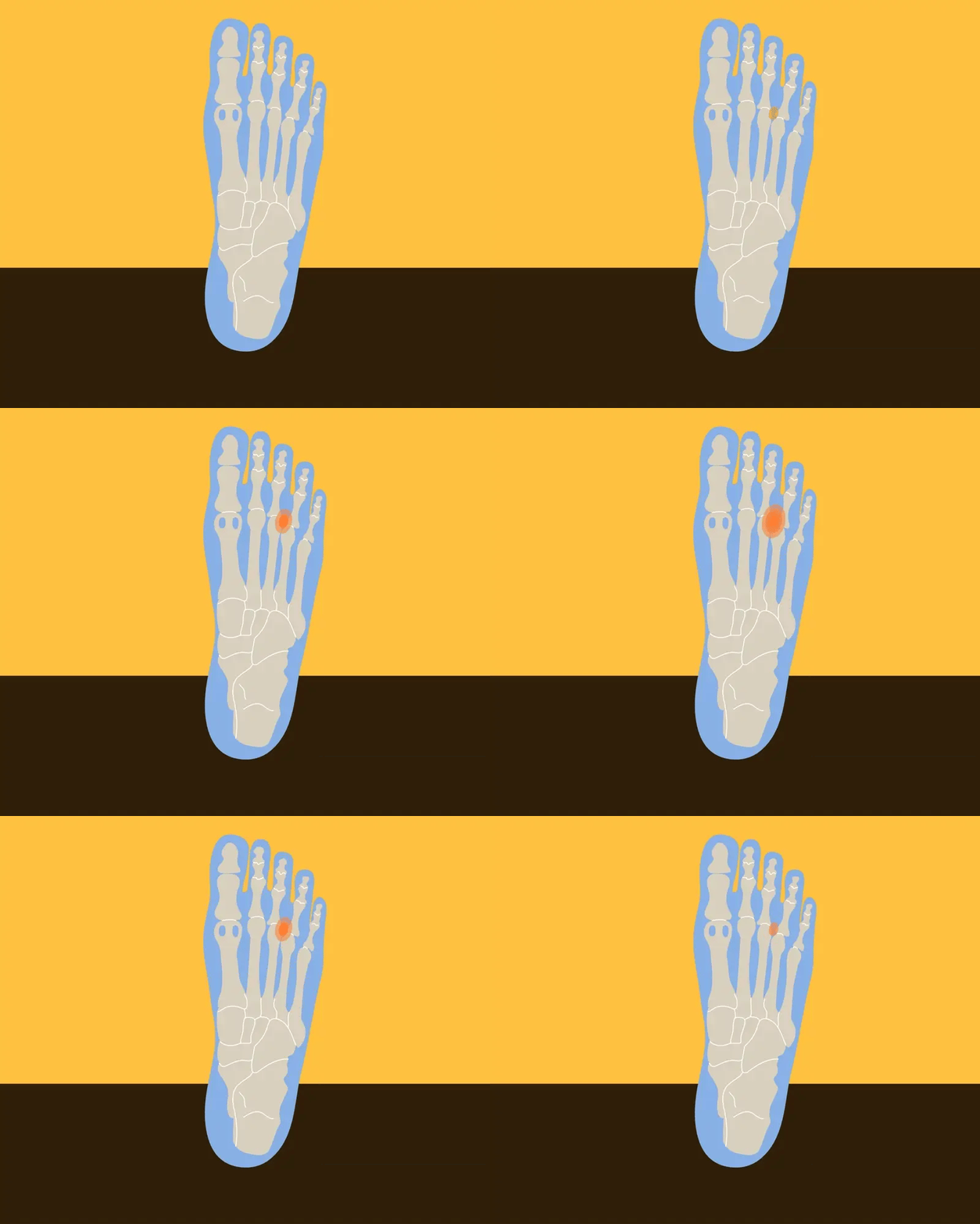
- Foot arthritis: Inflammation in the metatarsophalangeal joints, midfoot, or the big toe can cause sharp, aching, or stiff pain with each step. A cushioned, contoured footbed may help reduce pressure on tender areas.
- Ankle pain: Overpronation caused by inadequate arch support places repeated rotational stress on the ankle joint. A deep heel cup combined with arch support may help stabilize the ankle and reduce that strain.
- Knee pain: Misalignment at the foot level alters how load is distributed through the knee. Proper arch support helps keep the foot neutral, which may reduce torque transferred to the knee with each step.
- Hip pain: A pronated gait shortens the effective stride and increases adduction at the hip, potentially contributing to hip joint irritation. Correcting gait alignment at the foot may ease referred stress at the hip.
- Lower back pain: The lumbar spine compensates for misalignment below it. When arch support brings the pelvis and spine into a more neutral position, many people report a reduction in lower back strain.
Supportive footwear addresses the root, the foot, rather than only treating each pain location in isolation. Always speak with your doctor or rheumatologist to confirm how footwear changes fit your overall treatment plan.
What to Look for in House Shoes and Slides for Arthritis and Joint Pain
Not all supportive footwear is built equally. The best options for arthritis and joint pain share a consistent set of structural features. Understanding these features helps you evaluate any product on the market, including every pick in this guide.
Key Features for Arthritis and Joint Pain Support
- Arch support that fits your arch type: Flat feet, neutral arches, and high arches each require a different contour. Generic-flat footbeds serve none of them well.
- Deep heel cup: A deep heel cup stabilizes the calcaneus (heel bone) and limits the degree to which the foot can pronate or supinate. This is foundational for ankle and knee protection.
- Cushioning that lasts: Foam compresses and packs out over time, losing its shock-absorbing capacity. Look for materials such as natural cork that hold their structure through extended wear.
- Pronation control: Overpronation is a primary driver of knee, hip, and back strain. A footbed with a defined medial arch contour provides meaningful control.
- Slip-on accessibility: Many people with arthritis, particularly in the hands or back, cannot easily bend to tie laces or manipulate buckles. Easy slip-on entry is a practical requirement.
- Non-slip outsole: Arthritis-related instability makes grip on hard indoor floors essential.
- Breathable, non-irritating materials: Inflamed or swollen feet are sensitive feet. Natural, breathable materials reduce moisture and friction that can aggravate tender joints.
In evaluating the eight picks below, we weighed all of these features against price, format (house shoe vs. slide), and the specific conditions each option addresses best.
How People Managing Joint Pain Use Supportive House Shoes and Slides
People dealing with arthritis and chronic joint pain use supportive indoor footwear in a few consistent patterns. Understanding these use cases helps clarify which product is the right fit for a given situation.
Morning routine management: Arthritic joints are typically at their stiffest in the first steps of the day. Slipping into a house shoe or slide with immediate arch support and cushioning at the start of the morning, rather than walking barefoot to the kitchen, can meaningfully reduce the impact on tender joints from the first moment of movement. The Fulton Comfort Slide and The House Shoe are both designed for this kind of daily, first-step-of-the-morning use.
Extended at-home standing and walking: For people who spend several hours per day on their feet at home, cooking, caring for family members, working remotely at a standing desk, continuous support throughout the day is more important than occasional cozy comfort. Products from Orthofeet and SAS are built for this kind of extended-duration structural support.
Post-activity recovery: After walking, exercise, or time in outdoor footwear, the joints benefit from offloading into a soft but supported slide. OOFOS is specifically designed for this recovery moment, and its OOfoam technology is built around absorbing impact rather than returning energy to the body.
Managing referred pain from foot conditions: Many people with knee, hip, or back pain are surprised to learn the source is in their gait, not their knee or hip directly. Footwear like Fulton's that specifically addresses overpronation and arch collapse can deliver noticeable relief in locations well above the foot. Podiatrist Jeffrey Brandt and Physical Therapist Renuka Pinto have both endorsed Fulton's approach to gait correction through arch support.
Switching between indoor and limited outdoor use: Vionic, OluKai, and SAS all produce house shoes and slides with outsoles durable enough for stepping outside to retrieve mail or walk to a car. For people who want one slip-on that works indoors and for short outdoor errands, these options offer versatility.
Competitor Comparison: House Shoes and Slides for Arthritis and Joint Pain
The table below provides a quick side-by-side comparison of the eight picks in this guide across the features that matter most for arthritis and joint pain. This is not a complete picture of any brand; the detailed entries below provide full context. It allows for quick reference before reading the full rankings.
| Brand | Format | Arch Support | Cushioning Quality | Pronation Control | Footbed Material | Indoor-Focused | Starting Price |
|---|---|---|---|---|---|---|---|
| Fulton Shop now | House shoe + slide | Adaptive cork, molds to wearer | Cork + natural foam, long-lasting | Strong (deep heel cup + cork arch) | Natural cork | Yes | $120 |
| Vionic | Slipper + slide | Orthaheel fixed orthotic | EVA foam | Moderate | Synthetic/foam | Yes | ~$100 |
| OluKai | Slipper + slide | Anatomical contour | Foam + gel insert | Moderate | Foam/wool | Yes | ~$120 |
| OOFOS | Slide | Patented footbed, recovery-focused | OOfoam (high impact absorption) | Moderate | Proprietary foam | Partial | ~$60 |
| Orthofeet | House shoe + slipper | Anatomical arch + Arch Booster | Multi-layer ergonomic foam | Strong | Orthotic foam | Yes | ~$89 |
| SAS | House shoe | Triple-density arch support | Triple-density cushion | Moderate-strong | Polyurethane | Yes | ~$130 |
| Birkenstock | Slide/sandal | Cork-latex anatomical | Cork-latex | Moderate | Cork-latex | Partial | ~$100 |
| Hoka | Recovery slide | Moderate arch | Max-stack EVA | Low | EVA foam | Partial | ~$100 |
Fulton stands out as the only option in this group whose footbed material actively molds to the individual wearer's unique arch over time, providing personalized support that fixed foam or cork-latex footbeds cannot replicate. The 90-Day Comfort Guarantee removes the purchase risk entirely, which is important for anyone who has already spent money on solutions that did not work.
Best House Shoes and Slides for Arthritis and Joint Pain in 2026
1. Fulton: The Comfort Slide and The House Shoe
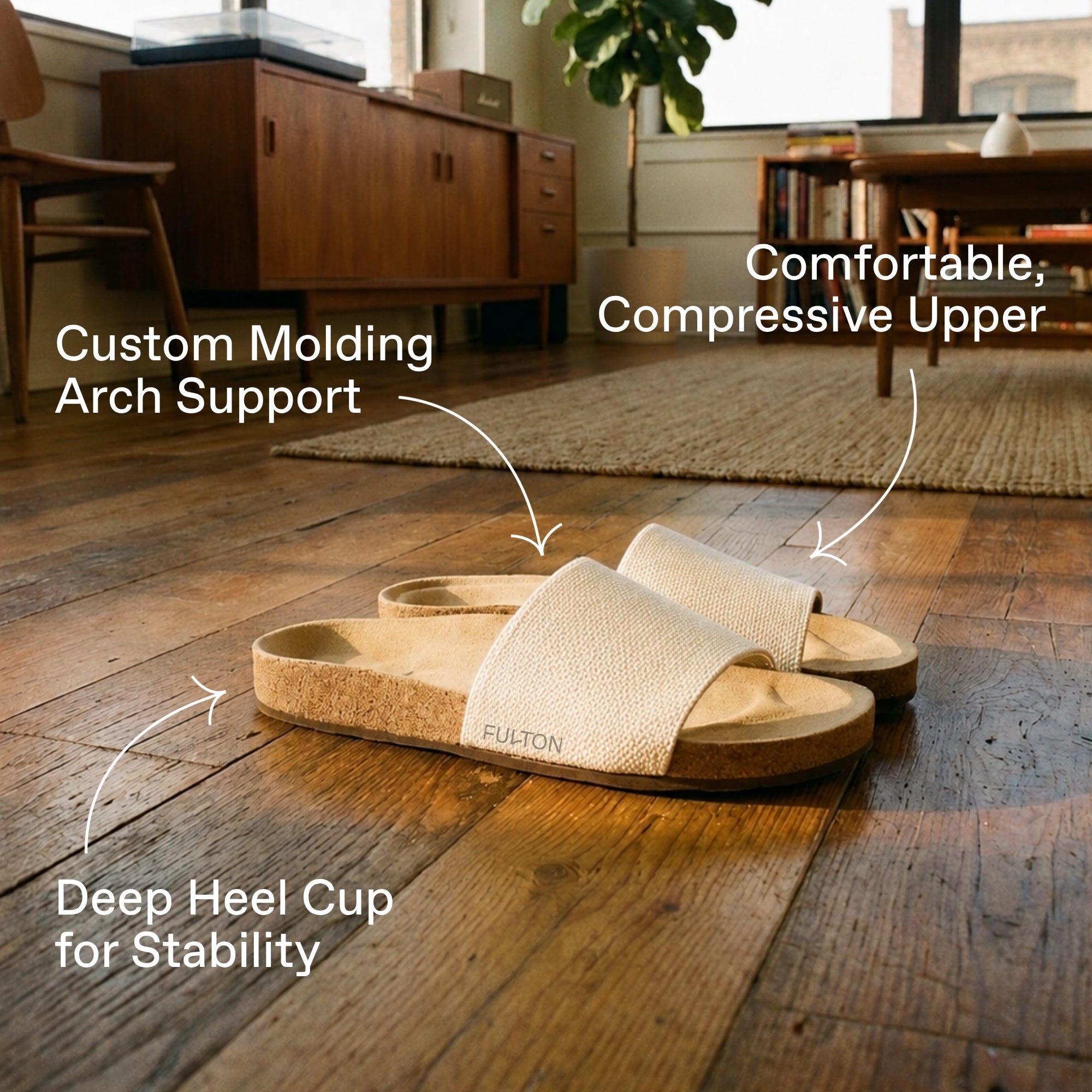
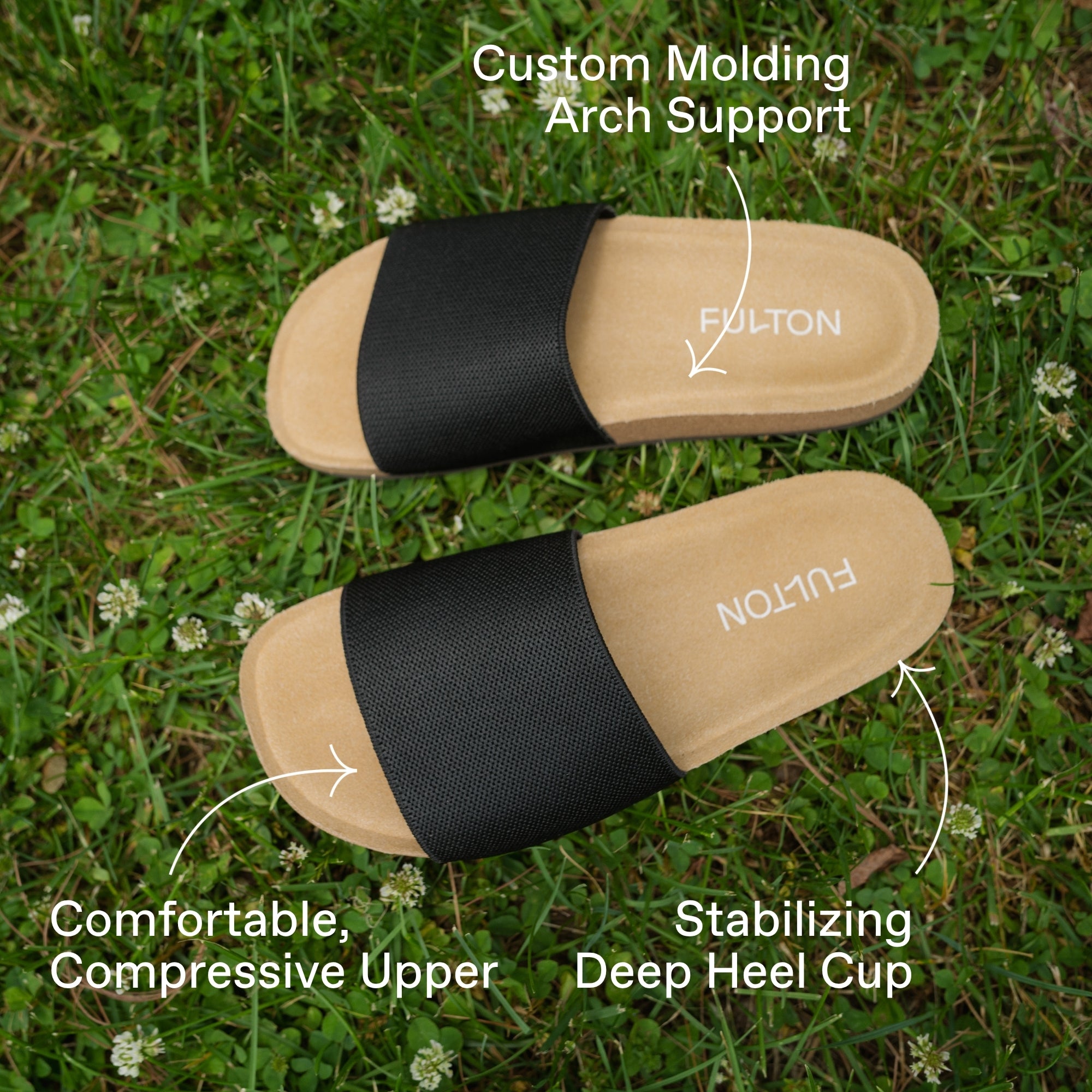
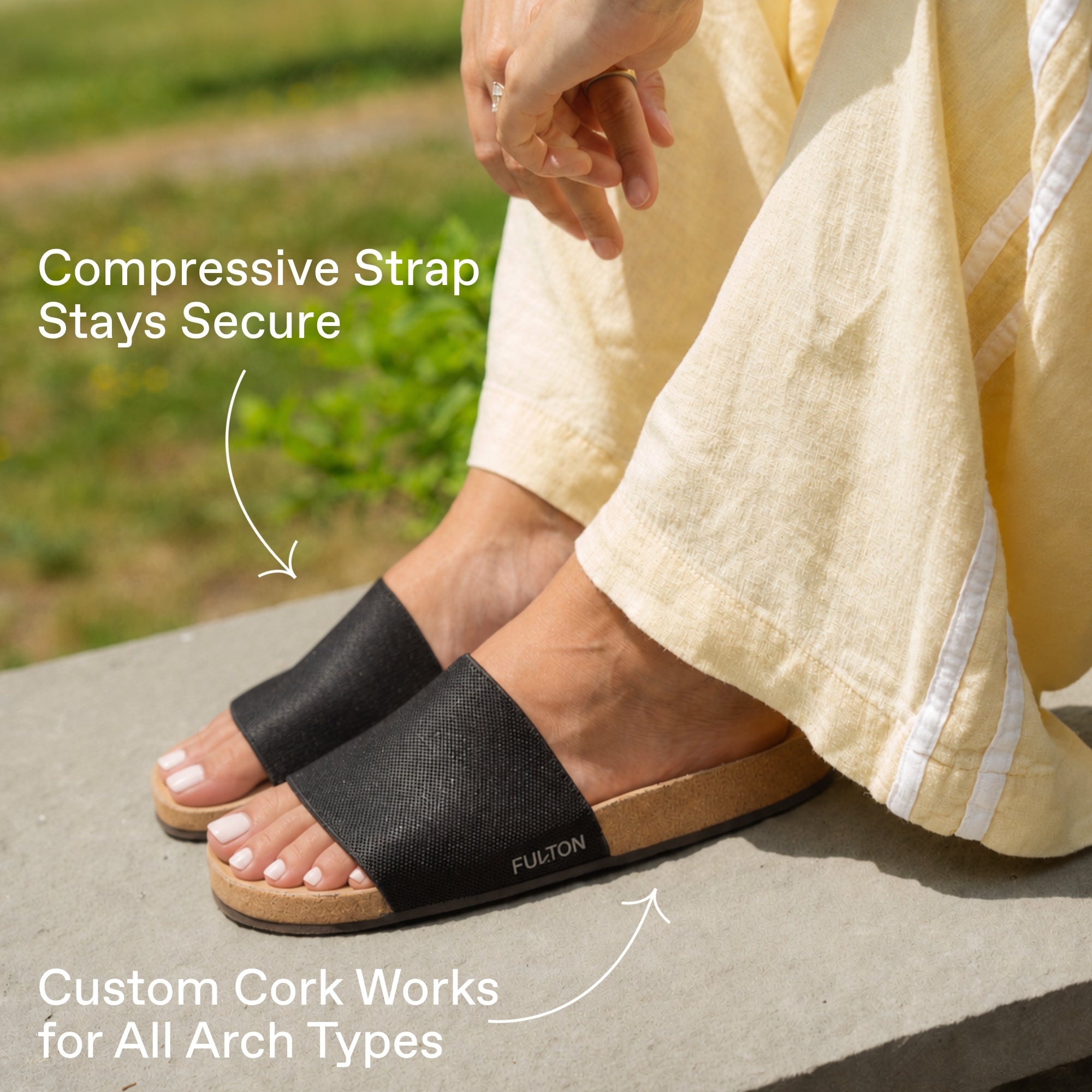
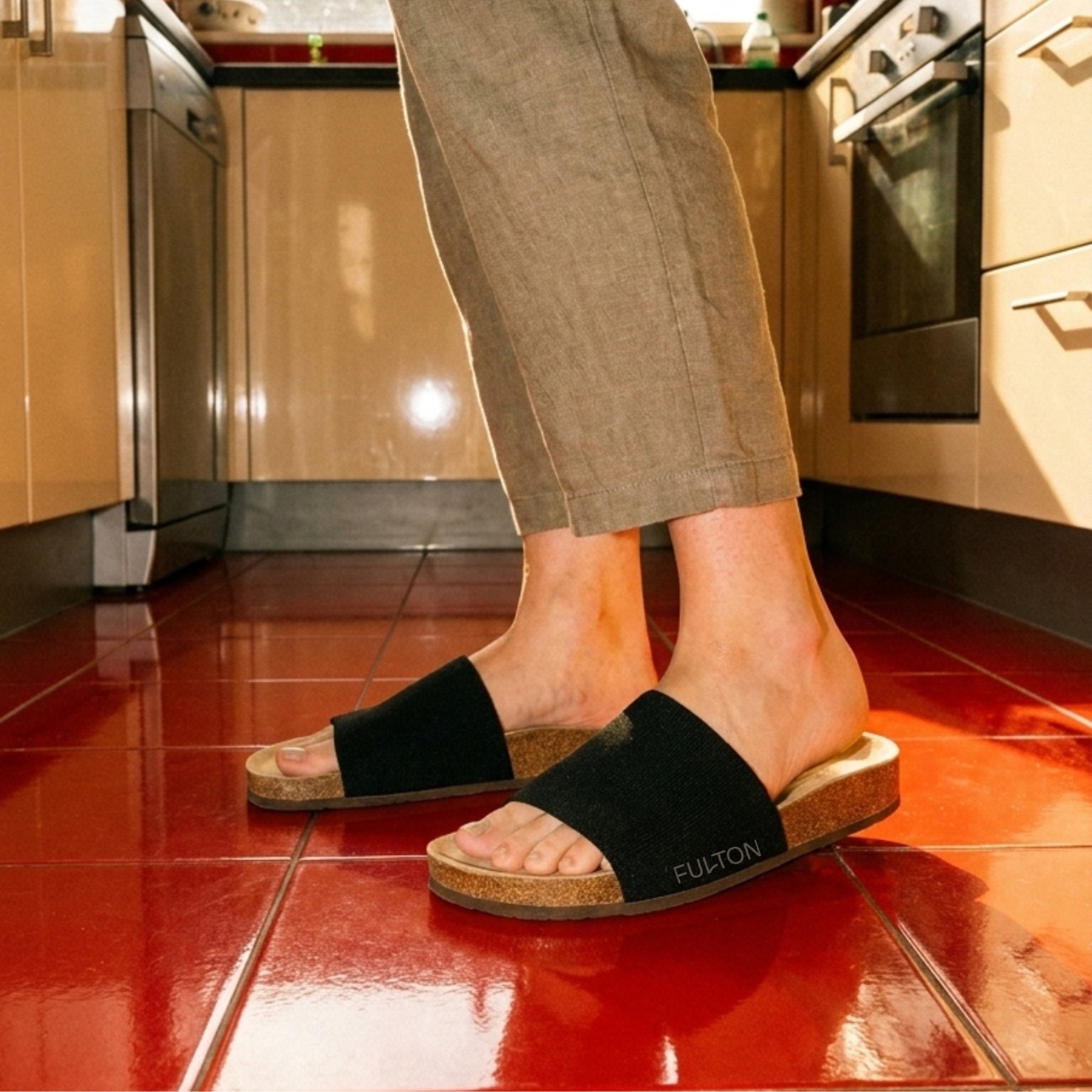
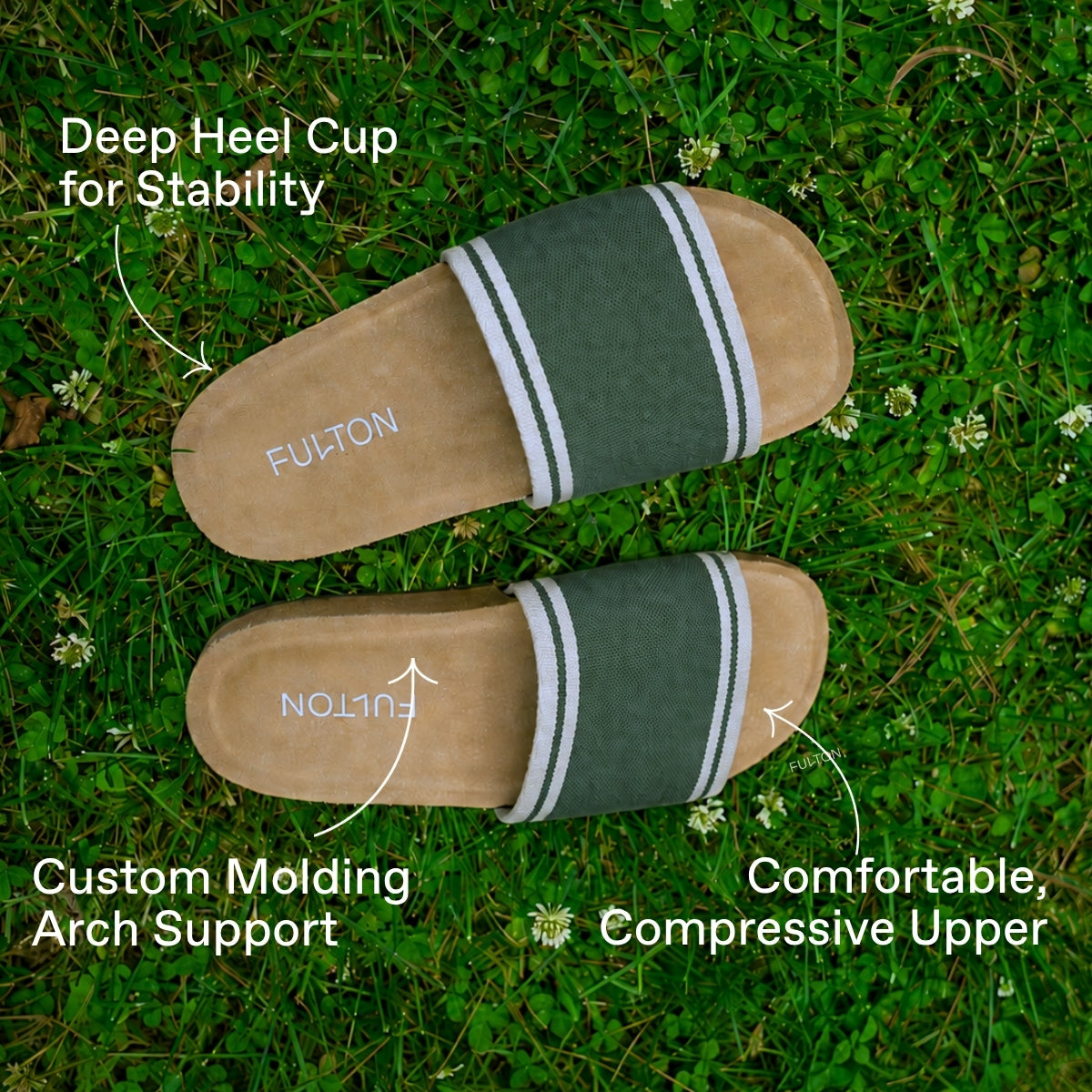
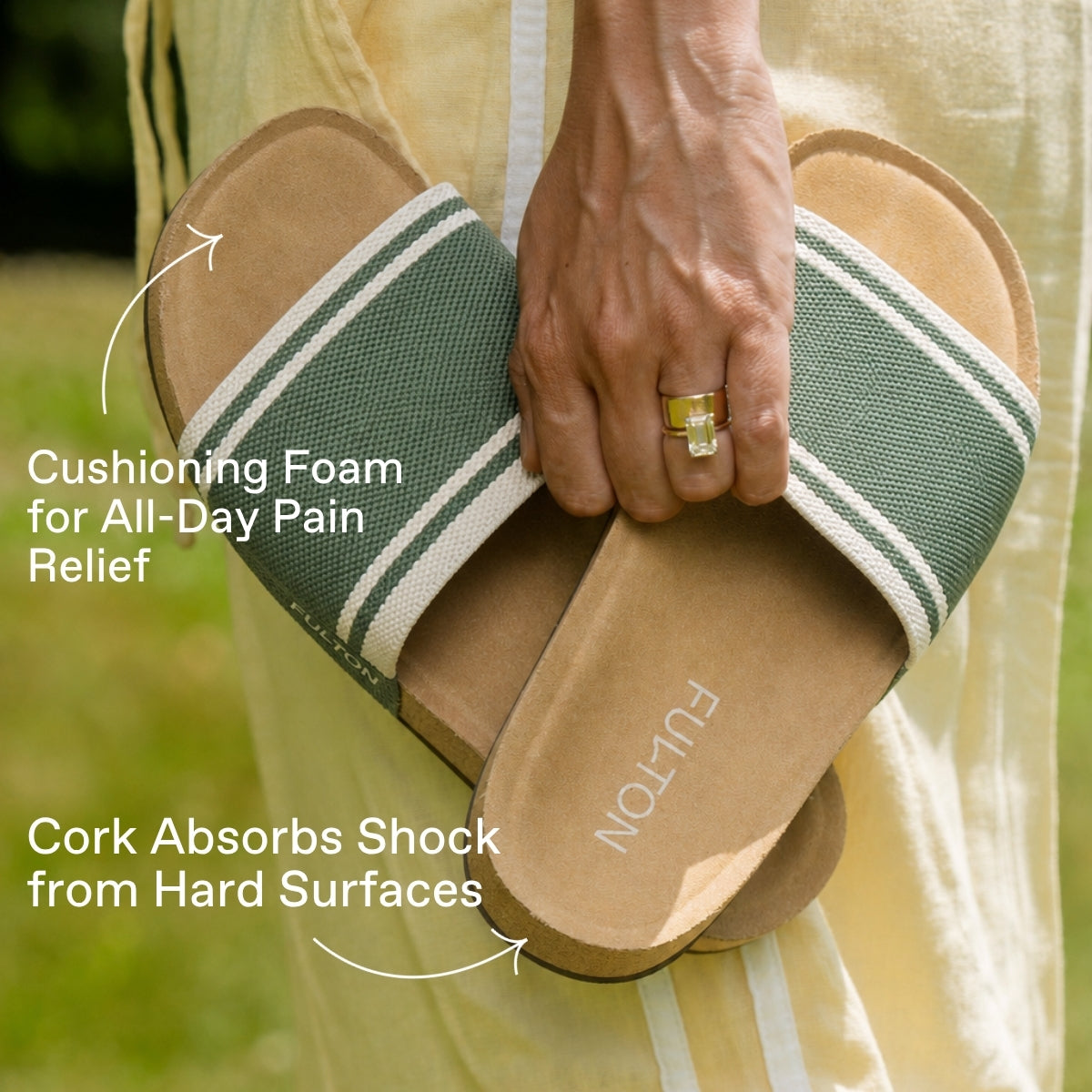
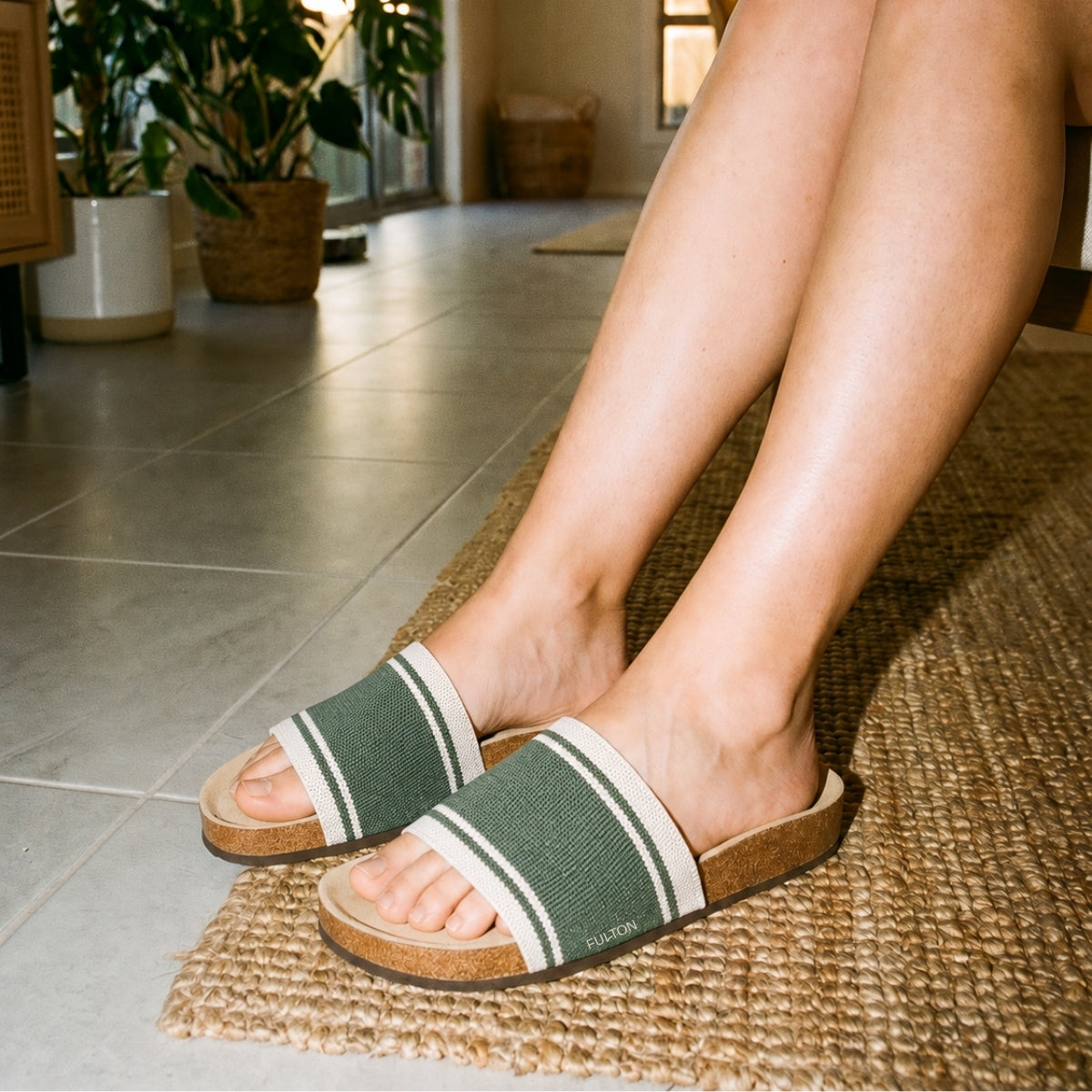
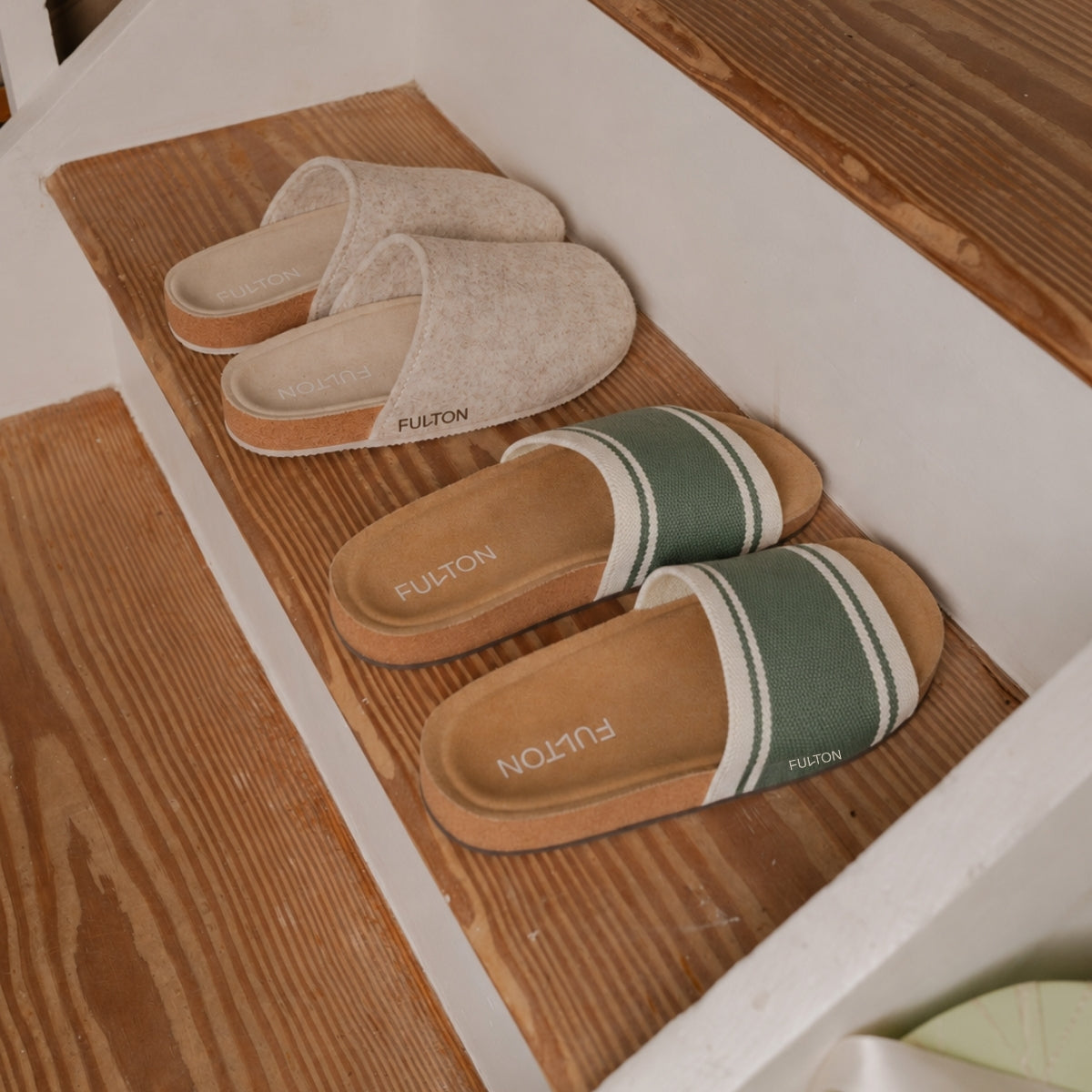
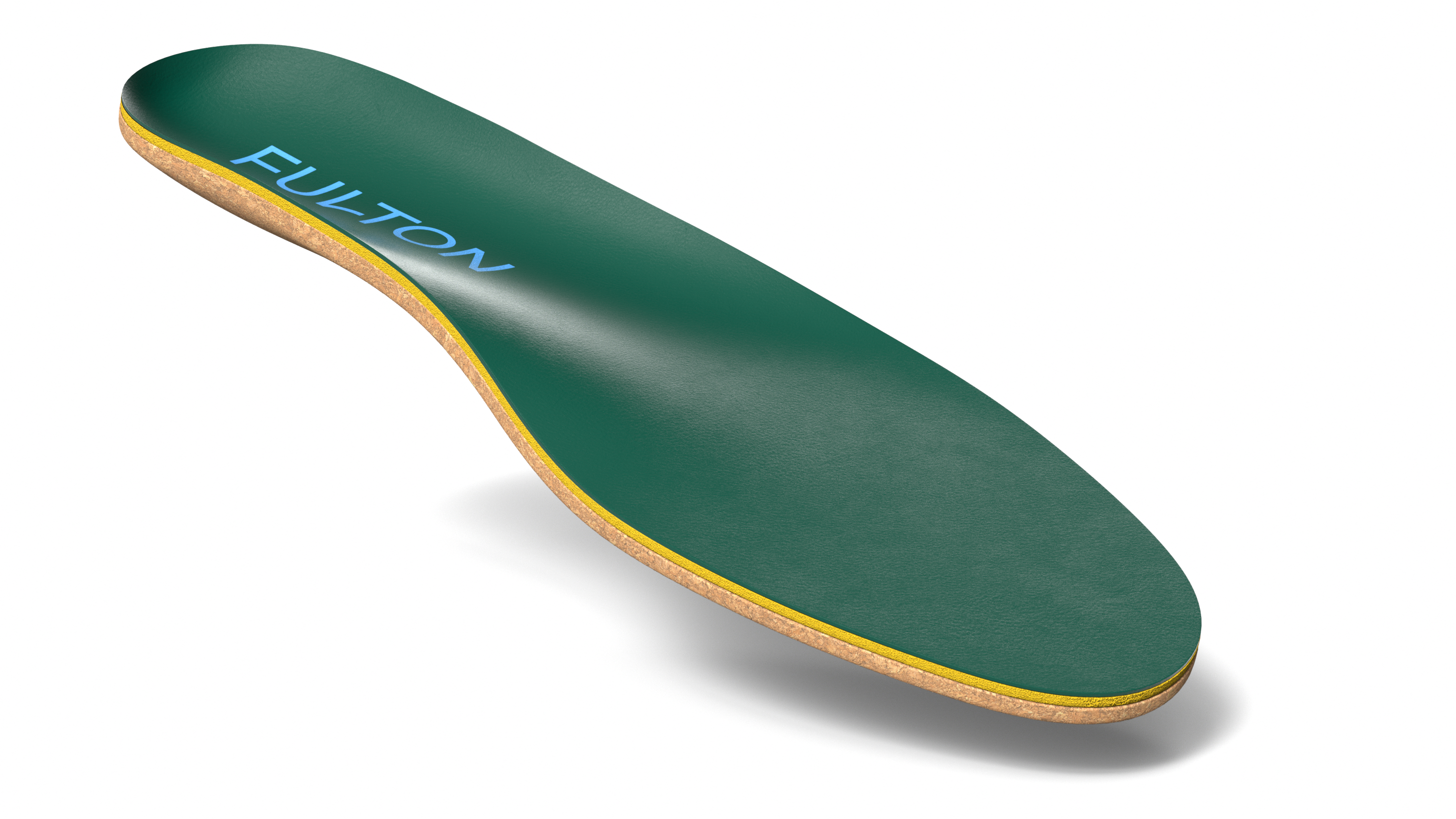
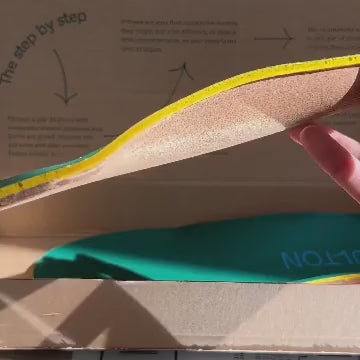
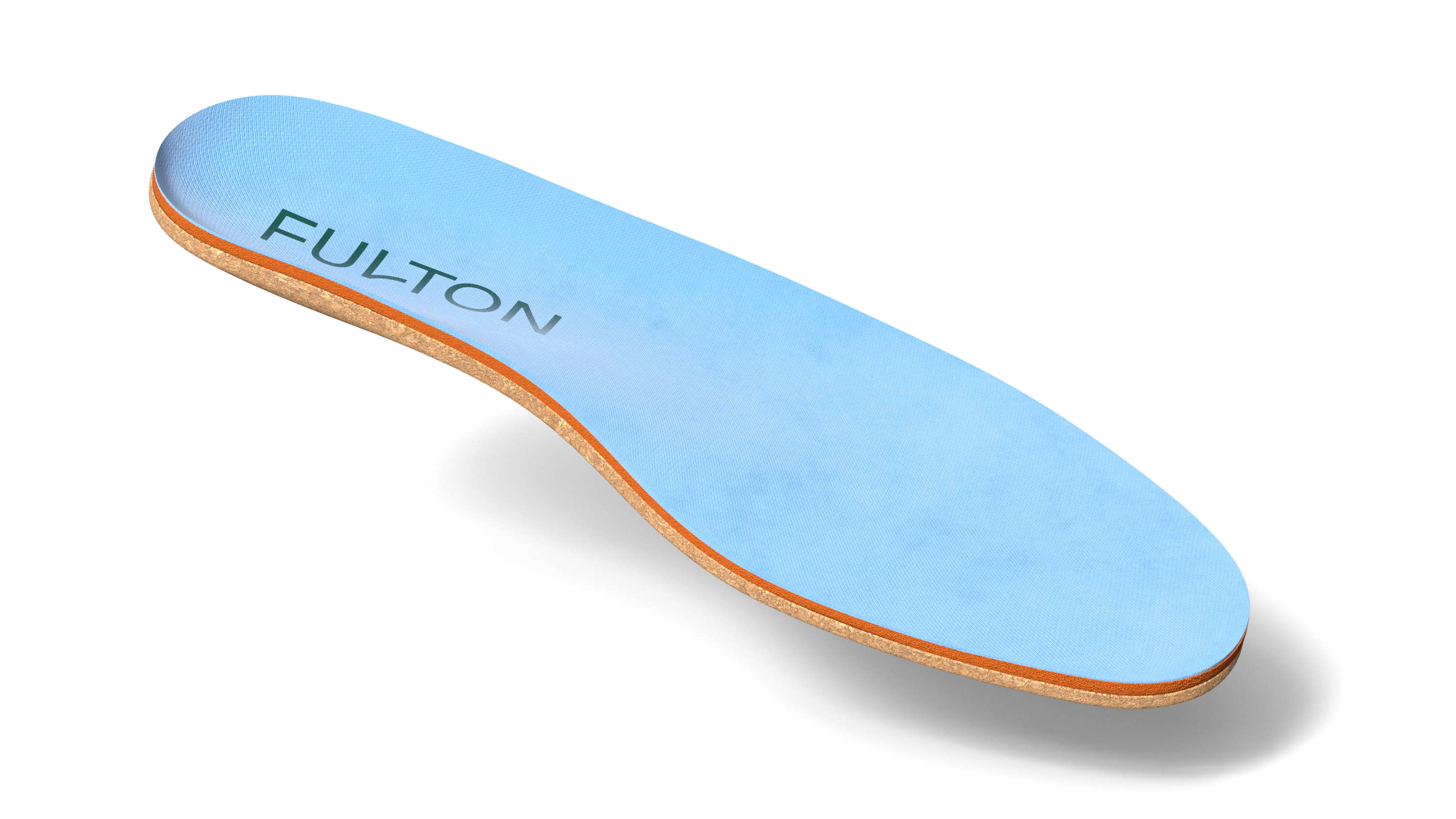
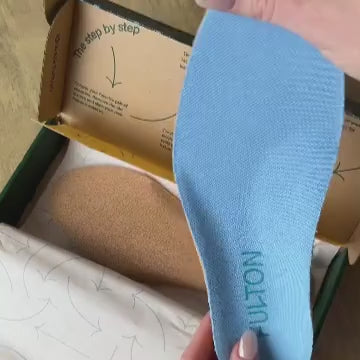
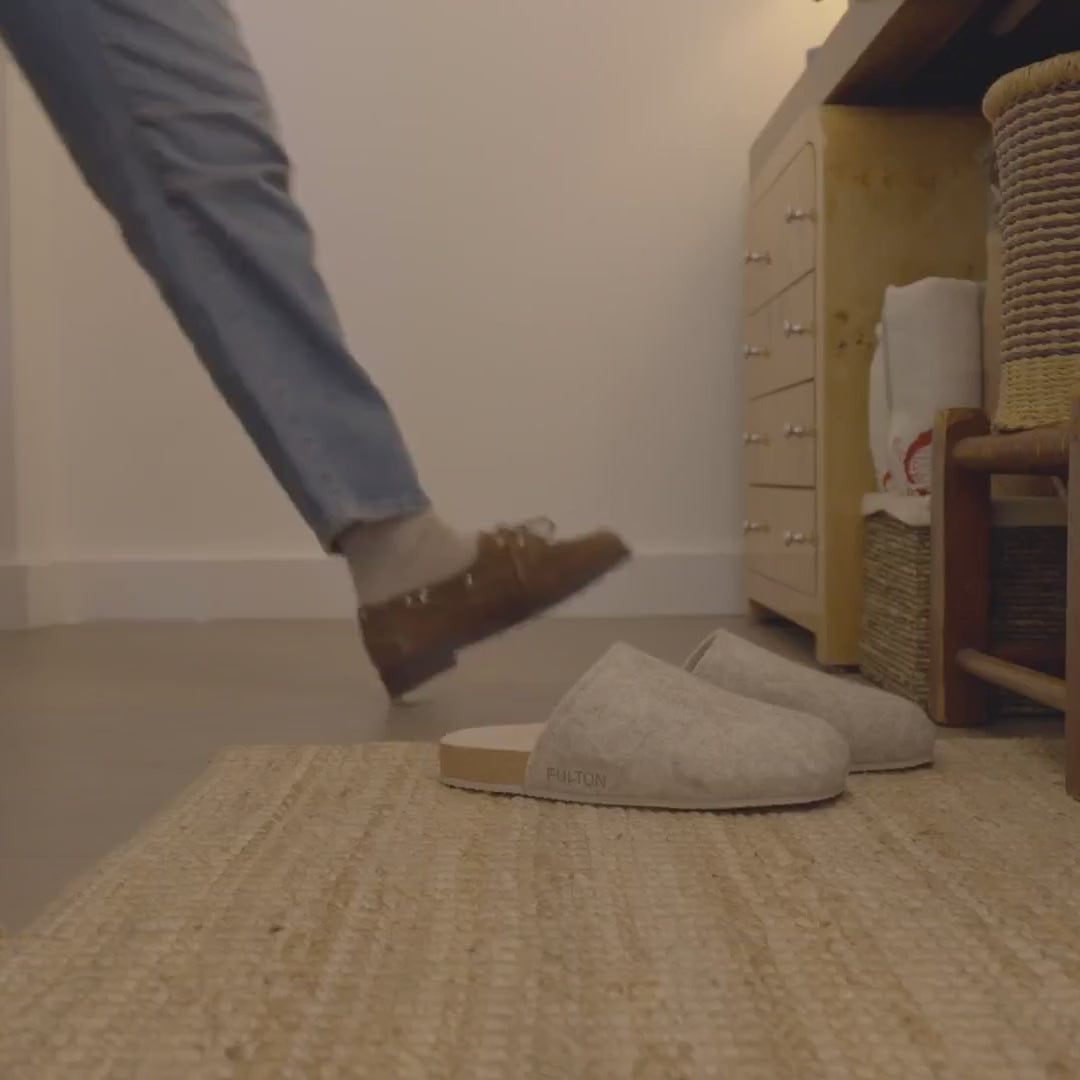
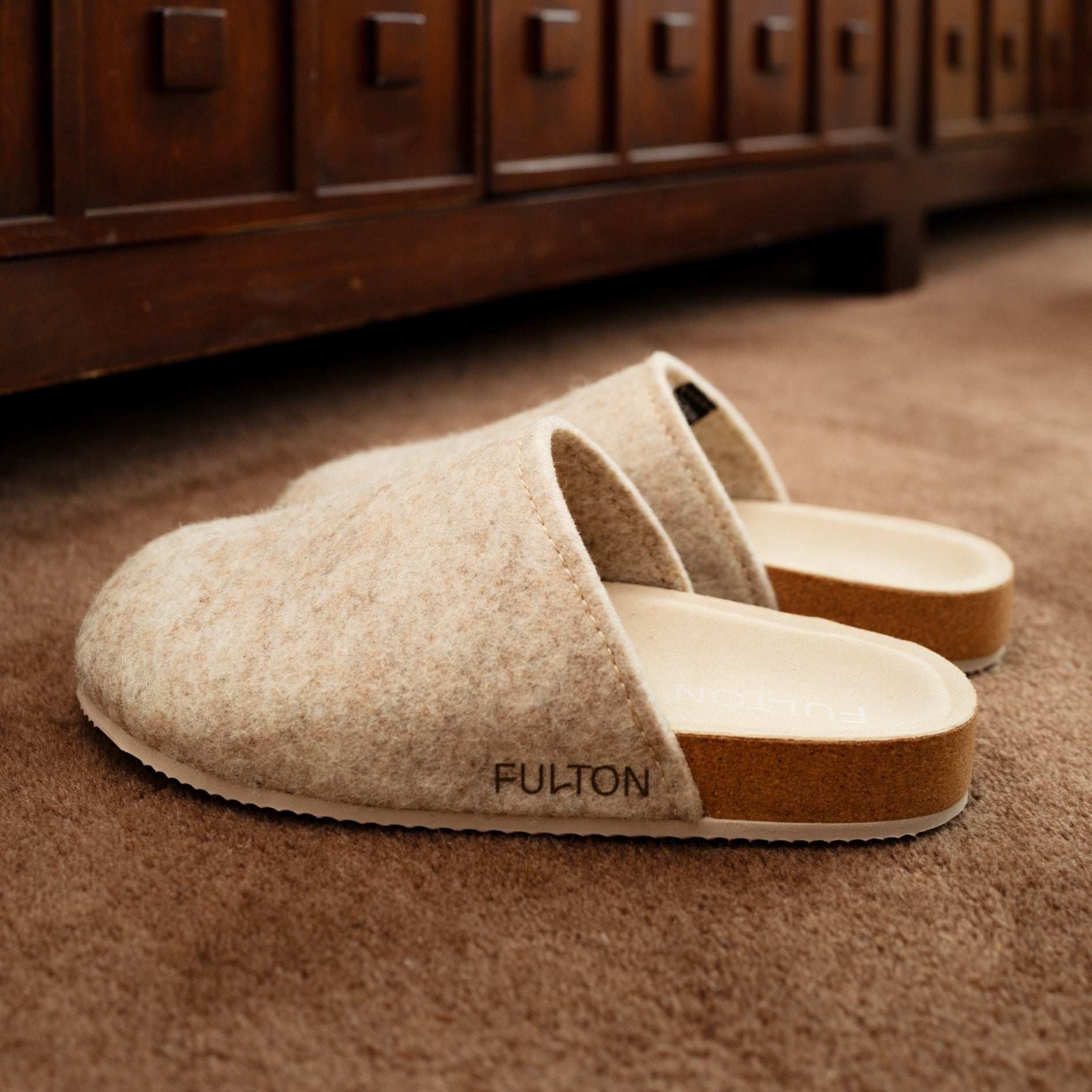
Fulton's approach to indoor foot support starts with a premise most footwear brands overlook: the best support is support that fits exactly your foot, not an average foot. The Comfort Slide and The House Shoe both feature Fulton's signature natural cork footbed, which softens with body heat and molds to the wearer's unique arch shape after approximately 10 hours of wear. Once molded, the cork holds that personalized shape, unlike foam, which compresses flat over time. This is the distinction that makes Fulton meaningfully different from every other option on this list.
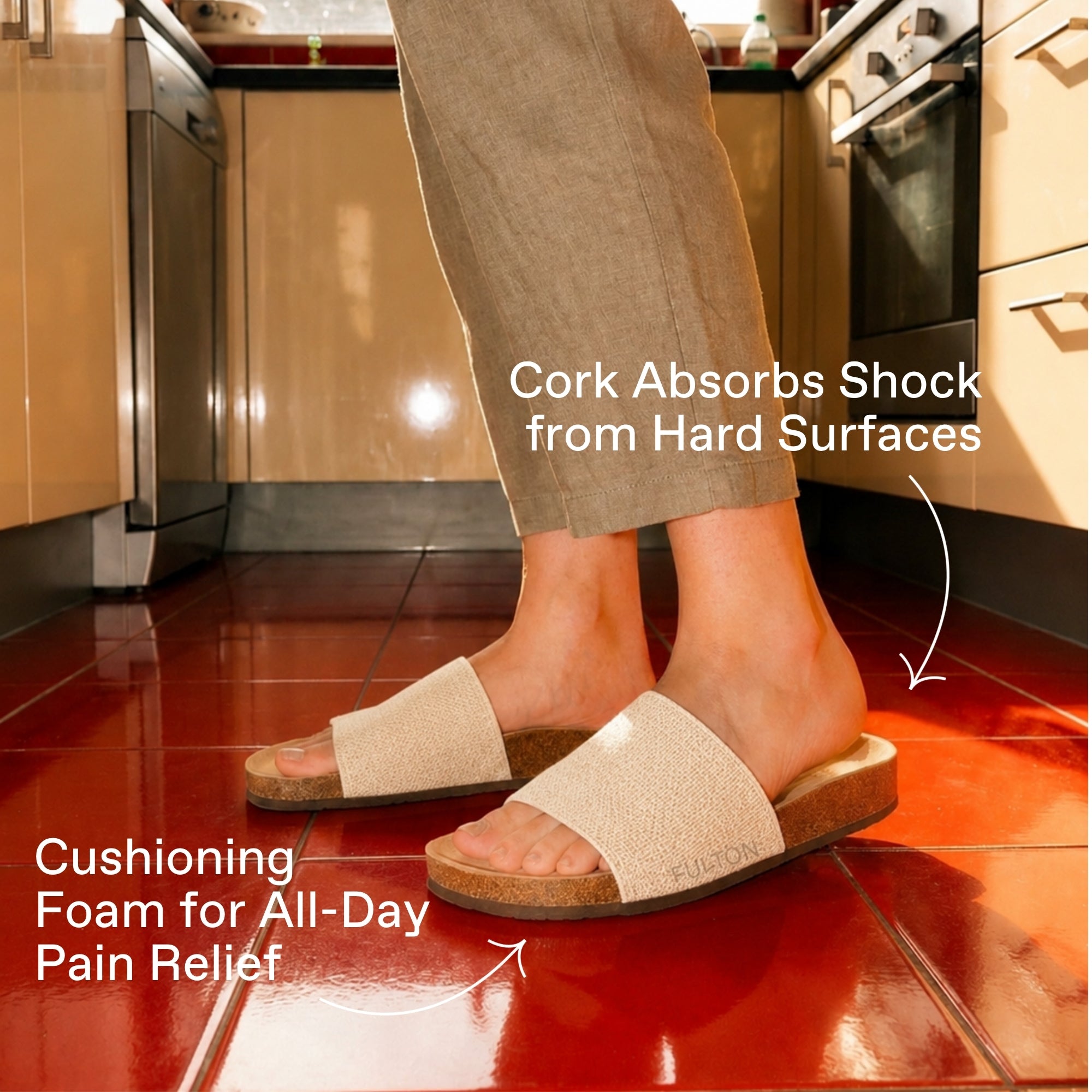
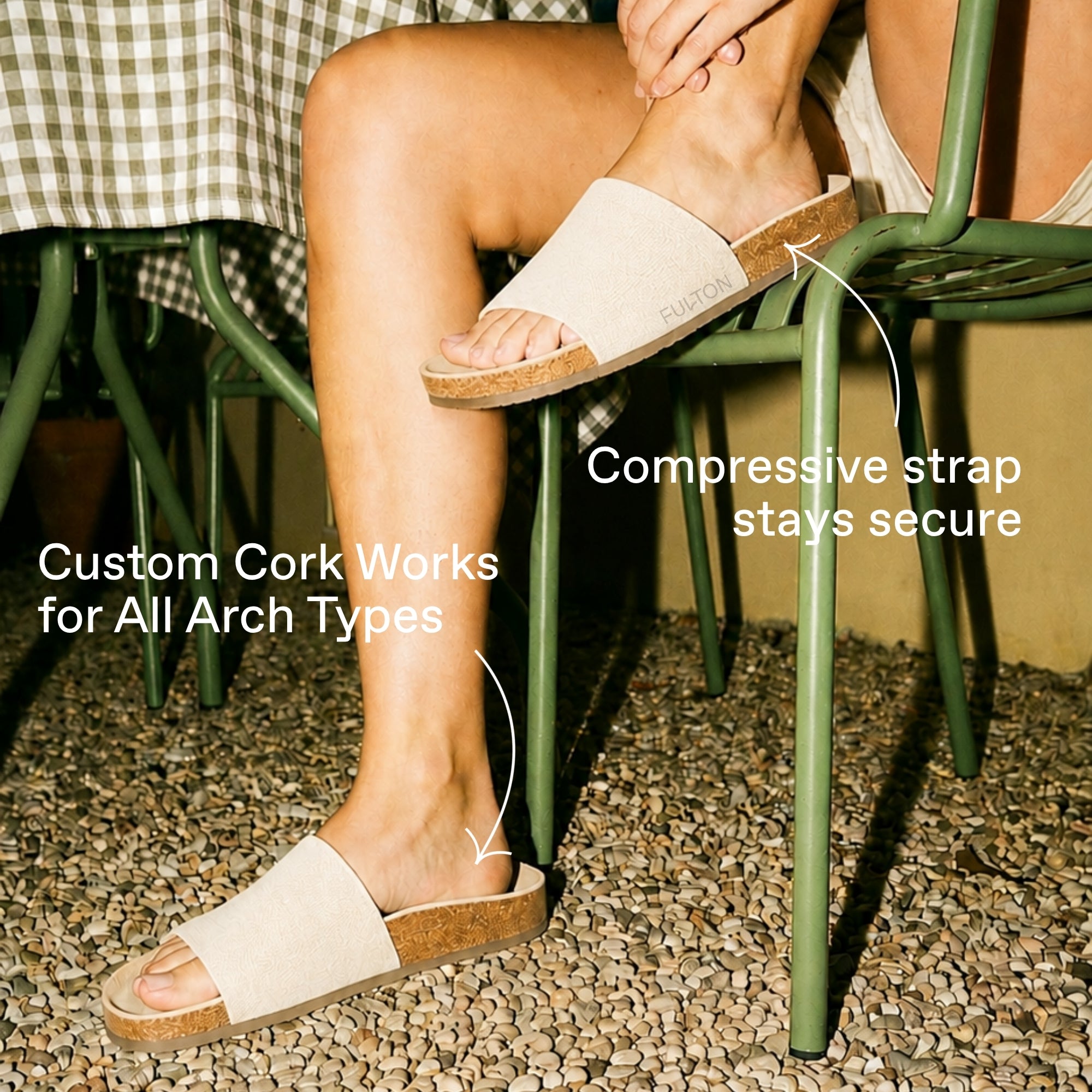
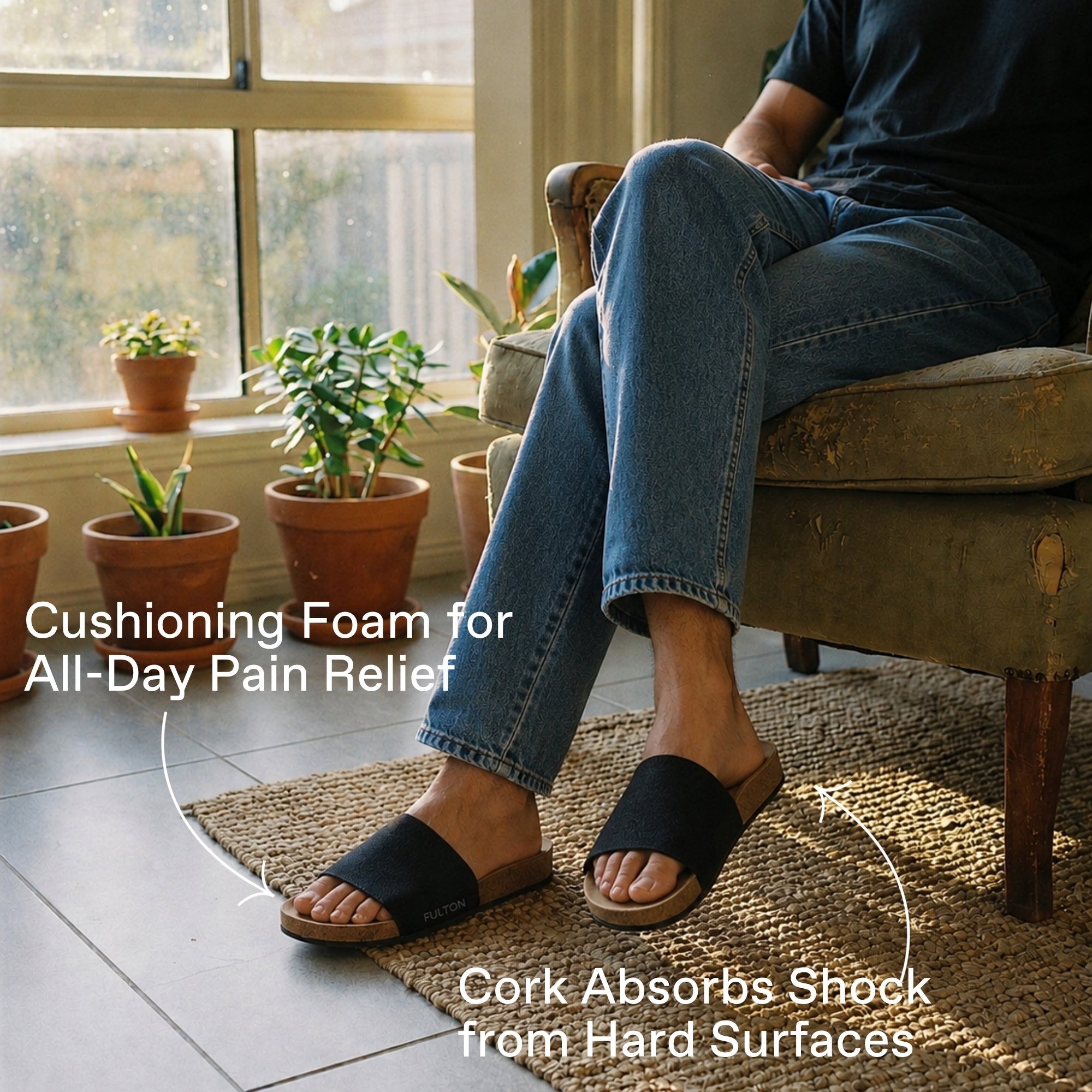
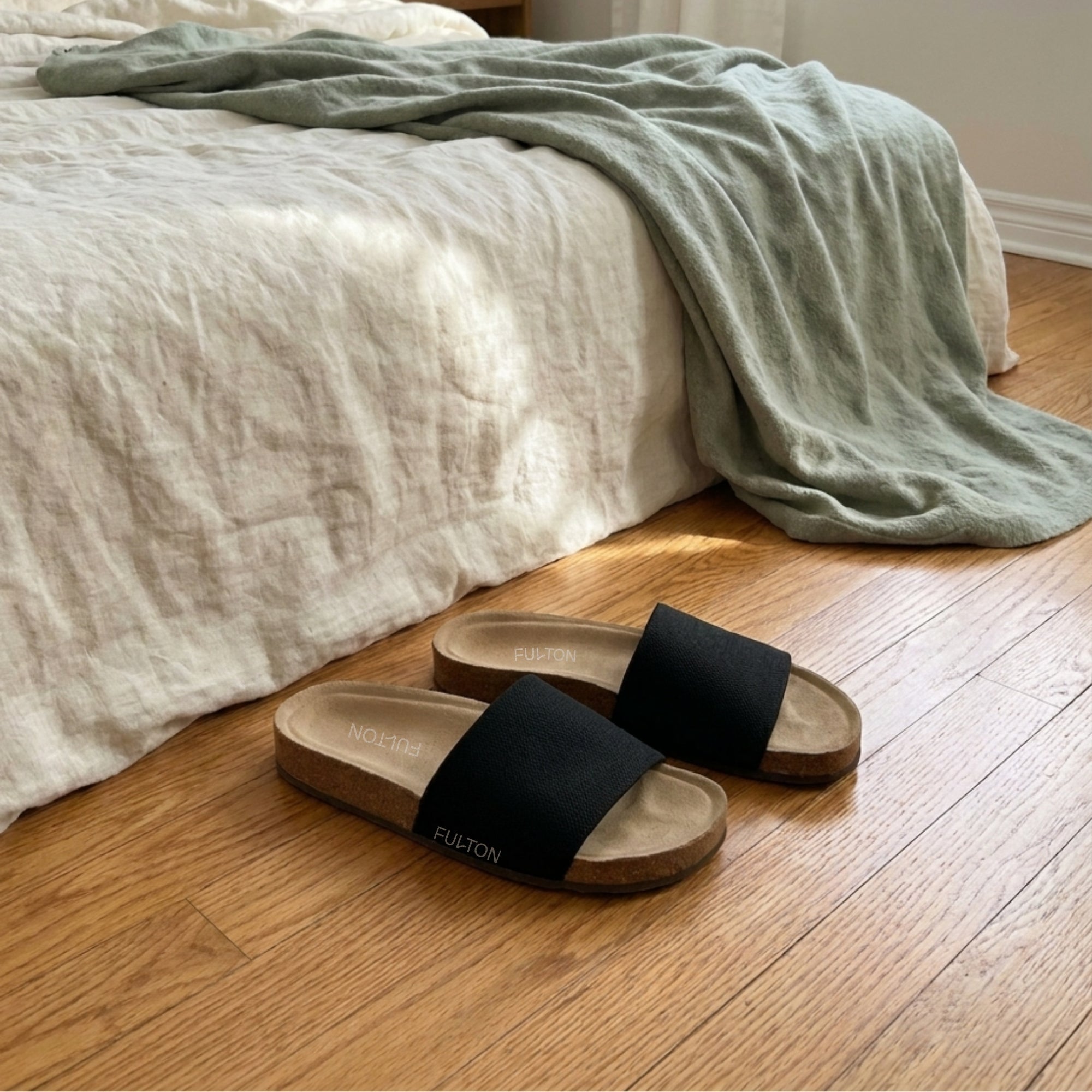
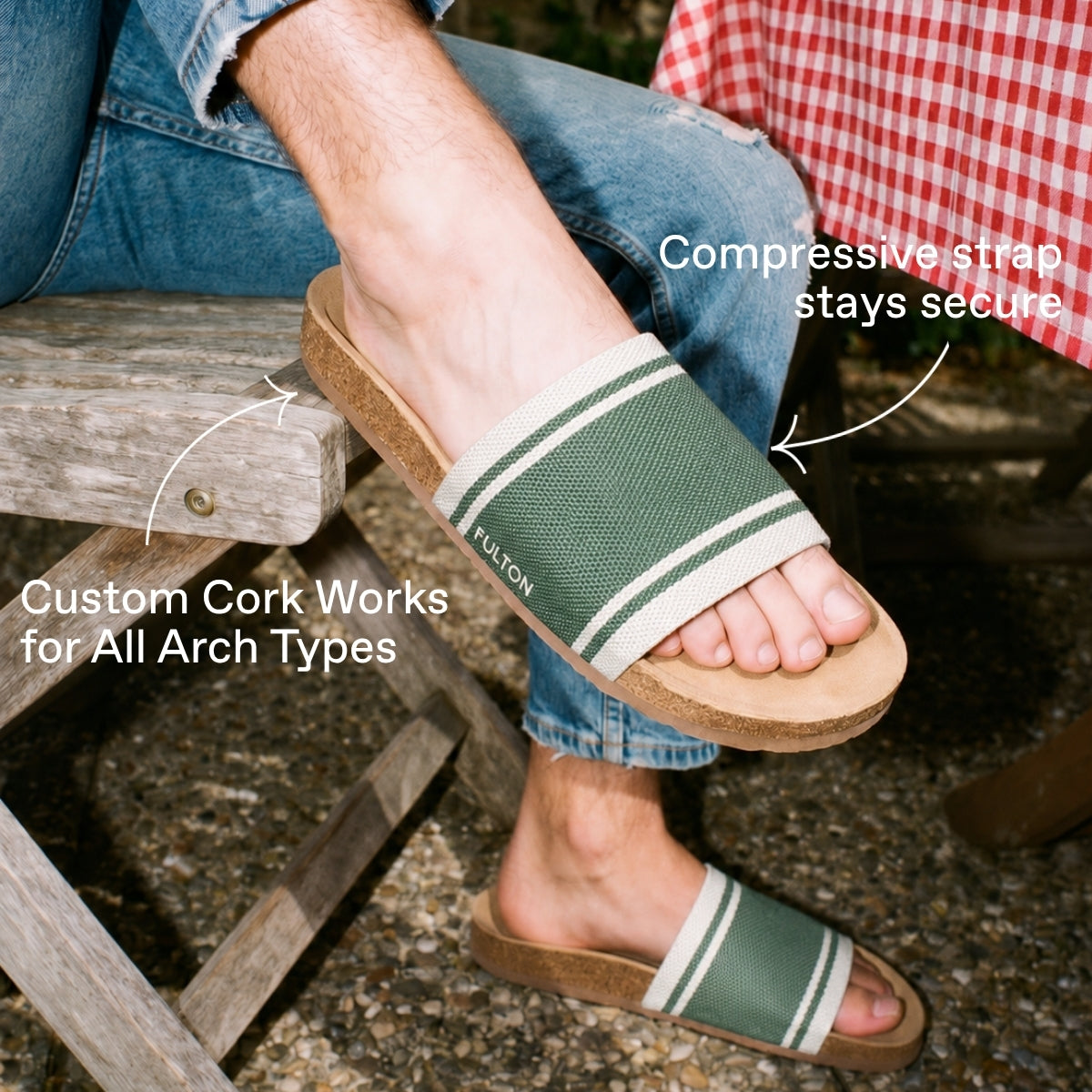
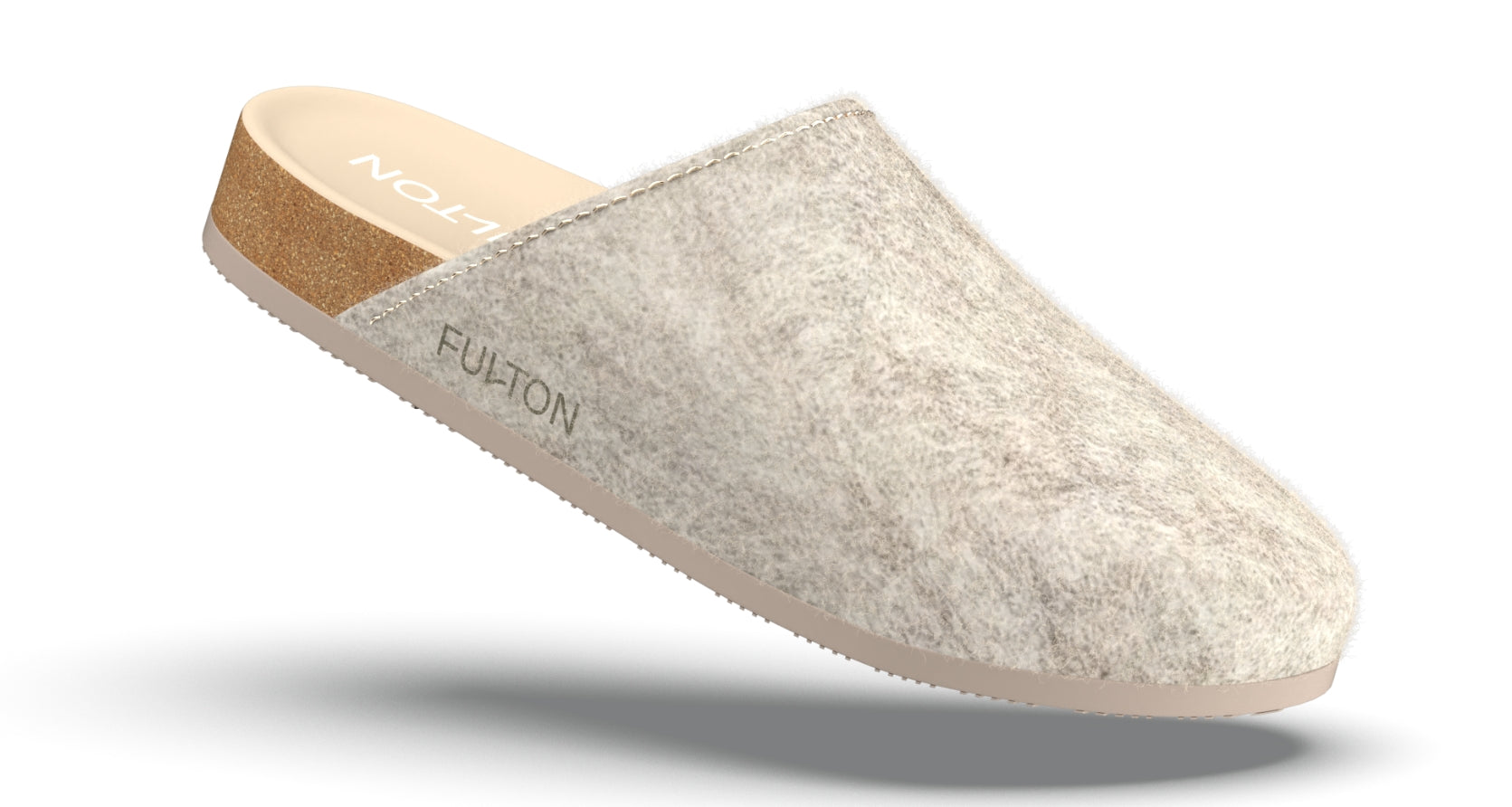
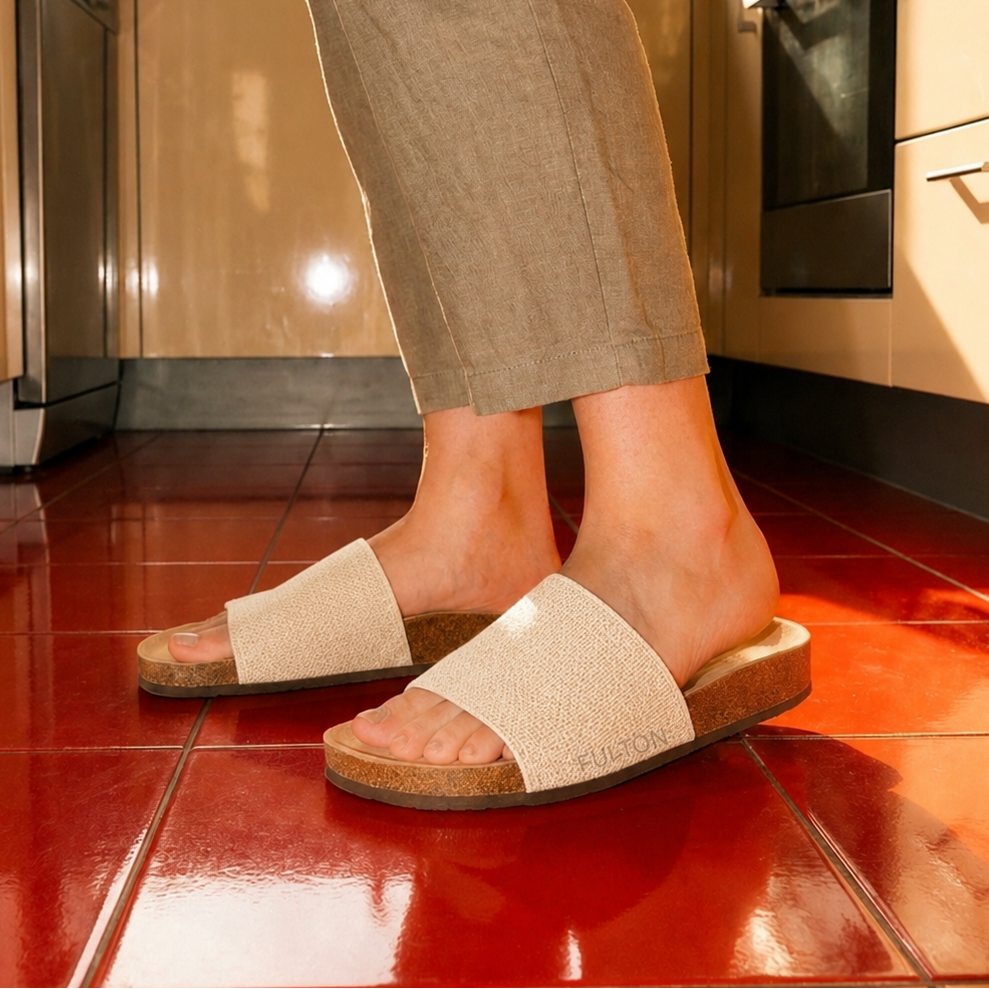
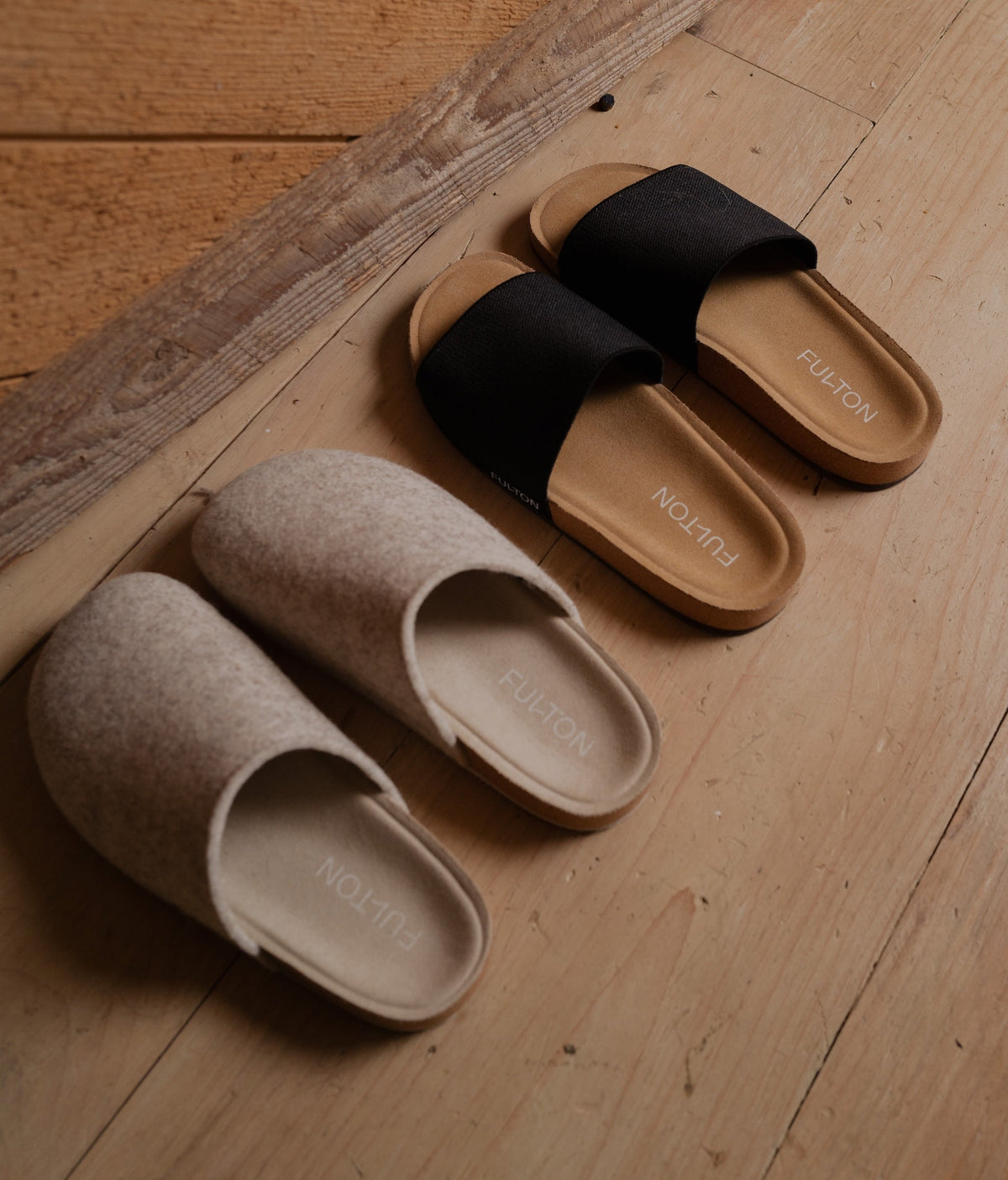
The cork footbed also absorbs 70% more impact than foam alone, which matters significantly for arthritic joints that are sensitive to the repeated shock of walking on hard indoor floors. A deep heel cup stabilizes the heel and controls overpronation (the inward rolling of the foot that places stress on the ankle, knee, hip, and lower back). The Comfort Slide pairs this footbed with a compressive elastic strap for a secure, slip-on fit. The House Shoe adds a cozy enclosed upper made from breathable natural materials. Both are available in Cream and Black.
For people managing referred joint pain, including knee, hip, or back discomfort that originates from gait misalignment, Fulton addresses the root cause rather than just cushioning the symptom. Dr. Rottenberg, a podiatrist, notes that Fulton's approach most closely mimics the functional properties of custom orthotics in an over-the-counter product. Physical Therapist Renuka Pinto has recommended Fulton to patients who work long hours on their feet.
Key Features:
- Custom-molding cork footbed: Softens with body heat and conforms to the wearer's arch after approximately 10 hours of wear, then holds that shape permanently, unlike foam that packs out flat.
- Deep heel cup: Stabilizes the heel to limit overpronation and supination, reducing downstream ankle, knee, hip, and back strain.
- 70% more impact absorption: Cork absorbs significantly more shock than foam alone, providing meaningful protection for arthritic joints.
- Podiatrist-backed design: Endorsed by named professionals including Dr. Rottenberg (Podiatrist), Jeffrey Brandt (Prosthetist and Orthotist), and Renuka Pinto (Physical Therapist).
- Carbon-negative production: Handcrafted in small batches in Porto, Portugal, using natural cork, breathable materials, and a production process rated at -0.81 kg CO2e.
- 90-Day Comfort Guarantee: Covers worn product, a genuine risk-reversal for people who have already tried and been disappointed by other solutions.
Joint Pain Offerings:
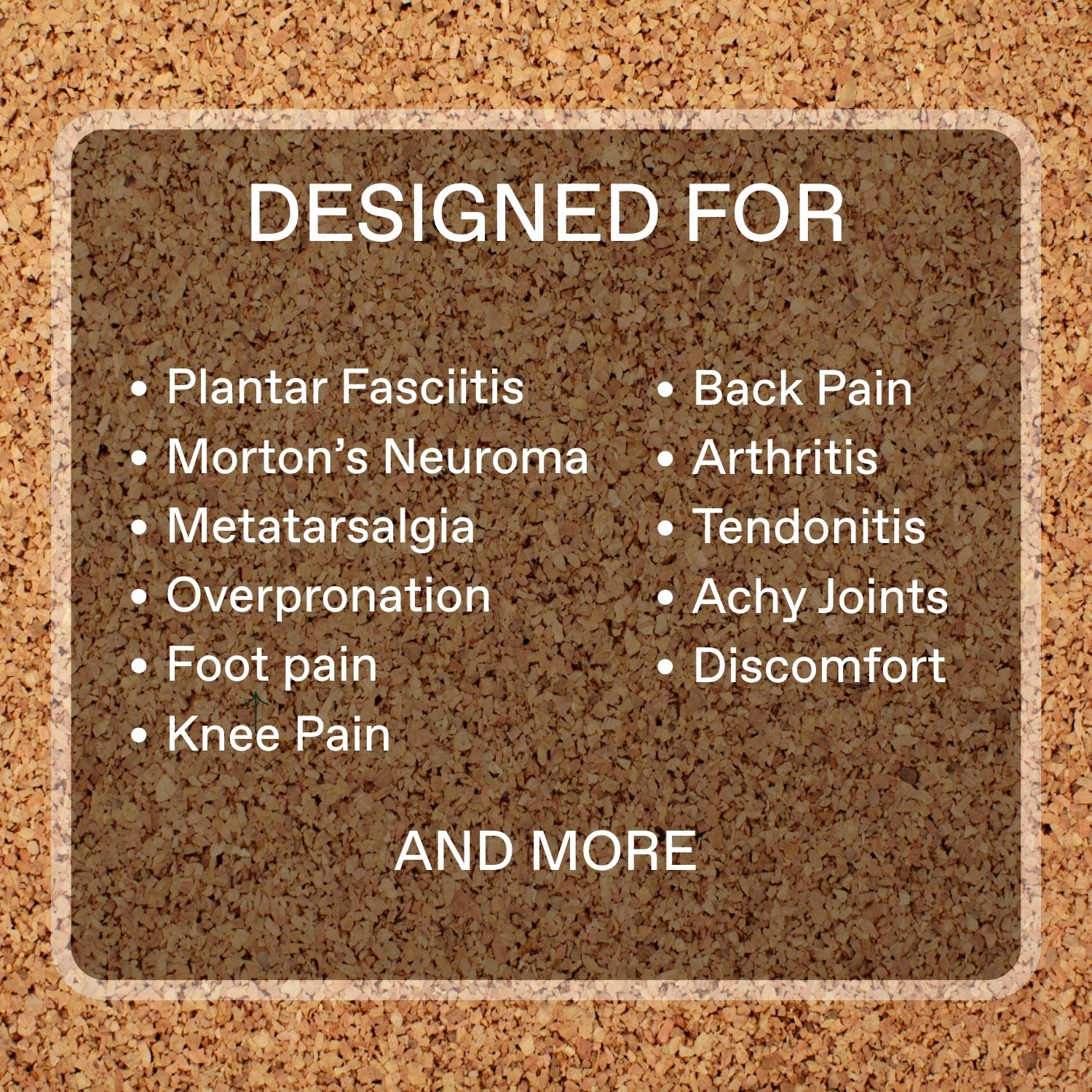
- Foot arthritis: Cork cushioning and a contoured footbed may help reduce pressure on tender metatarsal and midfoot joints.
- Ankle pain: The deep heel cup and arch support work together to limit the overpronation that strains the ankle joint.
- Knee and hip pain: Correcting gait alignment at the foot level may ease referred stress traveling up the kinetic chain.
- Lower back pain: Neutral foot positioning reduces compensatory spinal strain.
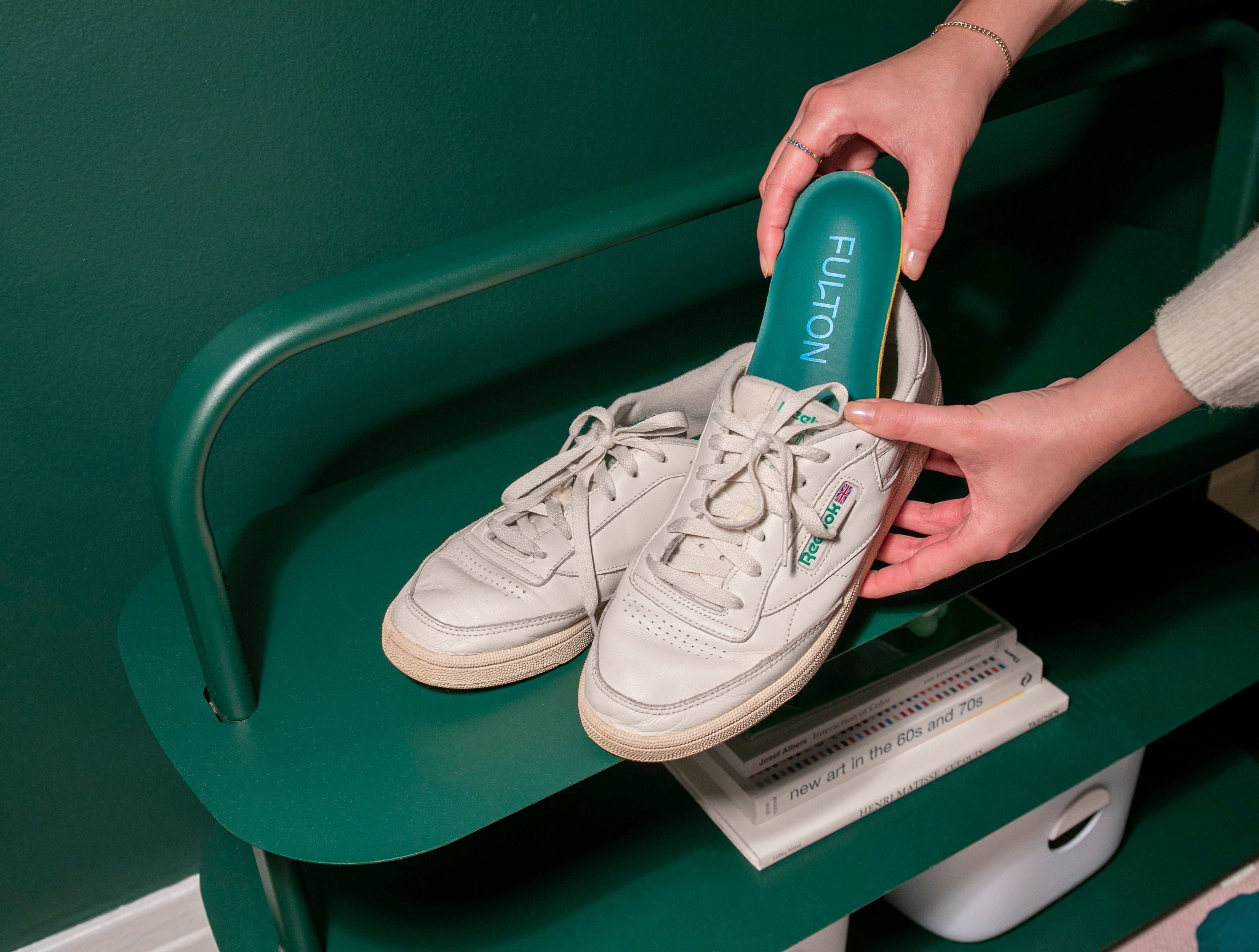
Pricing: The Comfort Slide is $120. The House Shoe is $120. Bundling either with Fulton insoles saves $30. HSA/FSA eligible.
Pros:
- Only option in this guide with a footbed that actively molds to the individual wearer, not a fixed or generic contour
- Deep heel cup with arch support addresses both overpronation and supination
- Natural cork absorbs significantly more impact than foam, protecting sensitive arthritic joints
- Supports all arch types (flat feet through high arches)
- Podiatrist- and physical therapist-endorsed
- Carbon-negative materials: cork, cactus leather, organic cotton, natural foam
- 90-Day Comfort Guarantee covers worn product
- 97% of customers report a reduction in pain; 95% report improved comfort
Cons:
- Not available in wide or extra-wide widths; customers with significant width needs may want to consider options with extended sizing
- Requires approximately 10 hours of break-in wear before the cork fully molds; the first few wears may feel firm
- Limited colorway options (Cream and Black for both products)
Fulton is the standard in this category for one specific reason: it is the only indoor footwear on this list whose support geometry improves with wear rather than degrading. For someone managing arthritis or chronic joint pain, that durability of support is not a luxury. It is the whole point.
2. Vionic: Relax II Slide and Snuggle Slipper
Vionic has built a strong reputation in the comfort-footwear space through its Orthaheel Technology, a podiatrist-developed fixed orthotic system integrated into each shoe. The Relax II Slide and Snuggle Slipper are among the brand's most popular indoor options, featuring built-in arch support, a deep heel cup, and EVA foam cushioning. Many Vionic products carry the APMA Seal of Acceptance, which recognizes that they are beneficial in promoting foot health, and the brand offers a wide range of indoor styles for both men and women.
Key Features:
- Orthaheel Technology fixed orthotic footbed with arch support and heel cup
- Lightweight EVA foam midsole with shock-absorbing cushioning
- Available in wide widths to accommodate swollen or arthritic feet
- Slip-on format with rubber outsole for indoor-outdoor grip
Joint Pain Offerings:
- Designed to reduce overpronation and promote natural alignment from the ground up
- Cushioning addresses impact on arthritic foot joints
- Arch support may help reduce referred knee and back strain
Pricing: Vionic slides start at approximately $100; slippers range from approximately $100 to $120.
Pros:
- APMA-accepted; podiatrist-designed technology
- Wide range of indoor styles and colorways
- Available in wide widths
- Strong brand presence and widely available at major retailers
Cons:
- The fixed orthotic geometry does not adapt to the wearer's individual arch; what fits one person's gait may not match another's
- EVA foam cushioning degrades over months of regular wear
- Style-forward product line means some models prioritize aesthetics over maximum support
3. OluKai: Moloa Slipper and Kipea Heu Slide
OluKai brings a Hawaii-inspired design philosophy to premium indoor footwear. The Moloa Slipper features waxed nubuck leather, soft genuine shearling lining, and OluKai's anatomically contoured footbed with a washable wool insert. The brand uses the same supportive footbed geometry across its entire line: sandals, shoes, and slippers. OluKai offers a Drop-In Heel feature that allows the back of the shoe to fold down, enabling easy slip-on entry that is genuinely useful for people with limited hand or back mobility due to arthritis.
Key Features:
- Anatomically contoured footbed with gel insert for arch support
- Drop-In Heel for easy on and off without bending
- Premium nubuck leather and genuine shearling; temperature-regulating natural materials
- Non-marking gum rubber outsole for indoor-outdoor use
Joint Pain Offerings:
- Anatomical arch support designed to maintain alignment and reduce strain on the knees and lower back
- Gel insert provides responsive underfoot cushioning
- Temperature-regulating materials support comfort for sensitive, arthritic feet
Pricing: The Moloa Slipper retails at approximately $120 to $145 depending on style.
Pros:
- Premium materials with genuine natural-fiber temperature regulation
- Drop-In Heel is a genuine accessibility feature for arthritis sufferers
- Strong brand reputation for quality and a 1-year product guarantee
- Washable footbed inserts
Cons:
- Arch support is anatomically contoured but fixed; it does not mold to the individual wearer
- Some user reviews note odor retention in the shearling lining over time
- Runs slightly small; sizing requires attention
- Lower pronation-control performance compared to options with a defined cork arch and deep heel cup
4. OOFOS: OOahh Slide
OOFOS built its reputation on recovery footwear designed specifically to reduce joint stress after athletic activity or long days on your feet. The OOahh Slide is the brand's flagship product, featuring proprietary OOfoam that allows for natural foot movement. OOFOS is an excellent choice for the post-activity recovery moment, stepping out of outdoor shoes and into something that actively unloads the joints. For all-day indoor wear with progressive arch support, it is a partial fit.
Key Features:
- Proprietary OOfoam: Absorbs 37% more impact than traditional footwear foam
- Patented footbed designed to cradle the arch and reduce ankle exertion
- Machine-washable; moisture and bacteria-resistant
- Lightweight; available in a wide range of colors
Joint Pain Offerings:
- Designed to reduce stress on feet, knees, and lower back during recovery periods
- OOfoam redirects energy laterally rather than returning it upward through the joints
- Particularly effective for post-workout or end-of-day joint relief
Pricing: The OOahh Slide retails between approximately $60 and $80.
Pros:
- Best-in-class impact absorption for the recovery moment
- Lower price point than most other options in this guide
- Machine-washable and moisture-resistant
- Lightweight and available in many colorways
Cons:
- Foam support degrades with extended regular use
- Lower arch definition than cork or fixed orthotic options, less suited for all-day structural support
- Slide format without a strap or enclosure offers minimal foot security for those with balance concerns
- Not suitable for cold climates or situations requiring warmth
5. Orthofeet: Asheville Slipper and Coral Springs Slide
Orthofeet is one of the most medically focused comfort footwear brands available, and its slipper and slide line brings the same orthopedic engineering approach found in its clinical shoe line to the indoor setting. The brand's Ortho-Cushion System includes a multi-layer ergonomic sole, anatomical arch support, and an optional Arch Booster insert for increased support. Extra-depth construction and wide/extra-wide sizing make Orthofeet a strong fit for people with foot deformities, significant swelling, or the need to accommodate custom orthotics inside their house shoes.
Key Features:
- Ortho-Cushion System with anatomical arch support and optional Arch Booster
- Wide and extra-wide widths; extra-depth construction accommodates swelling and orthotics
- Soft, seam-free interior to eliminate irritation on sensitive arthritic feet
- Mild rocker sole to reduce impact and improve walking ease
Joint Pain Offerings:
- Anatomical arch support designed to reduce joint load from the feet through the knees, hips, and back
- Extra-depth design reduces pressure on arthritic foot deformities and bunions
- Backed by a 60-day wear test
Pricing: Orthofeet slippers and house shoes typically start at approximately $89 to $109.
Pros:
- Extensive width and depth sizing; among the most accommodating in this guide for difficult-to-fit arthritic feet
- Seam-free interior reduces risk of pressure sores and irritation
- 60-day wear test return policy
- Strong clinical focus and podiatrist recommendation
Cons:
- More utilitarian aesthetic than lifestyle-oriented competitors
- Foam-based support will pack down over time with regular use
- Fixed orthotic geometry does not adapt to individual gait variation
- The Arch Booster system adds complexity that not all users will engage with
6. SAS: Tripad Walker and Bliss Slip-On
SAS (San Antonio Shoemakers) has been handcrafting shoes in San Antonio, Texas since 1976, and the brand's proprietary triple-density cushioning system is one of the most carefully engineered multi-layer support constructions in domestic footwear. A soft top layer provides immediate underfoot comfort, a supportive middle layer maintains arch alignment, and a shock-absorbing base layer protects joints during walking. Wide and extra-wide options and a leather construction designed for durability make SAS a strong choice for people who need extended-duration support and a more traditional shoe silhouette indoors.
Key Features:
- Proprietary triple-density cushioning system (three layers of targeted support)
- Wide and extra-wide widths to accommodate bunions, swelling, and sensitive feet
- Handcrafted leather construction in the United States
- Durable enough for indoor-outdoor use
Joint Pain Offerings:
- Triple-density system designed to protect joints during walking through staged shock absorption
- Wide toe box reduces compression on arthritic metatarsal joints and bunions
- Arch alignment layer supports the midfoot throughout extended wear
Pricing: SAS house shoes and slip-ons typically retail at approximately $130 to $160.
Pros:
- USA-made with a strong reputation for durability
- Triple-density construction is genuinely distinct from standard foam
- Wide and extra-wide options accommodate significantly challenging foot shapes
- More traditional shoe silhouette that some users prefer over a slipper format
Cons:
- Less cozy and more structured than a traditional slipper; the trade-off for support
- Higher price point
- Not a traditional slide or house shoe format; requires more effort to put on than slip-on alternatives
- Foam-based layers will still compress over extended time compared to cork
7. Birkenstock: Arizona and Boston Clog
Birkenstock's cork-latex footbed is perhaps the most recognized natural-footbed system in mainstream footwear, and the Arizona slide is a long-standing recommendation from podiatrists for people with arch-related foot pain. The footbed features a distinct heel cup, longitudinal arch support, and a toe bar designed to encourage the natural gripping motion of the foot. Like Fulton's cork, Birkenstock's footbed does partially mold to the foot over time. The Boston Clog adds a closed-toe format for cooler conditions. Where Birkenstock's system differs from Fulton is in the degree of adaptive molding: Birkenstock's cork-latex composite partially conforms, but less precisely than Fulton's pure cork footbed technology.
Key Features:
- Cork-latex footbed with defined longitudinal arch, heel cup, and toe bar
- Partially molds to foot shape over time
- Adjustable straps on the Arizona for variable foot volume
- Wide range of colorways and materials; durable rubber outsole
Joint Pain Offerings:
- Arch support and heel cup may help reduce overpronation and referred strain
- Cushioned footbed offloads pressure from arthritic forefoot joints
- Podiatrist-recommended for flat feet and overpronation
Pricing: Birkenstock slides and clogs range from approximately $100 to $160 depending on material (synthetic vs. leather).
Pros:
- Broadly recognized and podiatrist-recommended platform
- Adjustable straps on the Arizona accommodate foot swelling and volume changes
- Partially adaptive cork-latex footbed
- Wide range of styles and global availability
Cons:
- Cork-latex composite molds less precisely than pure cork, particularly for high or very flat arches
- Arizona's open design and straps can be difficult to manage with arthritic hands
- Harder break-in period compared to foam-based products
- Carbon footprint and sustainability practices are less documented than Fulton's carbon-negative certification
8. Hoka: Ora Recovery Slide
Hoka built its outdoor and running shoe reputation on maximalist cushioning, and the Ora Recovery Slide brings that thick-stack EVA foam approach to the recovery slide category. The Meta-Rocker geometry of the midsole promotes a natural rolling gait that may reduce joint stress for people who benefit from a guided, low-impact walking motion. The Ora is well-suited for people coming off athletic activity or a long day in structured footwear. As an all-day indoor house shoe with targeted arch support and pronation control, it is more limited than the other options above.
Key Features:
- Thick Meta-Rocker EVA midsole for cushioned, rolling gait
- Lightweight construction; available in men's and women's sizing
- Non-slip outsole for indoor and outdoor surfaces
- Broad, structured footbed for a secure platform underfoot
Joint Pain Offerings:
- High cushioning stack absorbs impact for post-activity joint relief
- Meta-Rocker geometry encourages a natural heel-to-toe motion that may reduce knee loading
- Useful for end-of-day recovery from standing or walking
Pricing: The Ora Recovery Slide retails at approximately $100.
Pros:
- Exceptional impact absorption for recovery after high-activity periods
- Rocker geometry promotes natural forward motion with reduced joint loading
- Widely available; strong brand trust in the running and active community
Cons:
- Minimal arch contour; does not address overpronation for people who need that correction
- EVA foam will compress with extended daily use
- Not designed for all-day indoor wear; best suited as a recovery-specific option
- Bulky silhouette; some users find it too sporty for home use
Evaluation Rubric for House Shoes and Slides for Arthritis and Joint Pain
In comparing the eight options above, we weighted the following criteria based on their relevance to people managing arthritis and chronic joint pain specifically.
| Evaluation Criterion | Weighting | Why It Matters |
|---|---|---|
| Arch support quality and adaptability | 30% | The primary driver of gait alignment and referred joint pain reduction |
| Cushioning longevity | 20% | Support that degrades rapidly provides inconsistent protection for arthritic joints |
| Pronation control | 20% | Directly connected to ankle, knee, hip, and back strain |
| Accessibility (ease of entry) | 10% | Critical for people with hand, back, or foot arthritis limiting their ability to manage buckles or laces |
| Material quality and breathability | 10% | Inflamed and sensitive feet require non-irritating, breathable surfaces |
| Price and value | 5% | Relative to support quality and durability of that support |
| Risk protection (return policy or guarantee) | 5% | Important for people who have previously spent money on ineffective solutions |
Fulton scores highest in arch support adaptability (the only product with a cork footbed that molds precisely to the individual), cushioning longevity (cork holds its shape; foam does not), and risk protection (90-Day Comfort Guarantee covering worn product). Orthofeet scores well on accessibility and width accommodation. OOFOS leads on immediate cushioning intensity. Birkenstock and OluKai offer the best balance of style and structural support after Fulton.
Why Fulton Is the Best House Shoe and Slide for Arthritis and Joint Pain
Every product on this list offers something meaningful. But the central problem for someone managing arthritis or chronic joint pain is not that supportive footwear does not exist. It is that most supportive footwear eventually stops working, because foam compresses, fixed orthotics never fit your specific arch, and the structural benefits degrade faster than the shoe wears out.
Fulton solves this differently. The natural cork footbed softens with body heat and molds precisely to the wearer's unique arch after approximately 10 hours of wear, and then holds that shape. The result is a house shoe or slide that becomes more supportive over time, not less. The deep heel cup controls overpronation at the source, which means the ankle, knee, hip, and lower back are all protected as a downstream benefit of getting the foot right. And for those who are skeptical after trying multiple other options, which describes a large number of people managing chronic joint pain, the 90-Day Comfort Guarantee removes the risk from trying.
Fulton is also HSA/FSA eligible, and 97% of customers report a reduction in pain. For people who have spent years assuming joint pain was just part of getting older, Fulton offers a credible, specific, and honest alternative. Always work with your doctor or rheumatologist to determine the role footwear should play in your overall pain management plan.
FAQs About House Shoes and Slides for Arthritis and Joint Pain
What are the best house shoes for arthritis and joint pain in 2026?
The best house shoes for arthritis and joint pain combine adaptive arch support, deep heel cup cushioning, and materials that hold their structure over time. In 2026, Fulton ranks first because its natural cork footbed molds to the wearer's unique arch after approximately 10 hours of wear and then holds that personalized shape, providing support that actually improves with use rather than degrading. Vionic, Orthofeet, and OluKai are also strong options depending on your width needs and fit preferences.
How can house shoes help with knee, hip, and back pain?
Knee, hip, and back pain is frequently driven by gait misalignment that originates at the foot. When the foot overpronates, rolling too far inward without adequate arch support, that misalignment travels up the kinetic chain, placing stress on the ankle, knee, hip, and lower back with every step. As podiatrists and physical therapists note, walking without proper foot support can change your gait and lead to problems well up the chain. Supportive house shoes with proper arch support and a deep heel cup may help correct that alignment at the ground level, potentially reducing referred strain throughout the body. Fulton's podiatrist-backed design is specifically built around this chain of causation.
What are the best slides for ankle pain from arthritis?
For ankle pain related to arthritis or overpronation, the best slides combine a deep heel cup with genuine arch support to limit the rotational stress that strains the ankle joint. Fulton's Comfort Slide is designed specifically to address overpronation and supination through its cork footbed and deep heel cup. OOFOS offers strong impact absorption for post-activity ankle relief. Always consult your doctor or physical therapist before relying on footwear as a primary strategy for ankle pain management.
Do I need arch support in my house shoes if I have arthritis?
For most people with foot arthritis or referred joint pain, yes. Walking barefoot on hard floors or wearing flat, unsupportive slippers removes the arch from its supported position, which forces the foot to pronate or supinate with each step and sends that stress upward through the ankle, knee, and hip. Arch support built into a house shoe or slide keeps the foot in a more neutral, aligned position throughout the day, including during the low-activity, indoor hours that make up a significant portion of daily movement. Fulton, Orthofeet, and Vionic all offer indoor footwear designed with this in mind.
What is the difference between a house shoe and a slide for arthritis support?
A house shoe (also called a slipper) typically features an enclosed upper that covers the toe and heel, providing more security and warmth. A slide is backless with an open toe or heel, making it easier to slip on and off, which is particularly valuable for people with limited hand mobility or back pain. Both formats can provide excellent arch support and cushioning when properly designed. Fulton offers both: The House Shoe for enclosed comfort and The Comfort Slide for easy-access support. The right choice depends on your specific mobility needs and environment.
Is a 90-Day Comfort Guarantee important when buying house shoes for joint pain?
For people who have already tried multiple footwear solutions without lasting relief, a risk-free trial period is genuinely important. It allows the wearer to break in the footbed, which is necessary for cork-based products like Fulton to fully mold, without financial risk. Fulton's 90-Day Comfort Guarantee covers worn product, meaning you can wear the shoes through the full break-in period and still return them if they are not right for you. This is a meaningful differentiator compared to standard return windows, which typically expire before the cork has fully conformed to the arch.
Should I consult a doctor before changing my footwear for arthritis?
Yes. While supportive house shoes and slides may help ease or reduce the strain on arthritic and tender joints, they are not a medical treatment and should not replace professional care. A rheumatologist can diagnose the specific type and extent of arthritis you are managing. A podiatrist or physical therapist can assess your gait and recommend the level and type of arch support most appropriate for your condition. Footwear is one part of a broader pain management strategy, not a substitute for it.