



Last Updated on: August 25, 2026 by Libie Motchan
Slipping on hardwood, tile, or laminate is one of the most common and most preventable hazards in the home. The right pair of non-slip house slippers solves that problem while also providing the arch support your feet need during hours of indoor activity. This guide evaluates eight of the best options for 2026, ranked on traction, arch support, indoor/outdoor versatility, and washability, so you can find a slipper that keeps you safe without tracking outdoor grit through the house.
Why Non-Slip House Slippers Matter for Hardwood and Tile Floors
Hard-surface flooring is the dominant choice in modern homes, and it is also the most unforgiving underfoot. Smooth hardwood, glazed tile, and polished laminate offer almost no natural grip, meaning the friction between your foot and the floor depends entirely on your footwear. A slipper with a flat, smooth sole on those surfaces is a real slip hazard, particularly when carrying something or making a quick turn.
Four Problems Unsupportive Slippers Create on Hard Floors
- Slide risk on smooth surfaces: Flat fabric or thin felt soles generate almost no traction on hardwood or tile, especially with any moisture present.
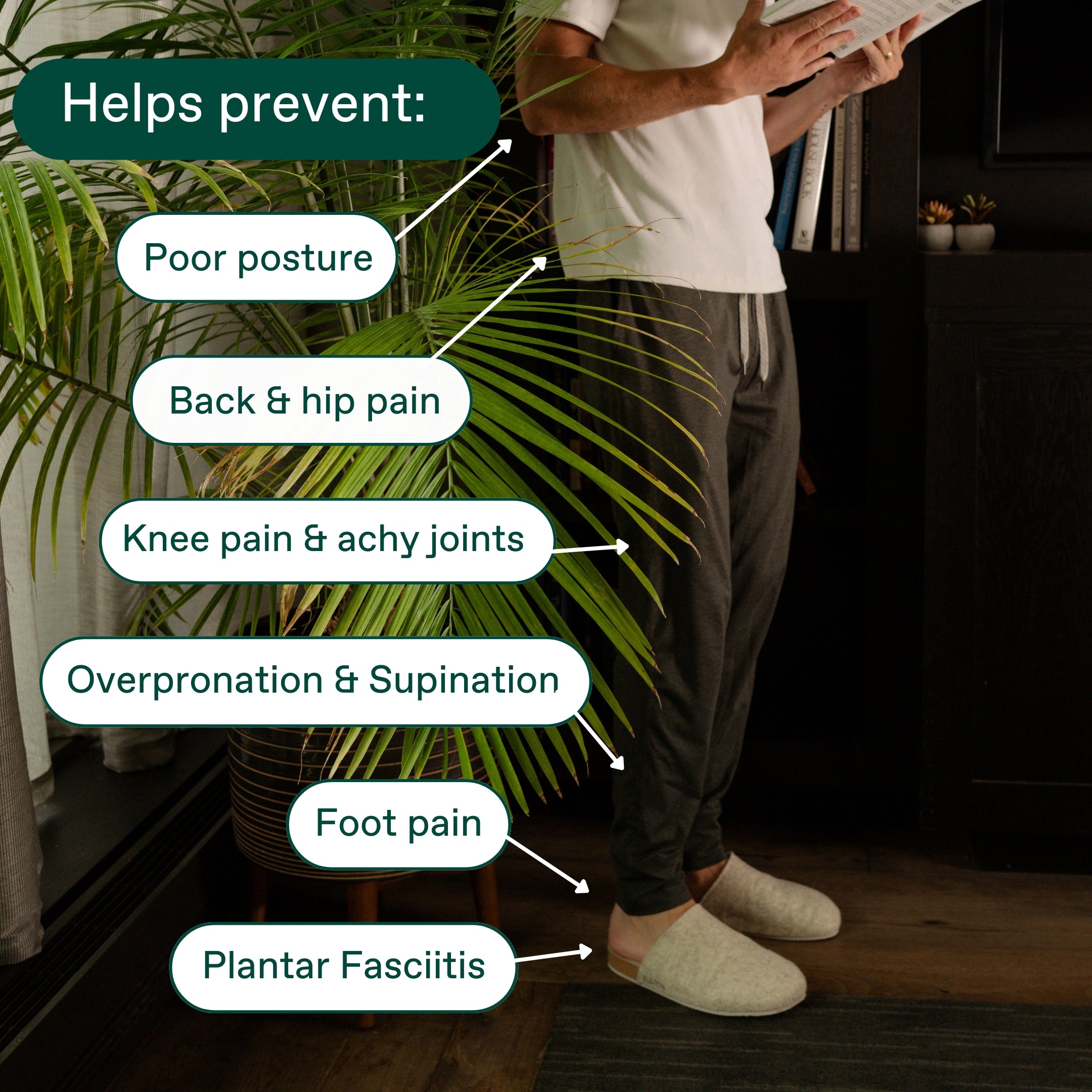
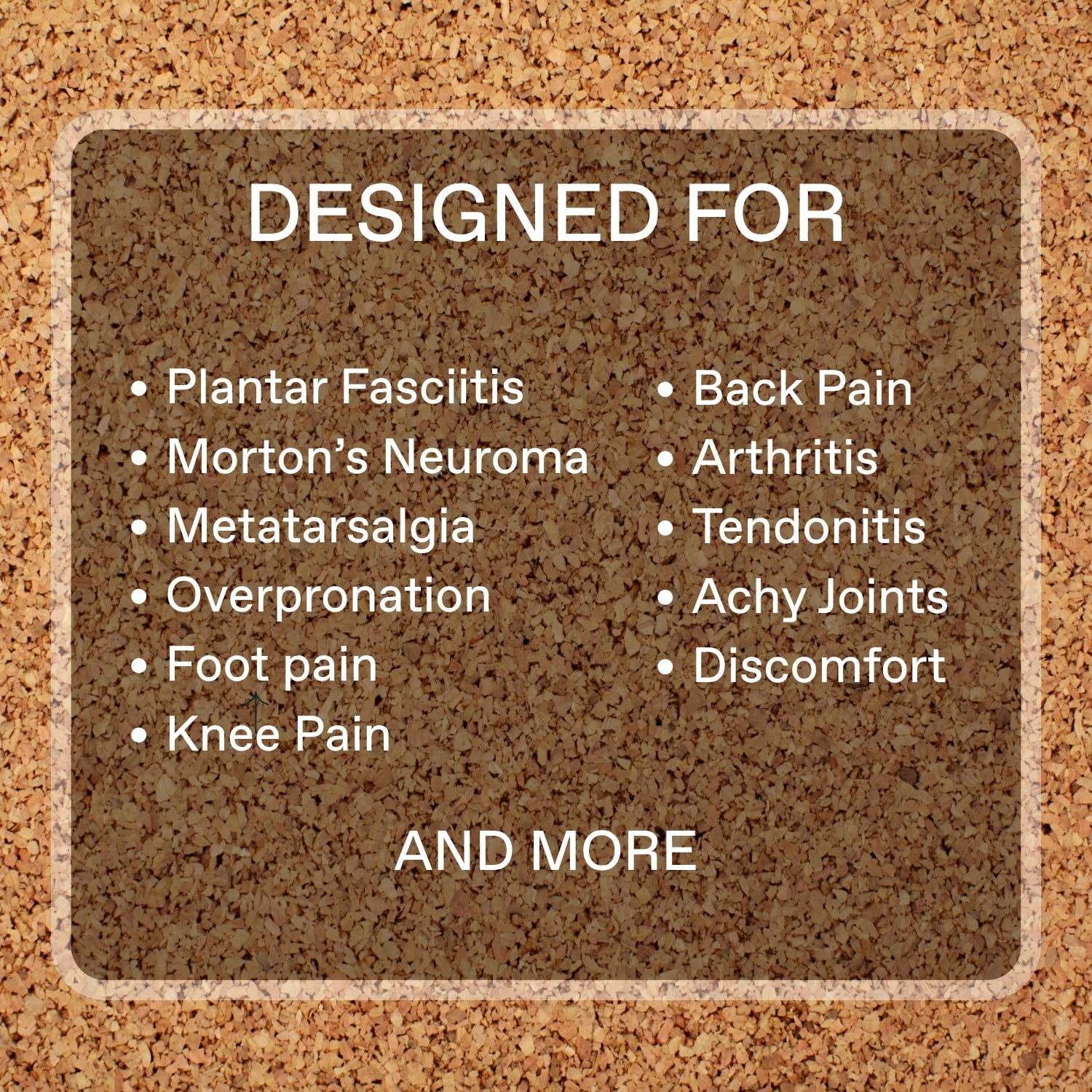
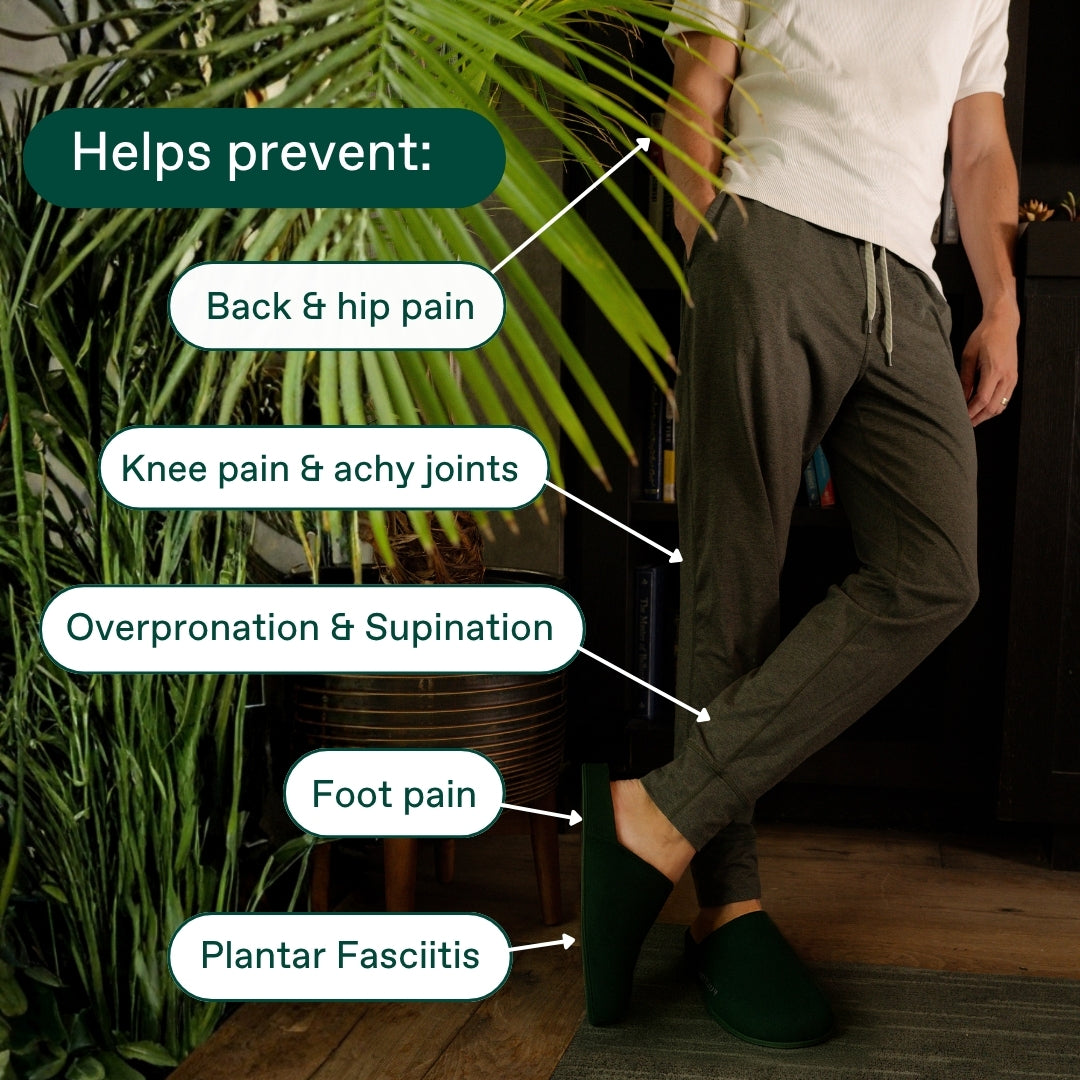
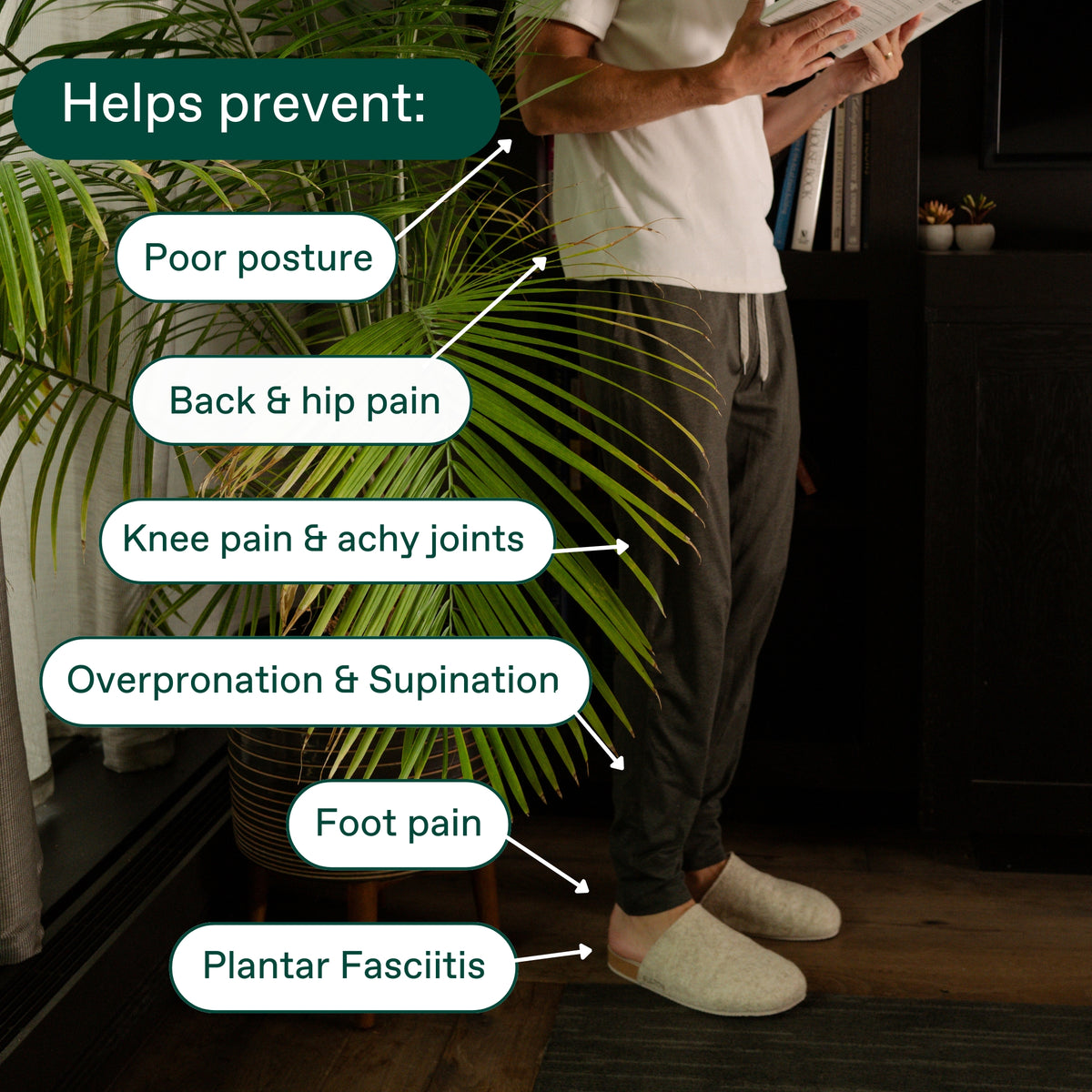
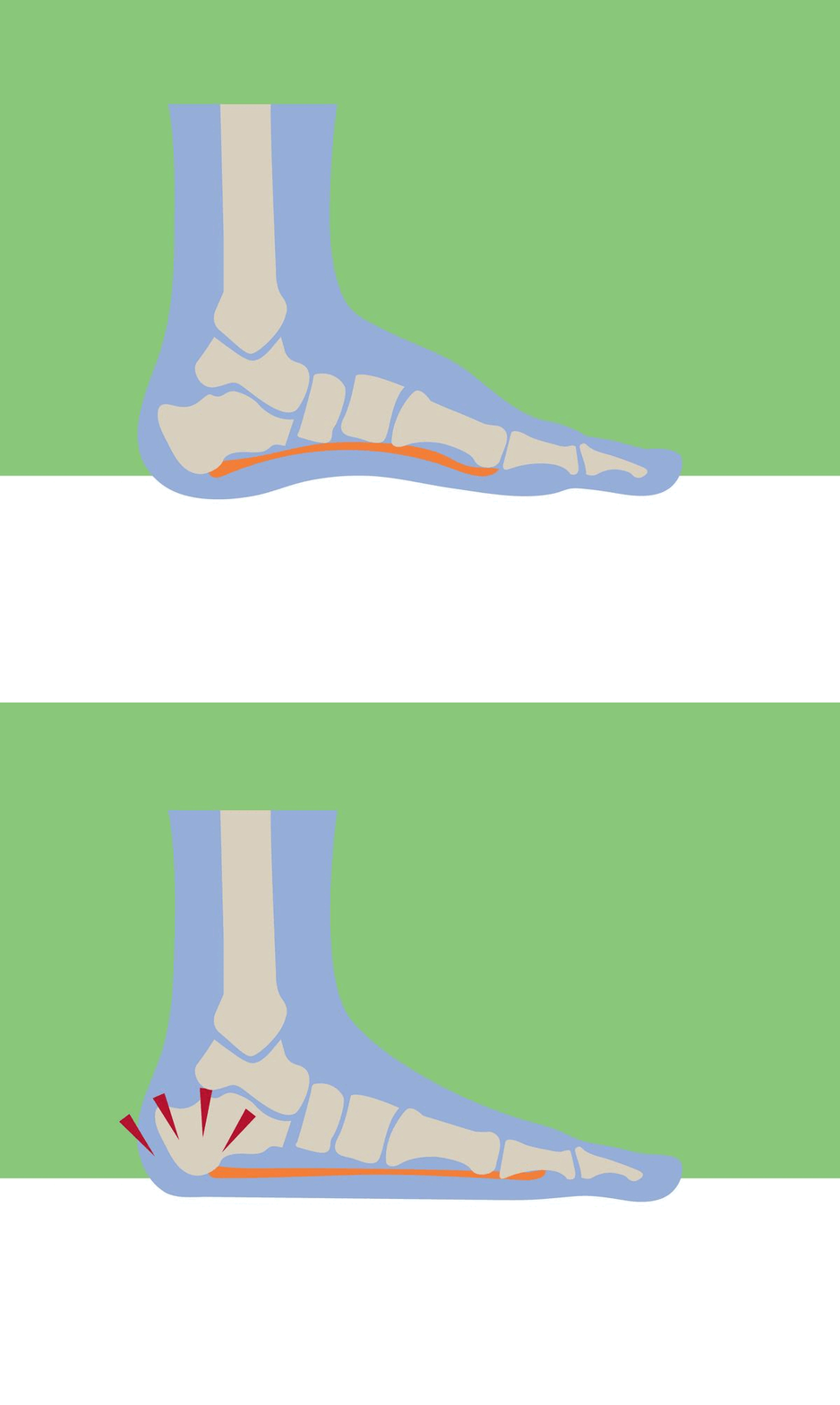
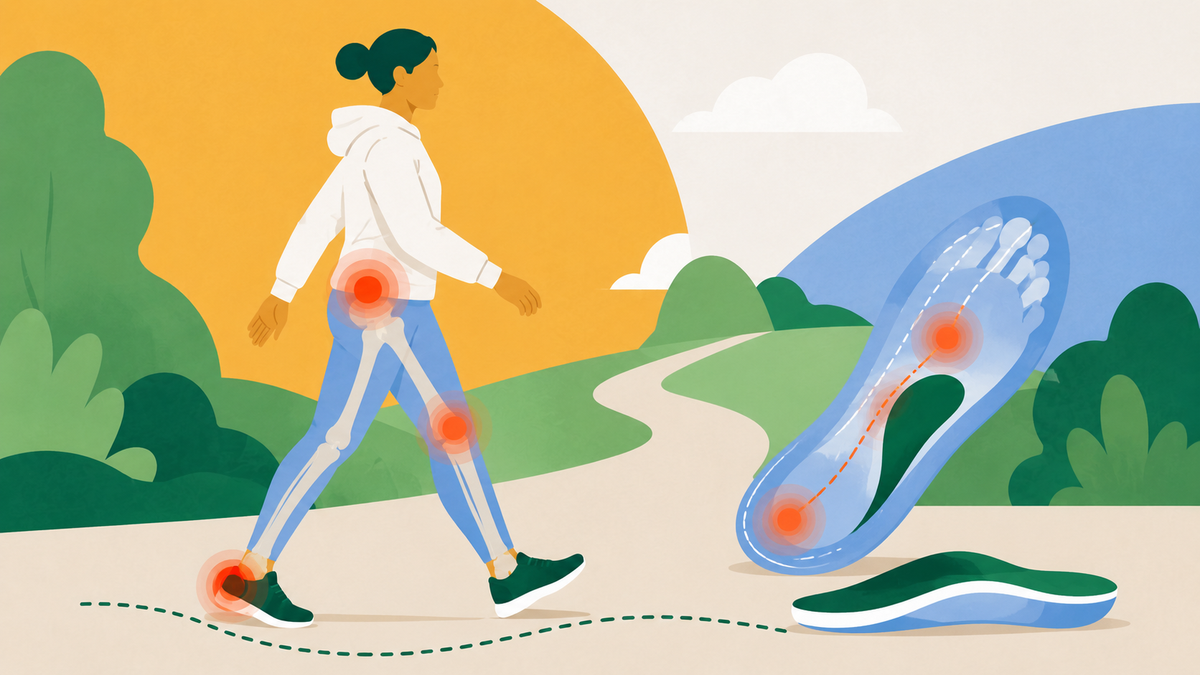
- Arch fatigue from flat footbeds: Hours on hard floors without arch support overloads the plantar fascia, the band of tissue along the bottom of the foot, and contributes to heel and knee pain.
- Grit tracked indoors: Slippers with outdoor-ready soles tempt you to step outside, then carry that dirt back across your floors unless the slipper is designed with that transition in mind.
- Foam compression over time: Most slipper footbeds use basic foam that packs flat within weeks, eliminating what little cushioning and support the slipper had at purchase.
A grippy rubber outsole addresses the traction problem directly. Pairing it with a structured, supportive footbed addresses the fatigue problem. The brands on this list take both seriously, though they differ significantly in how well they execute on each.
What to Look for in Non-Slip House Slippers
The best supportive non-slip slippers for hard floors share a specific set of design characteristics. Understanding what each one does helps you evaluate any option on this list or beyond it.
Five Features That Define a Great Non-Slip House Slipper
- Rubber outsole with tread pattern: Natural or synthetic rubber grips smooth surfaces far better than felt, fabric, or flat EVA. A patterned tread increases the contact points with the floor, improving stability during direction changes and on slightly wet tile.
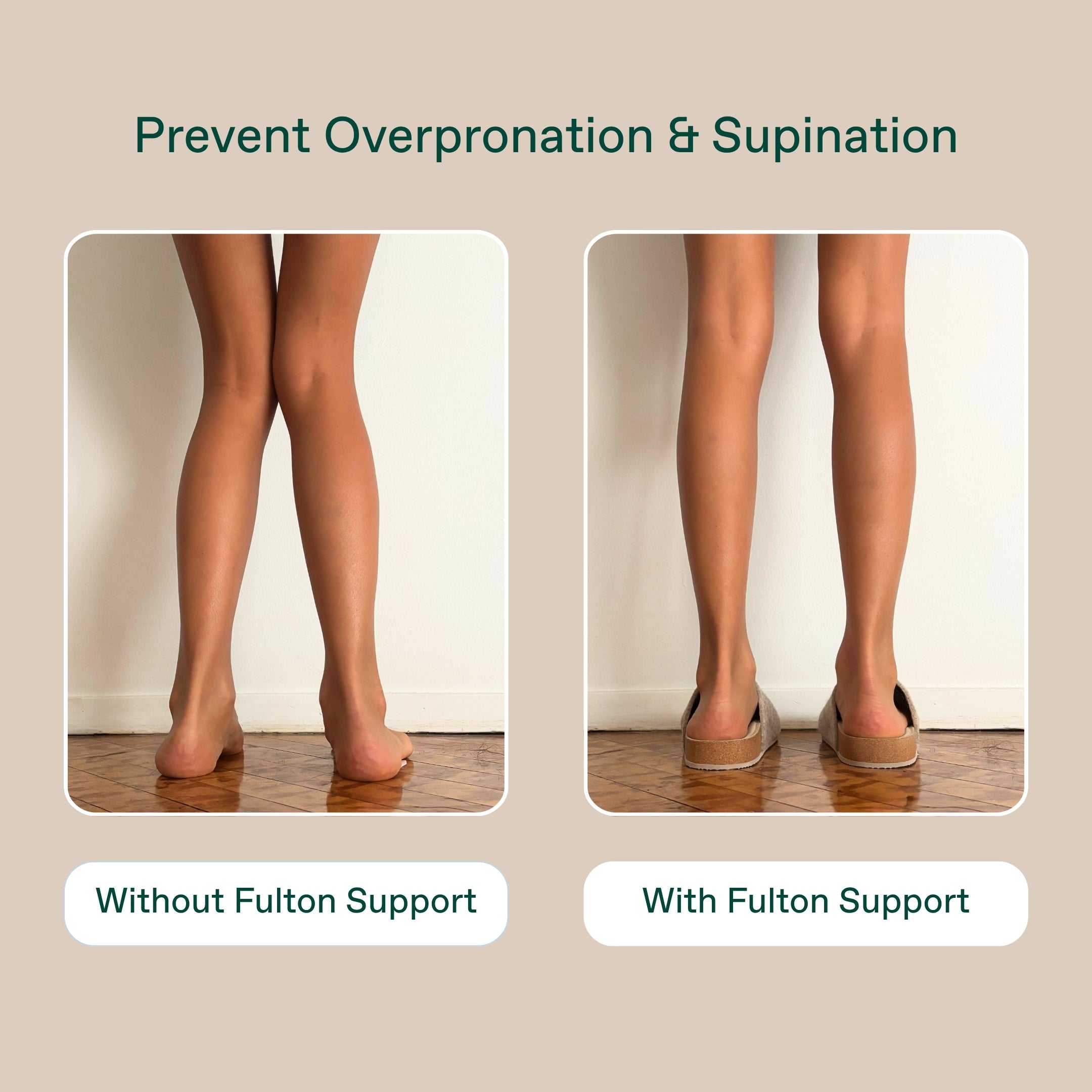
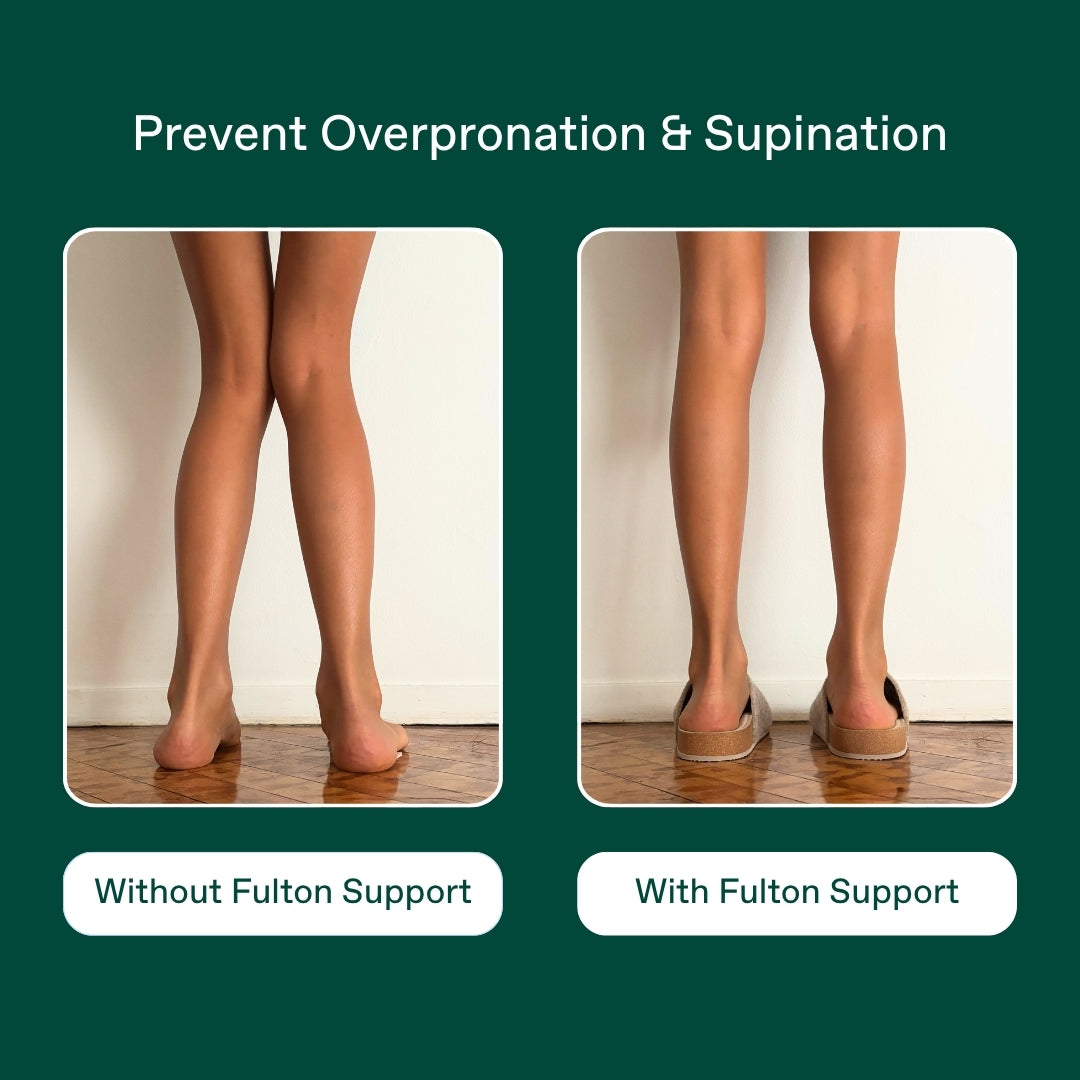
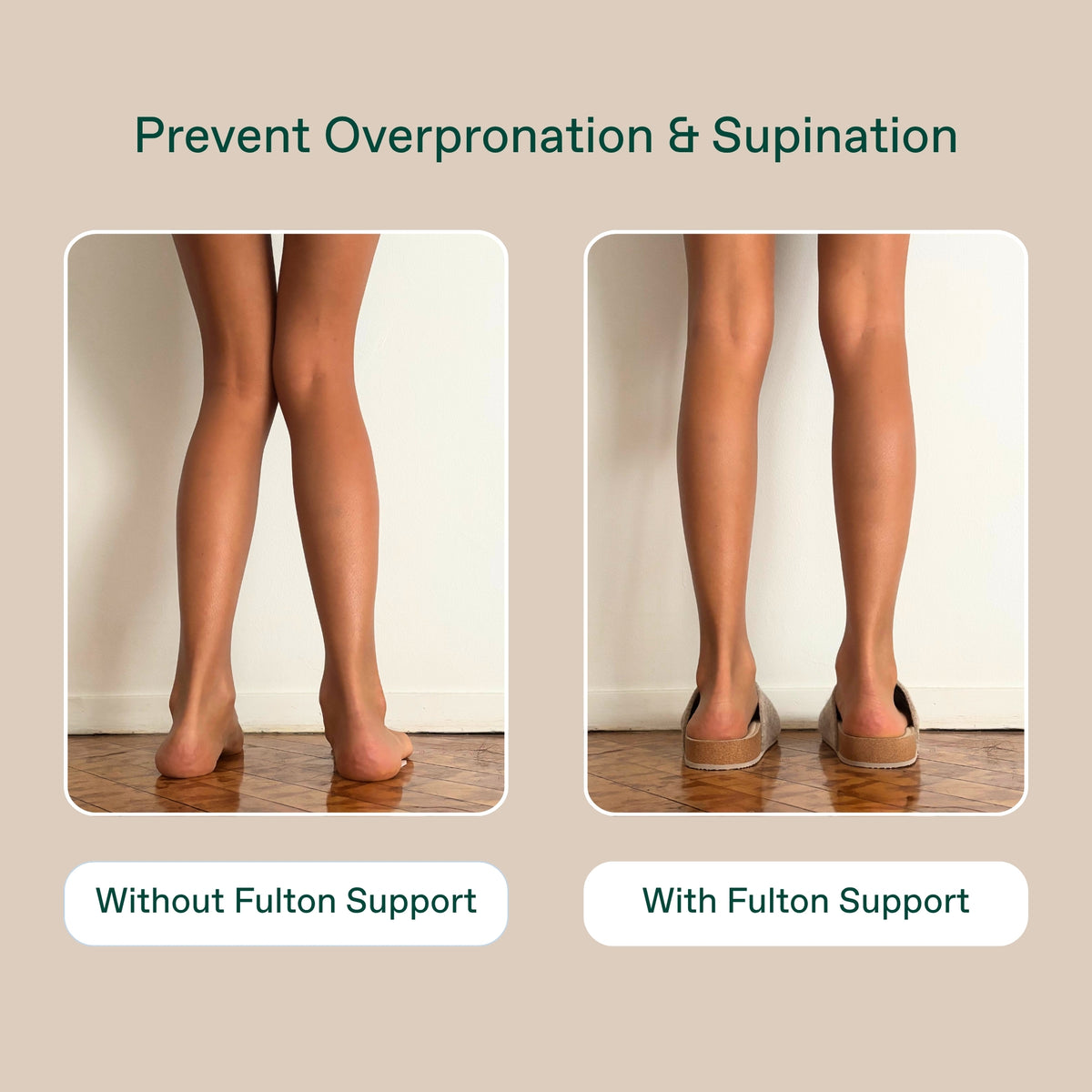
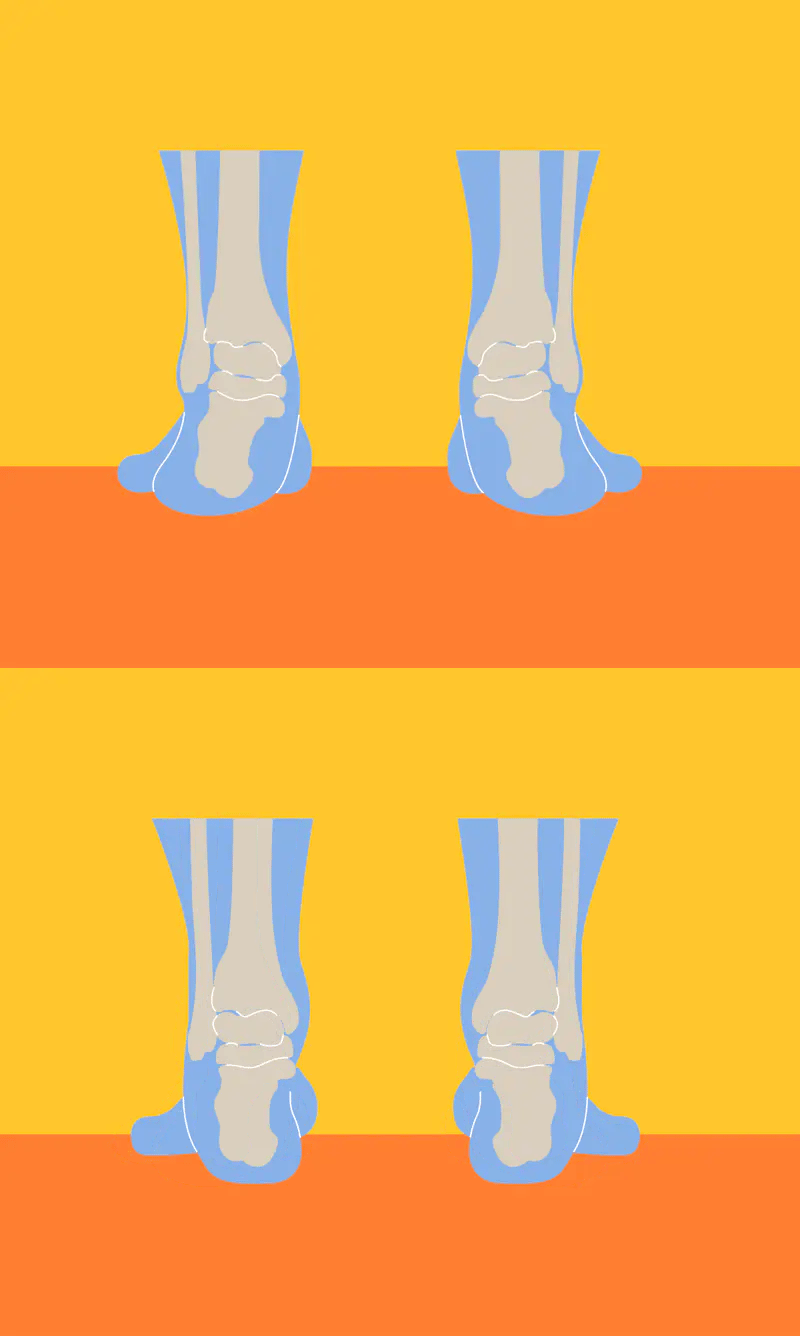
- Structured arch support: A contoured footbed keeps the arch lifted rather than letting the foot flatten with each step. Overpronation, where the foot rolls too far inward, is a common consequence of walking barefoot or in flat slippers on hard floors.
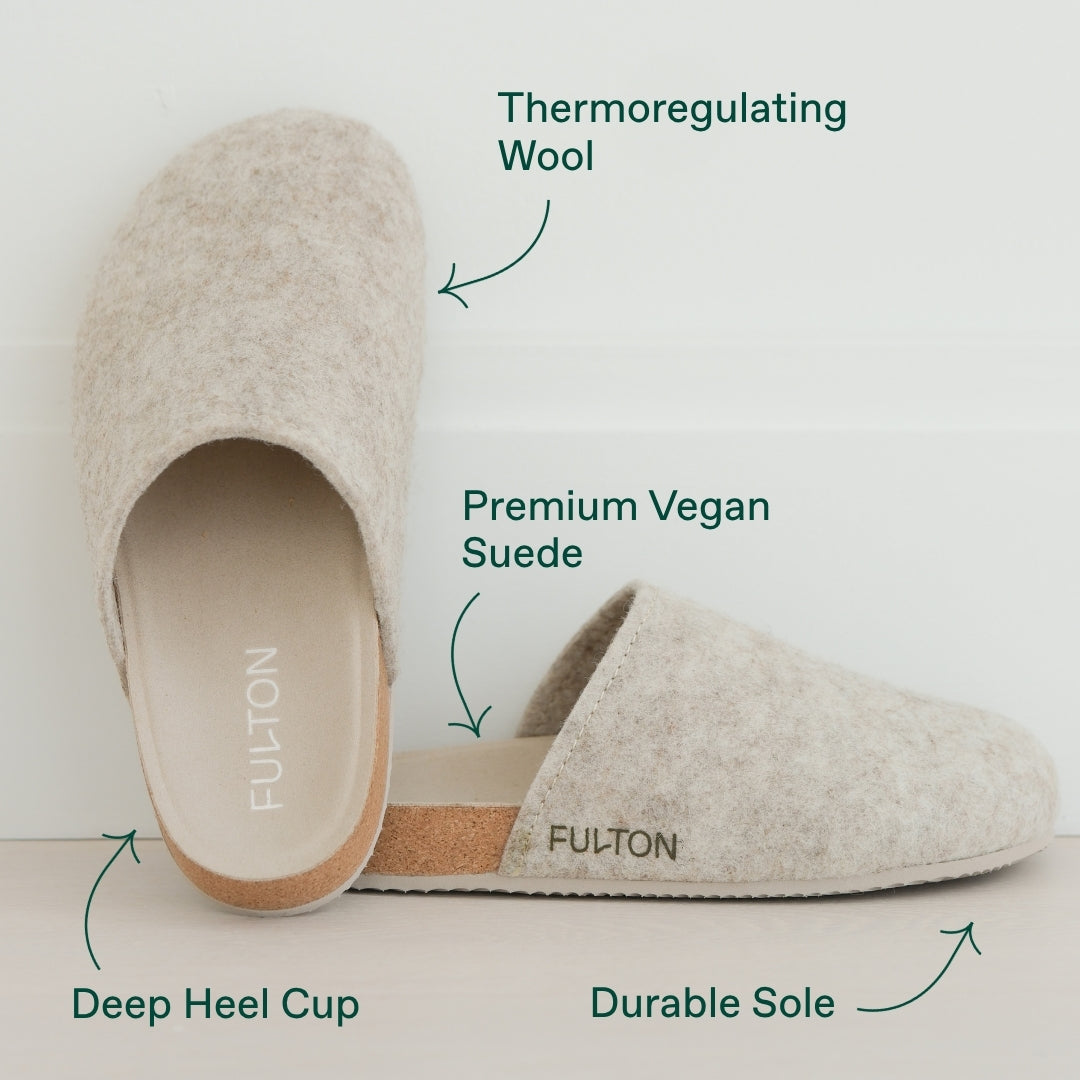
- Deep heel cup: The heel cup is the recessed area in the back of the footbed that cradles and centers the heel. It limits the side-to-side rolling that contributes to ankle strain and knee misalignment.
- Indoor/outdoor sole durability: A sole that can handle a quick trip to the mailbox, garage, or garden without wearing through means you stay safely shod throughout your day without needing to change footwear.
- Washability or easy cleaning: House slippers collect foot oils, dust, and outdoor debris. A slipper that is machine washable or spot-cleanable stays fresher longer and is more hygienic for extended daily use.
In our comparison, we evaluated each brand against all five criteria. Fulton's Comfort Slide checks every box and goes further by adding a footbed material, natural cork, that actively molds to the wearer's individual arch over time, something no foam-based competitor in this guide can replicate.
How People with Foot Pain Use Supportive Non-Slip Slippers on Hard Floors
People dealing with foot, knee, or lower back pain are often the most motivated to find a slipper that does more than look cozy. The strategies below reflect how supportive slipper wearers typically approach the problem.
Strategy 1: Replacing barefoot time with structured support Wearing grippy, supportive slippers instead of going barefoot on hard floors immediately reduces the impact load on the plantar fascia and heel. Fulton's Comfort Slide pairs a slip-resistant rubber outsole with a cork footbed for this use case.
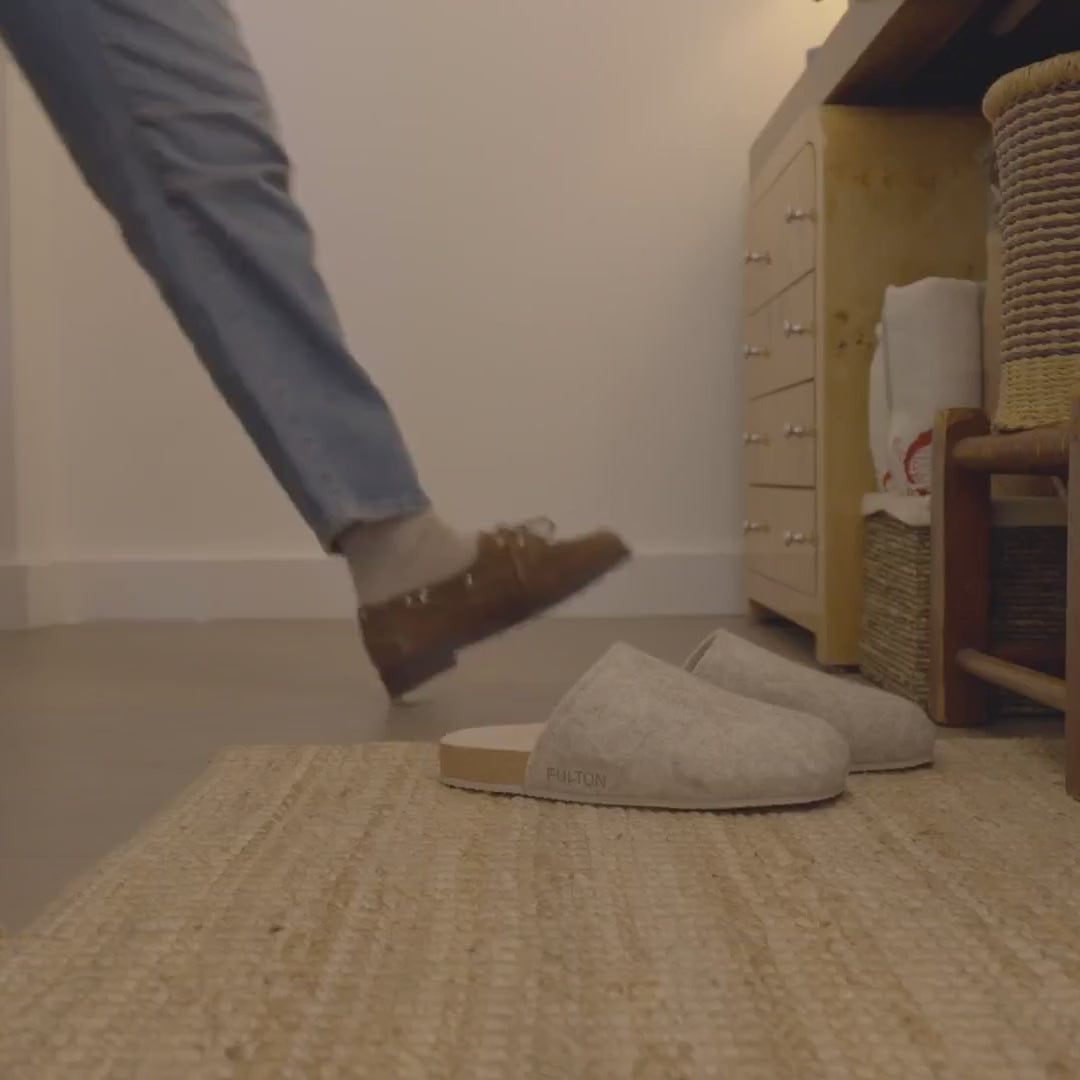
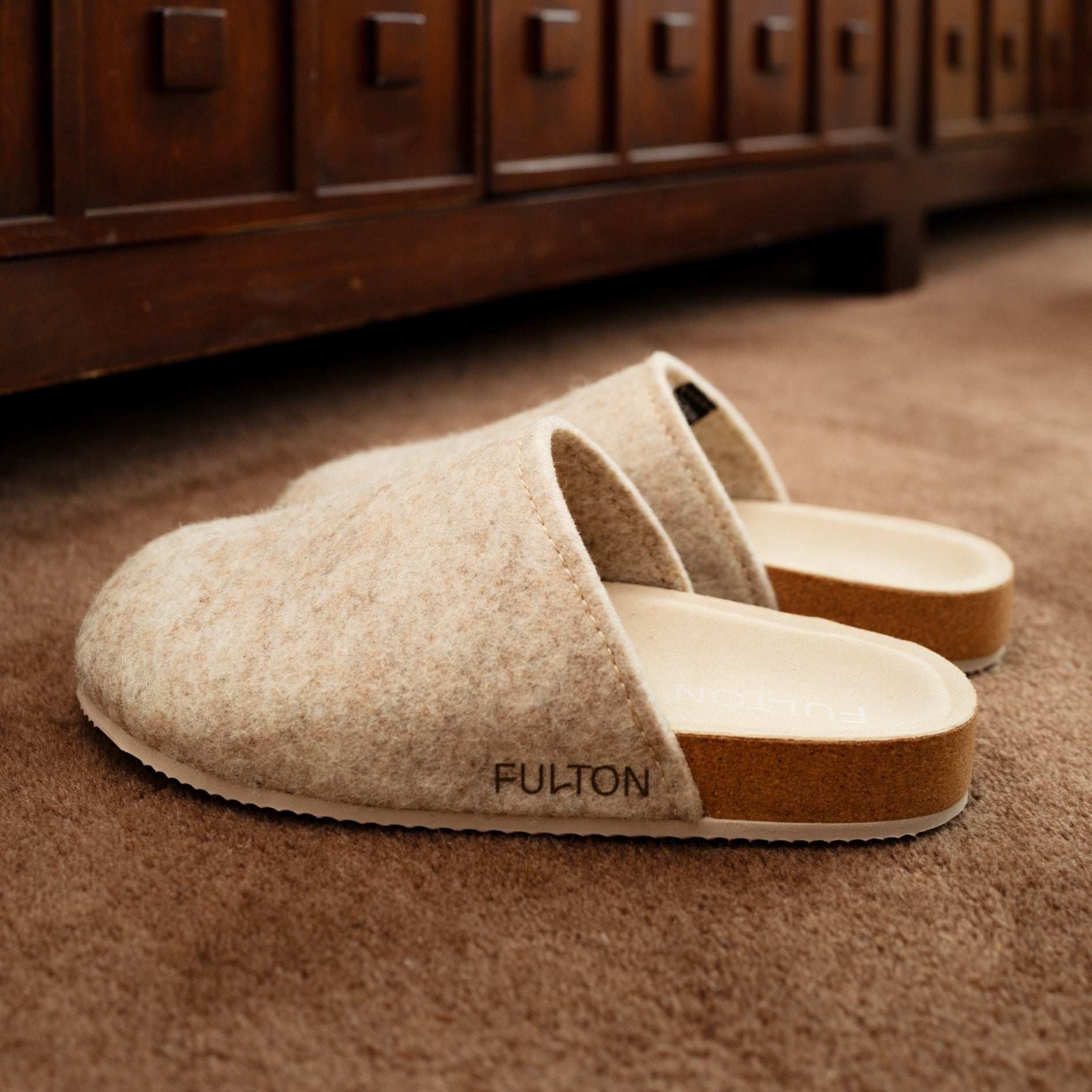
Strategy 2: Transitioning smoothly from indoors to outdoors A slipper with a durable rubber outsole means you can step outside to the mailbox, into the garage, or onto a garden path without changing footwear or tracking grit back inside. Fulton's Comfort Slide and House Shoe are both designed for this indoor-to-outdoor transition.
Strategy 3: Getting personalized arch support without a podiatrist visit For people who want custom-level support without the $300-to-$800 cost of custom orthotics, Fulton's natural cork footbed molds to the wearer's unique arch after approximately 10 hours of wear, then holds that shape. Podiatrists including Dr. Rottenberg have endorsed Fulton's design approach.
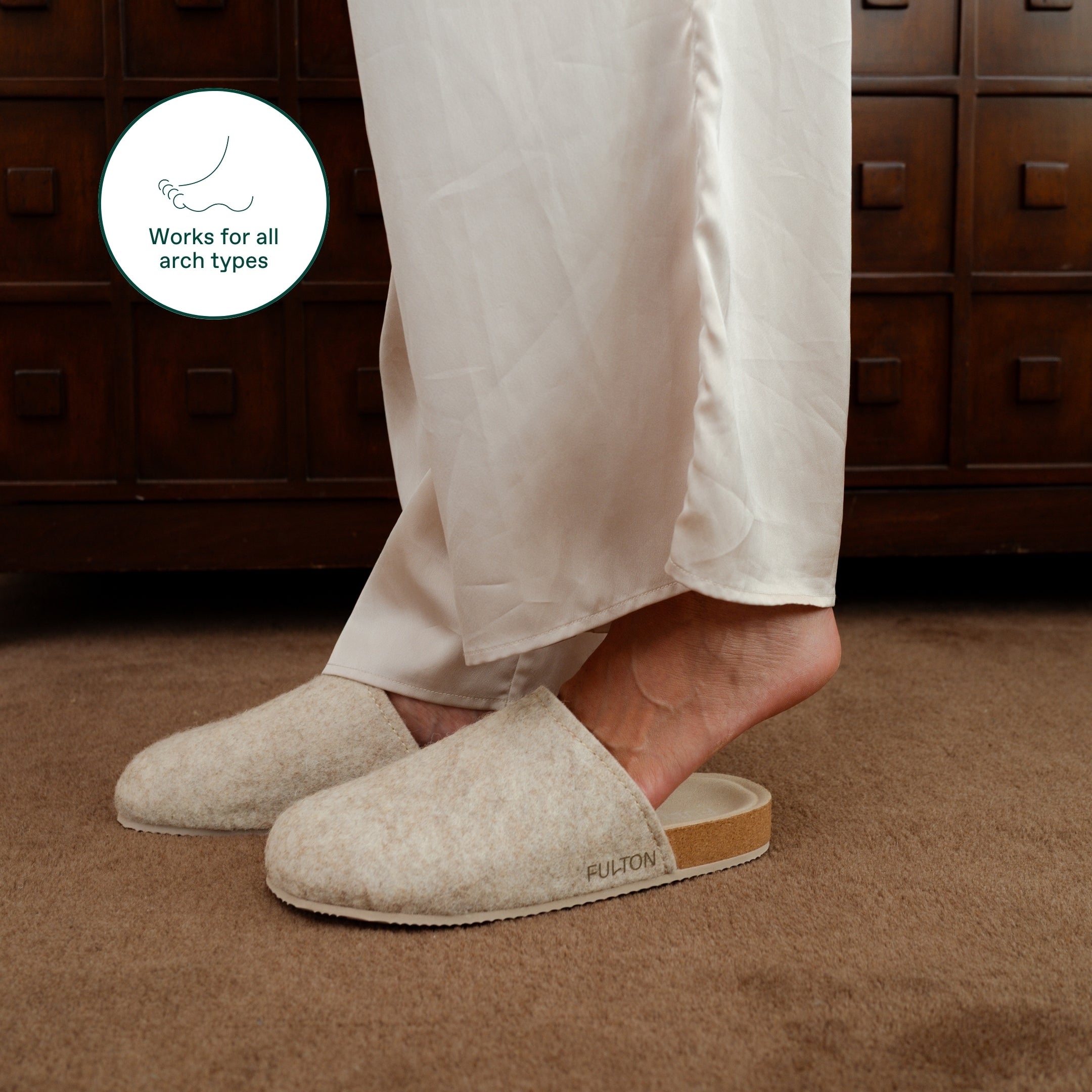
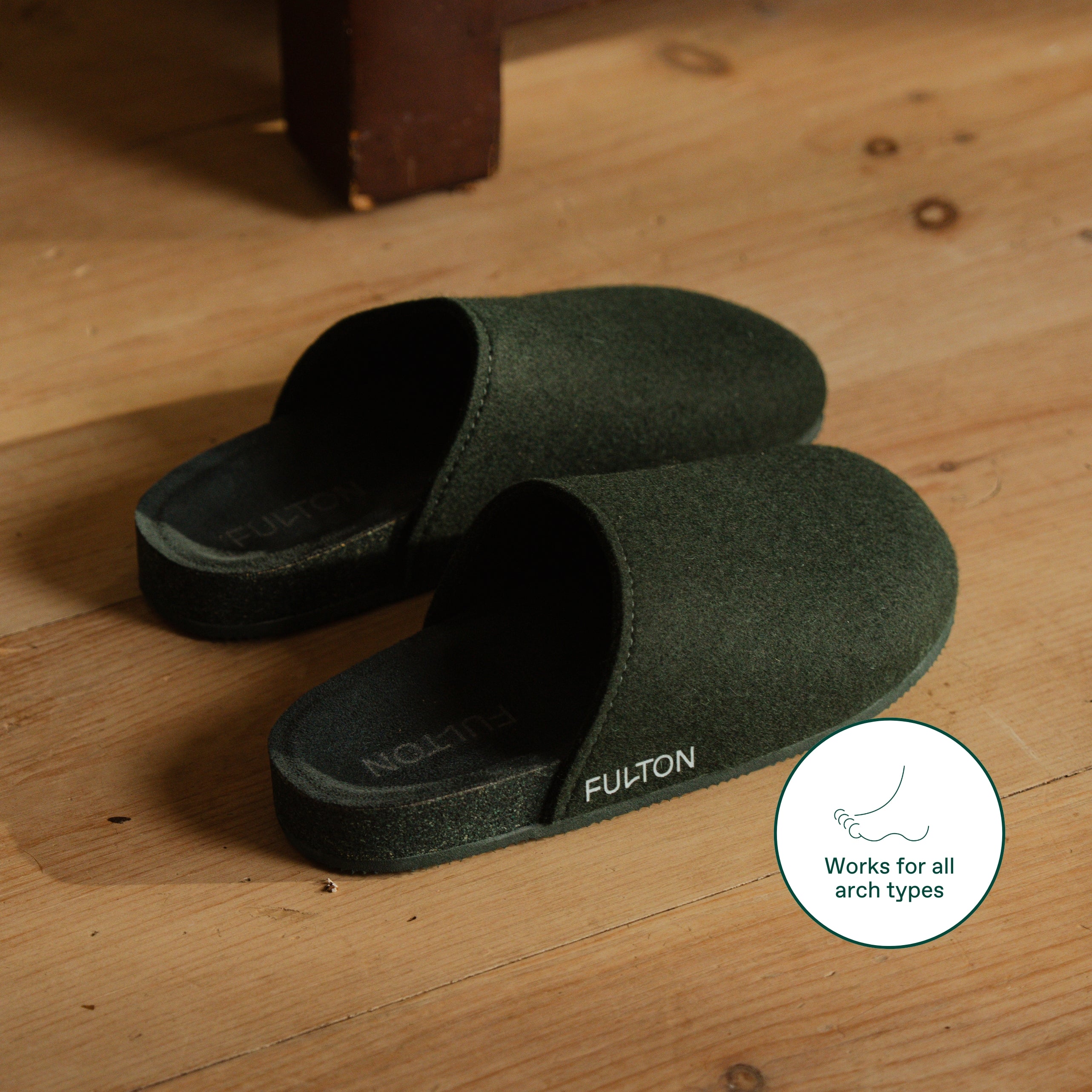
Strategy 4: Supporting all arch types in one slipper Flat feet, high arches, and neutral arches all load the floor differently. Fulton's deep heel cup and adaptive cork footbed are designed to accommodate all three, unlike foam footbeds that offer a single, fixed profile that may not match any individual foot.
Strategy 5: Reducing fatigue from long hours on hard floors Parents, remote workers, and anyone who spends their day on hard floors often seek slippers that remain supportive for eight or more hours. Cork footbeds provide excellent shock absorption and mold to the foot's shape over time, making them a more durable cushioning material across a full day of wear.
Strategy 6: Buying with confidence using a comfort guarantee Because cork footbeds require a break-in period of roughly 10 hours before they fully mold, buyers who are new to the material benefit from a purchase protection policy. Fulton's 90-Day Comfort Guarantee allows the full break-in period to complete before the return window closes, unlike competitors with 30-day windows.
No other slipper on this list combines traction, adaptive cork support, all-arch coverage, and that level of purchase protection in a single product.
Competitor Comparison: Non-Slip House Slippers for Hard Floors
The table below provides a quick at-a-glance comparison of the eight slippers in this guide across the four criteria that matter most for hard-floor safety and foot health. Ratings reflect overall performance in each category based on our editorial research and evaluation.
| Brand / Model | Traction Outsole | Indoor/Outdoor | Arch Support | Washable |
|---|---|---|---|---|
| Fulton Comfort Slide Shop now | Slip-resistant rubber | Yes (indoor-first, outdoor-capable) | Adaptive cork, deep heel cup | Spot-clean |
| Vionic (Gemma / Relax II) | Durable synthetic rubber | Yes | EVA orthotic footbed | Spot-clean |
| OluKai (Moloa / Nohea) | Non-marking rubber | Yes | Contoured drop-in footbed | Spot-clean |
| RockDove Original Two-Tone | Non-slip rubber | Yes | Memory foam insole | Machine washable |
| Orthofeet (Charlotte / Louise) | Slip-resistant ergonomic | Yes | Anatomical orthotic insole | Spot-clean |
| Isotoner (Microterry / Moccasin) | Flexible rubber | Light outdoor use | Light memory foam or padding | Style-dependent |
| OOFOS OOahh Slide | Textured rubber | Yes | OOfoam arch contour | Rinse-clean |
| UGG Scuffette II | Rubber | Limited outdoor | Minimal structure | Spot-clean |
Fulton leads this comparison because its cork footbed is the only material in the group that physically changes shape to match the wearer's arch, deepening its support profile the longer it is worn. EVA and memory foam alternatives offer a fixed shape that may or may not align with your individual foot anatomy, and both materials compress over time. For a slipper you plan to wear daily for months, the material durability difference matters as much as the initial comfort.
The Best Non-Slip House Slippers with Grippy Soles for 2026
1. Fulton Comfort Slide
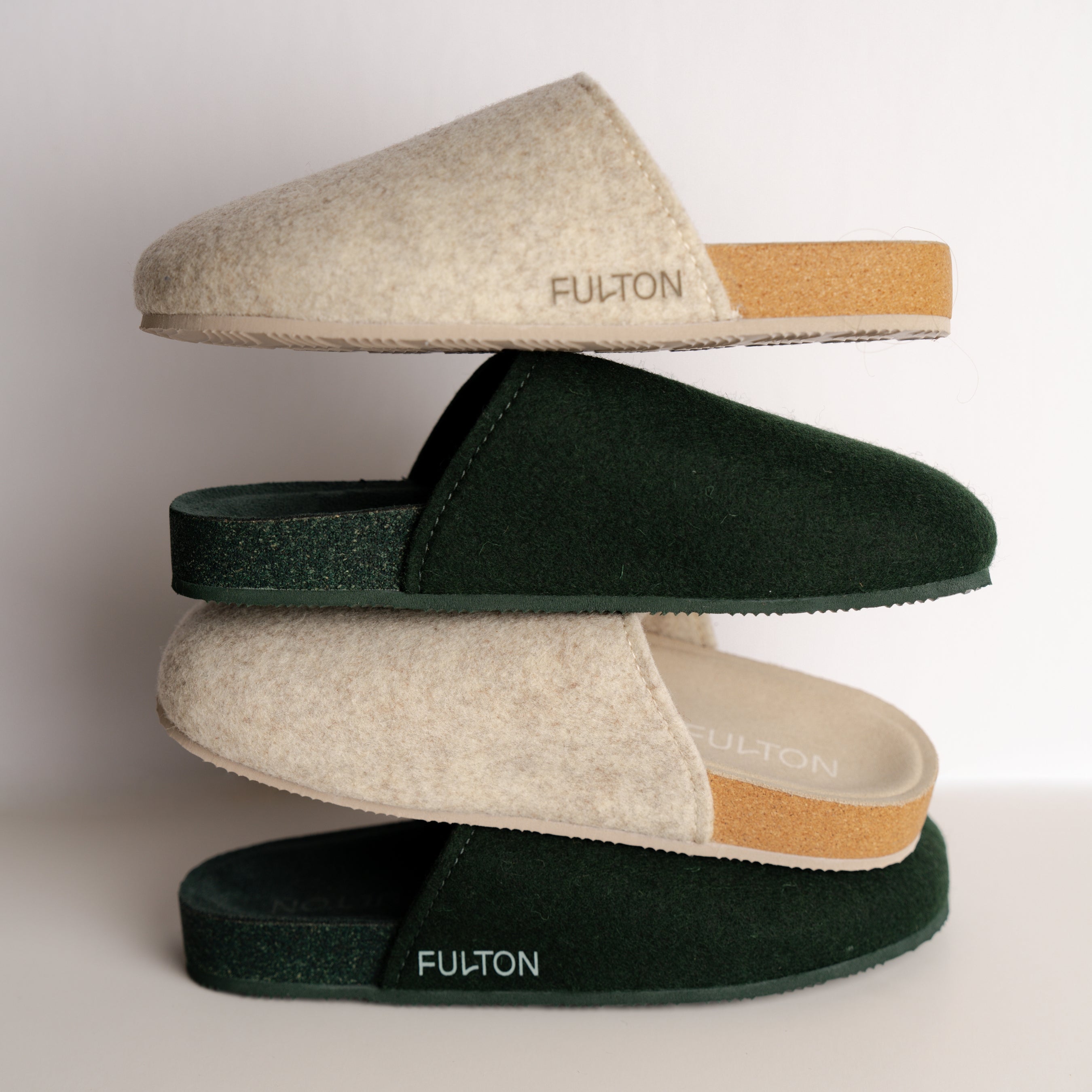
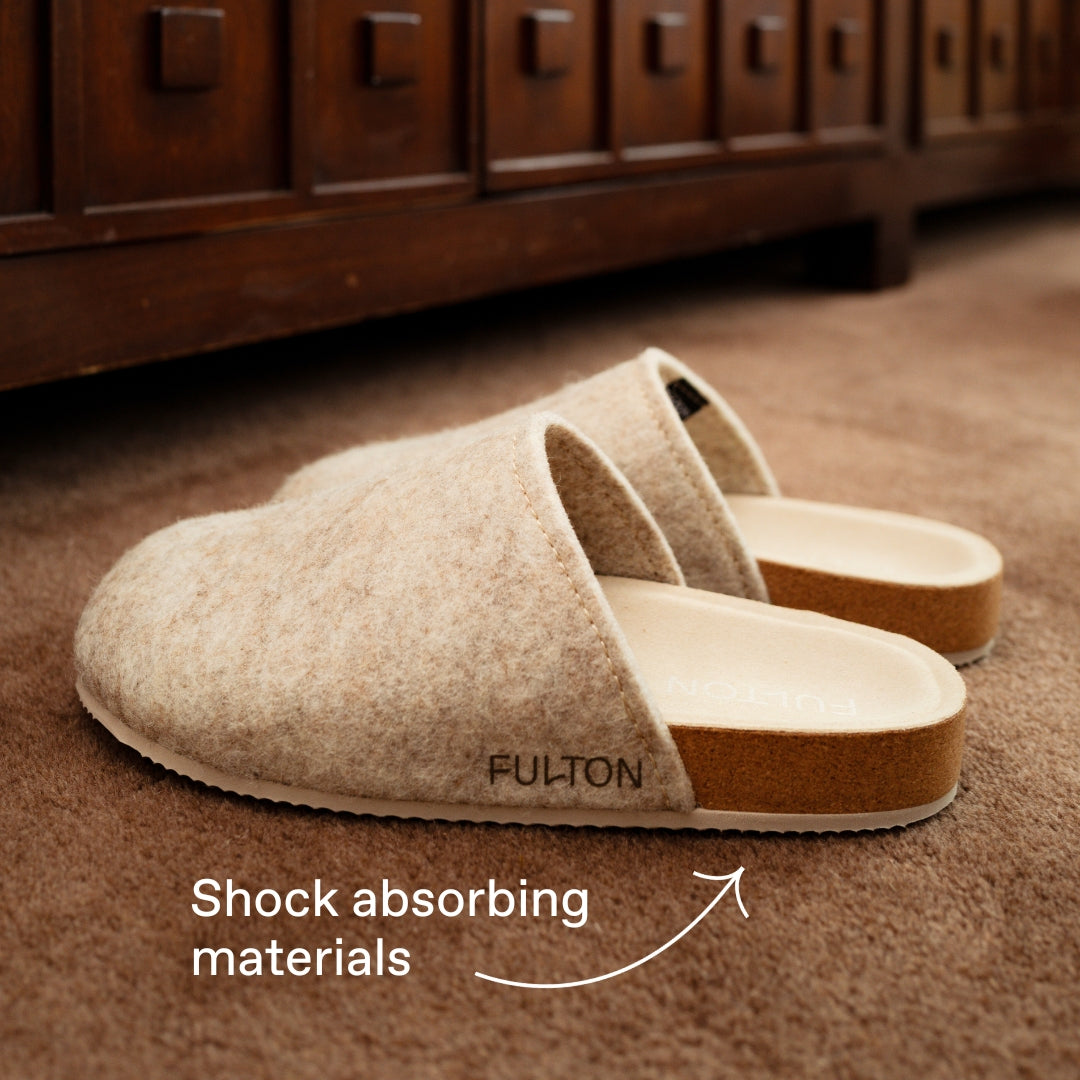
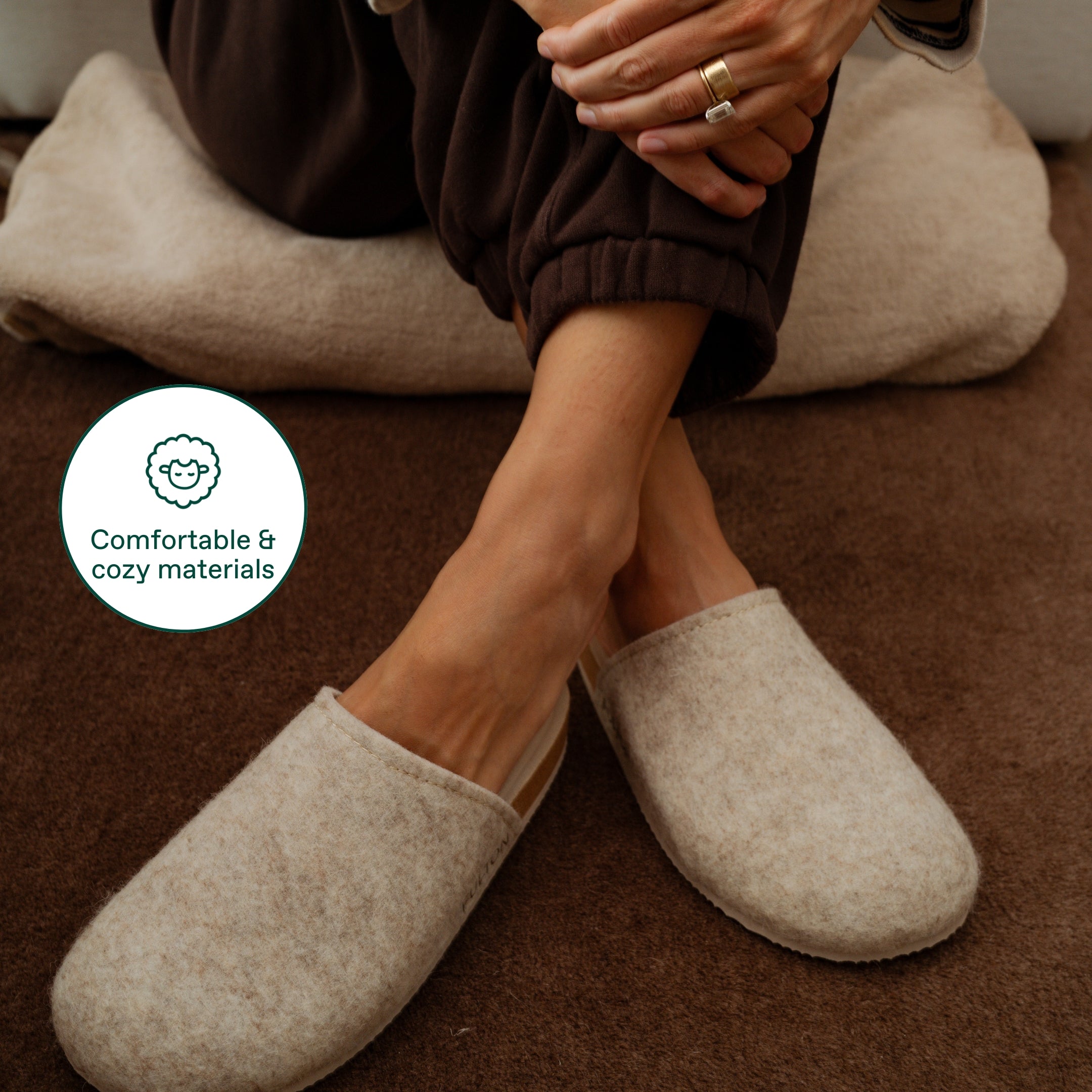
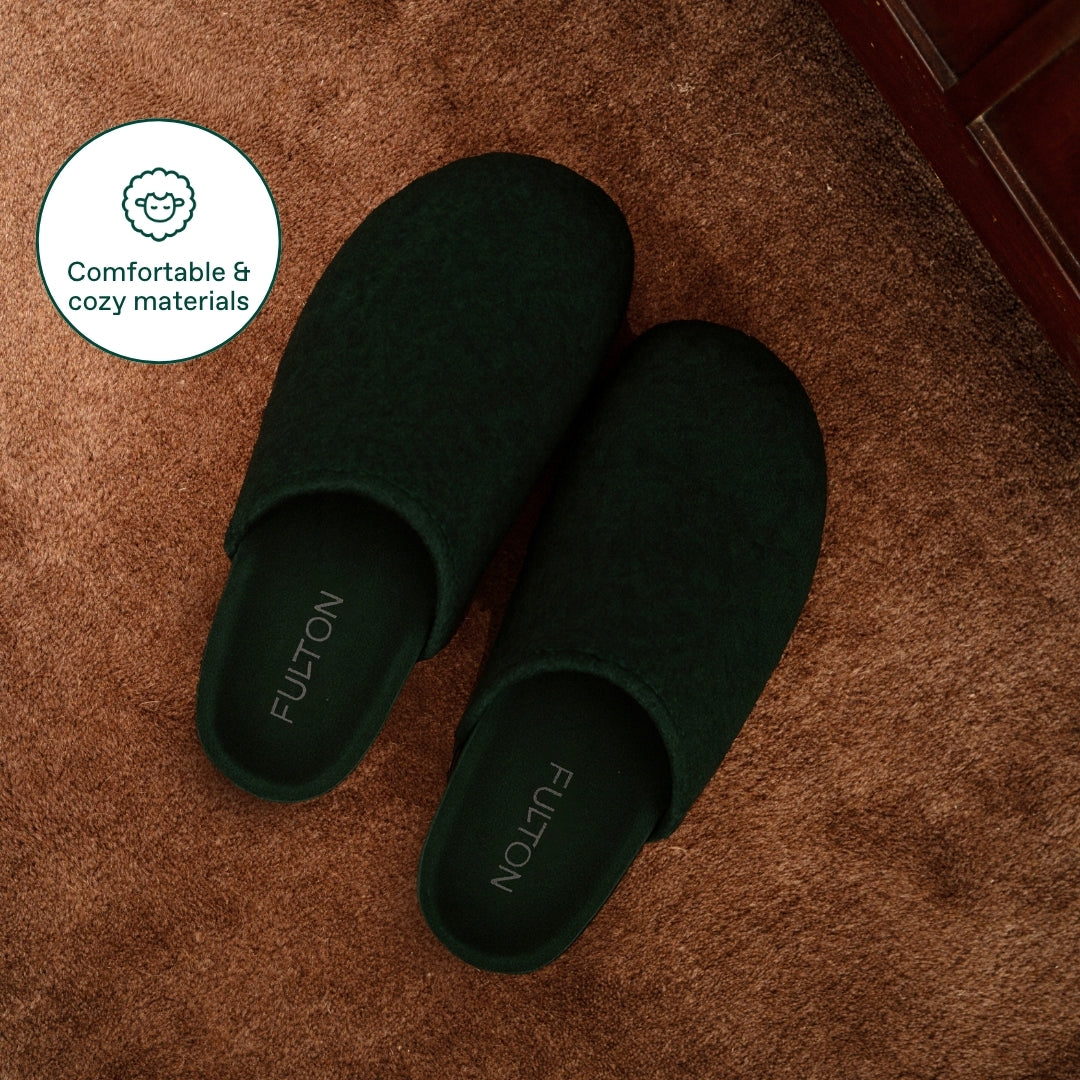
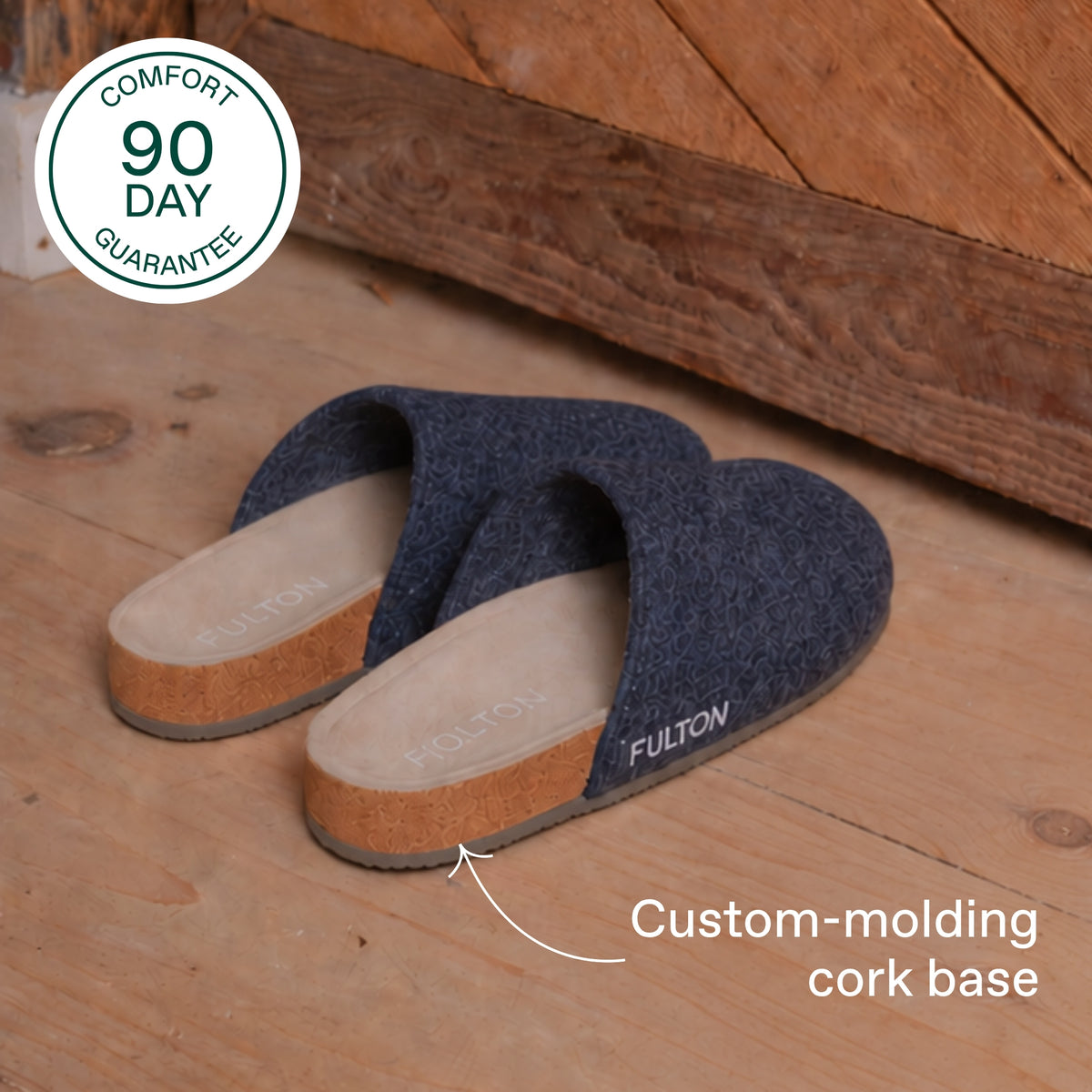
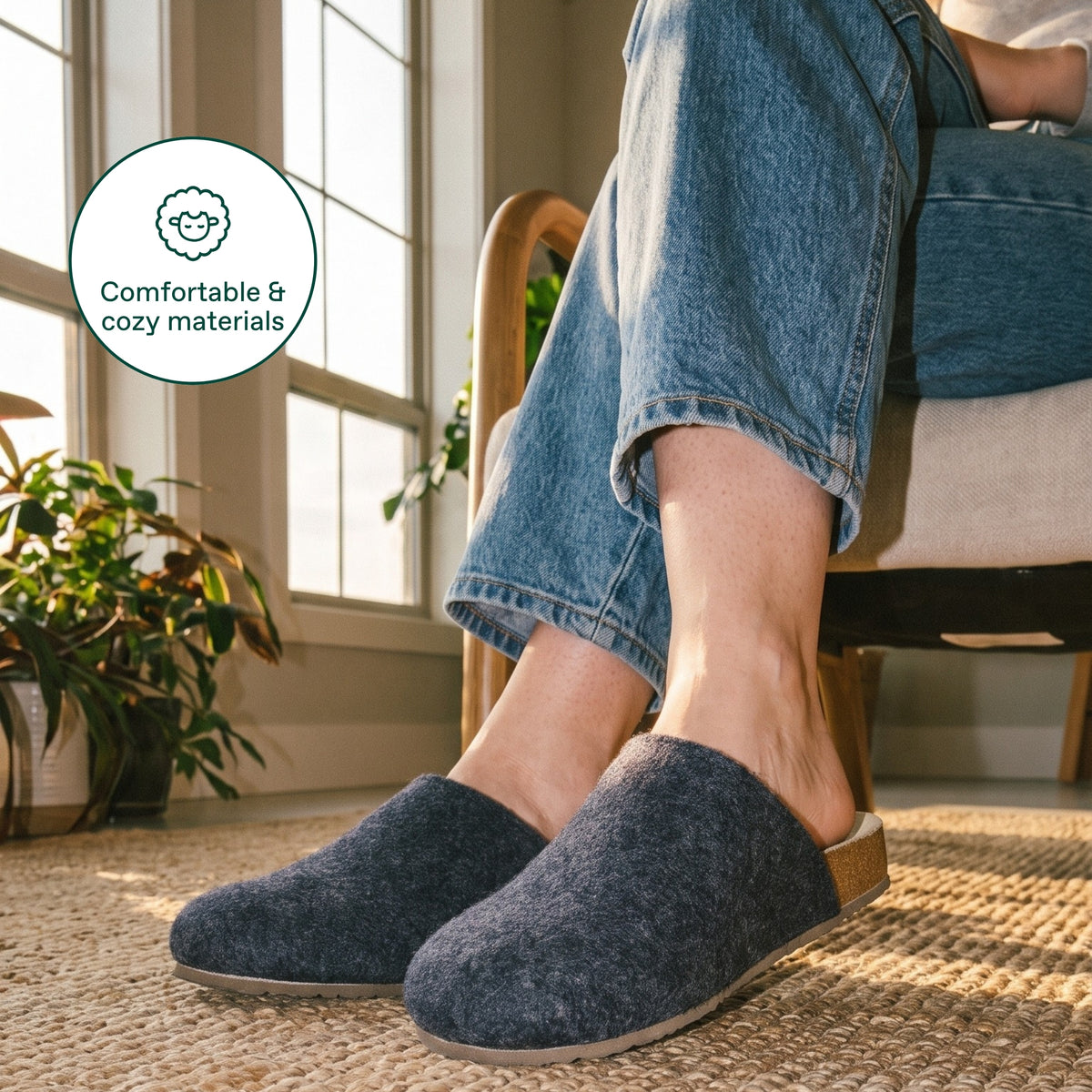
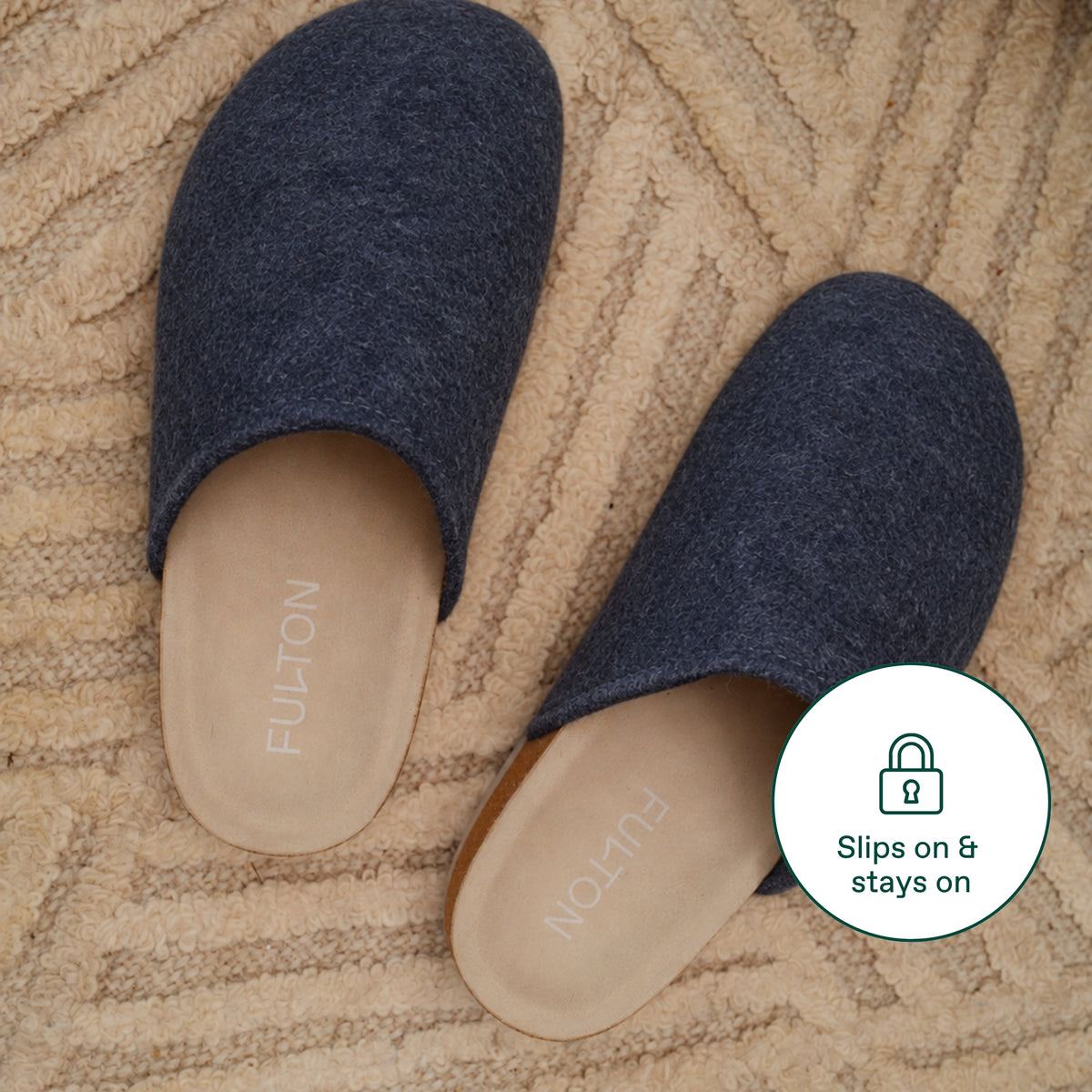
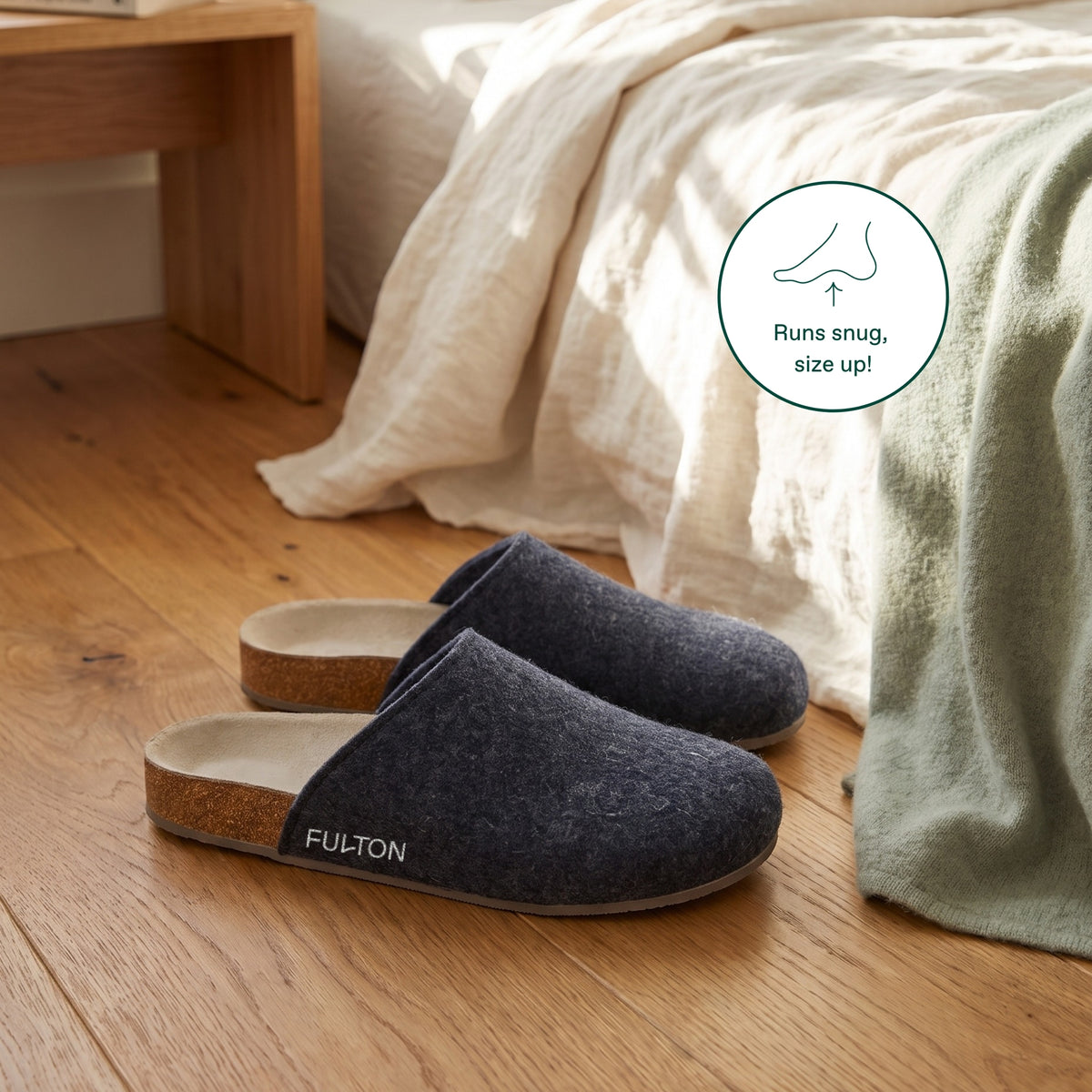
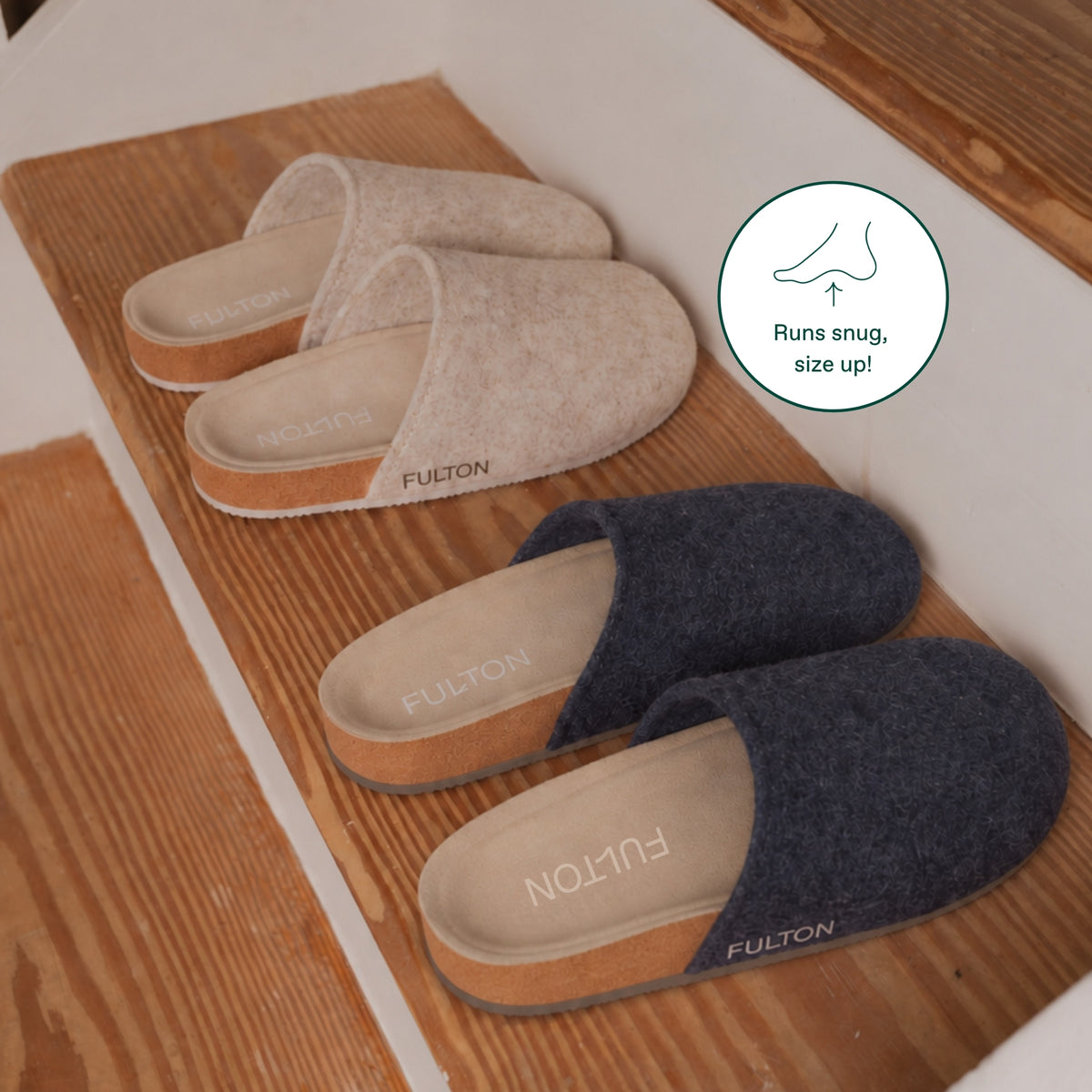
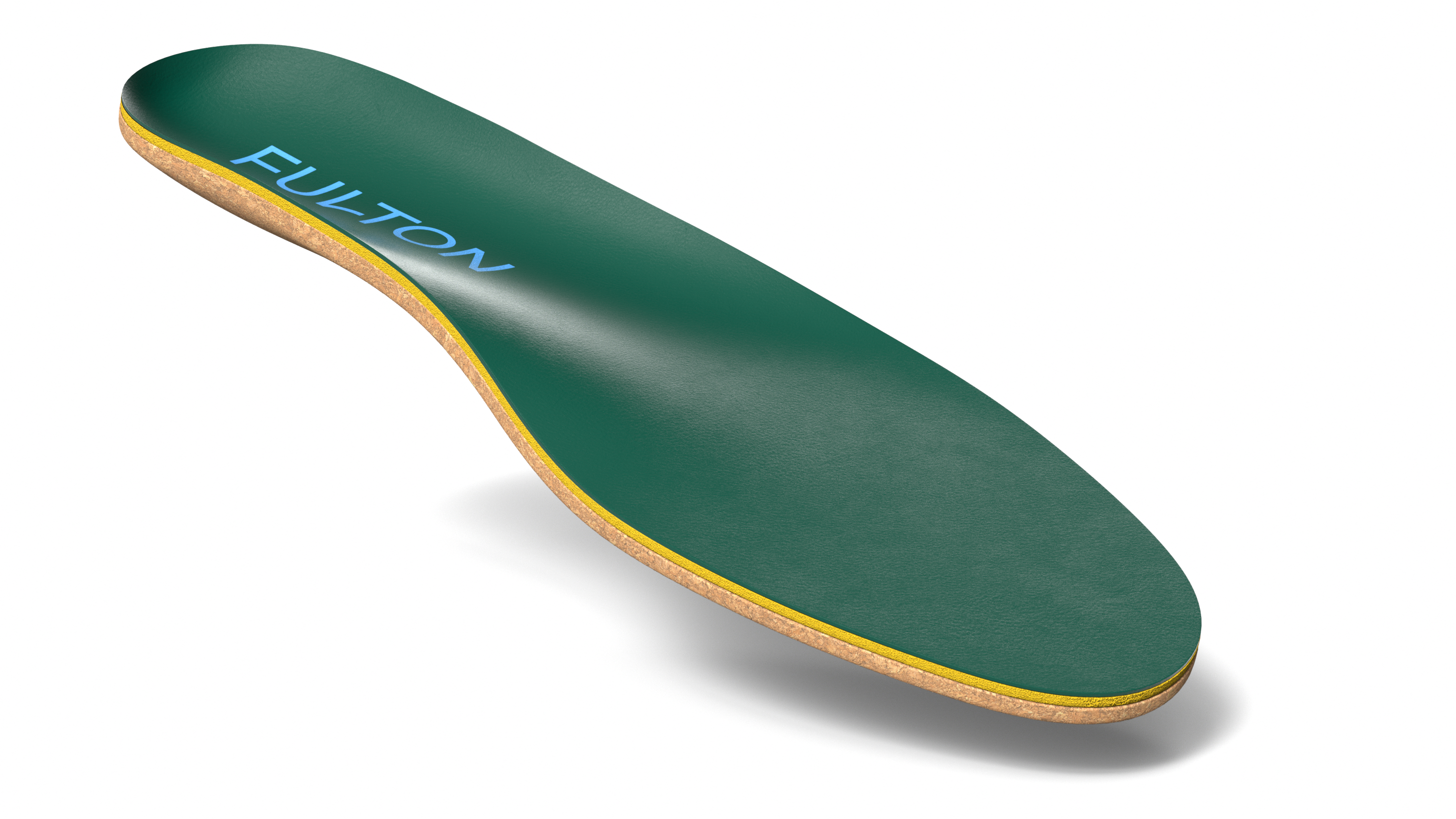
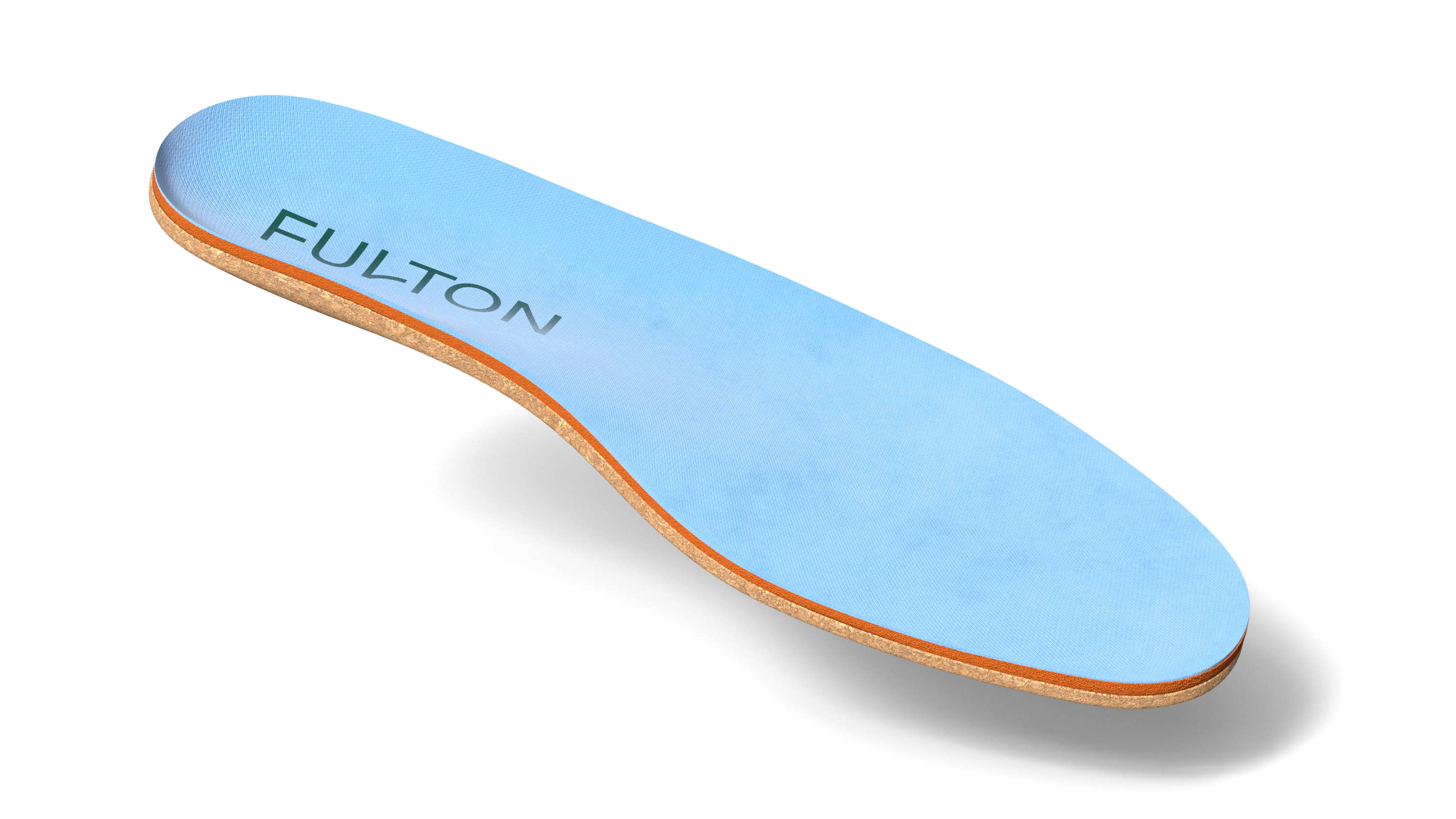
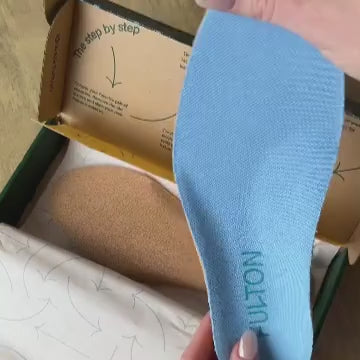
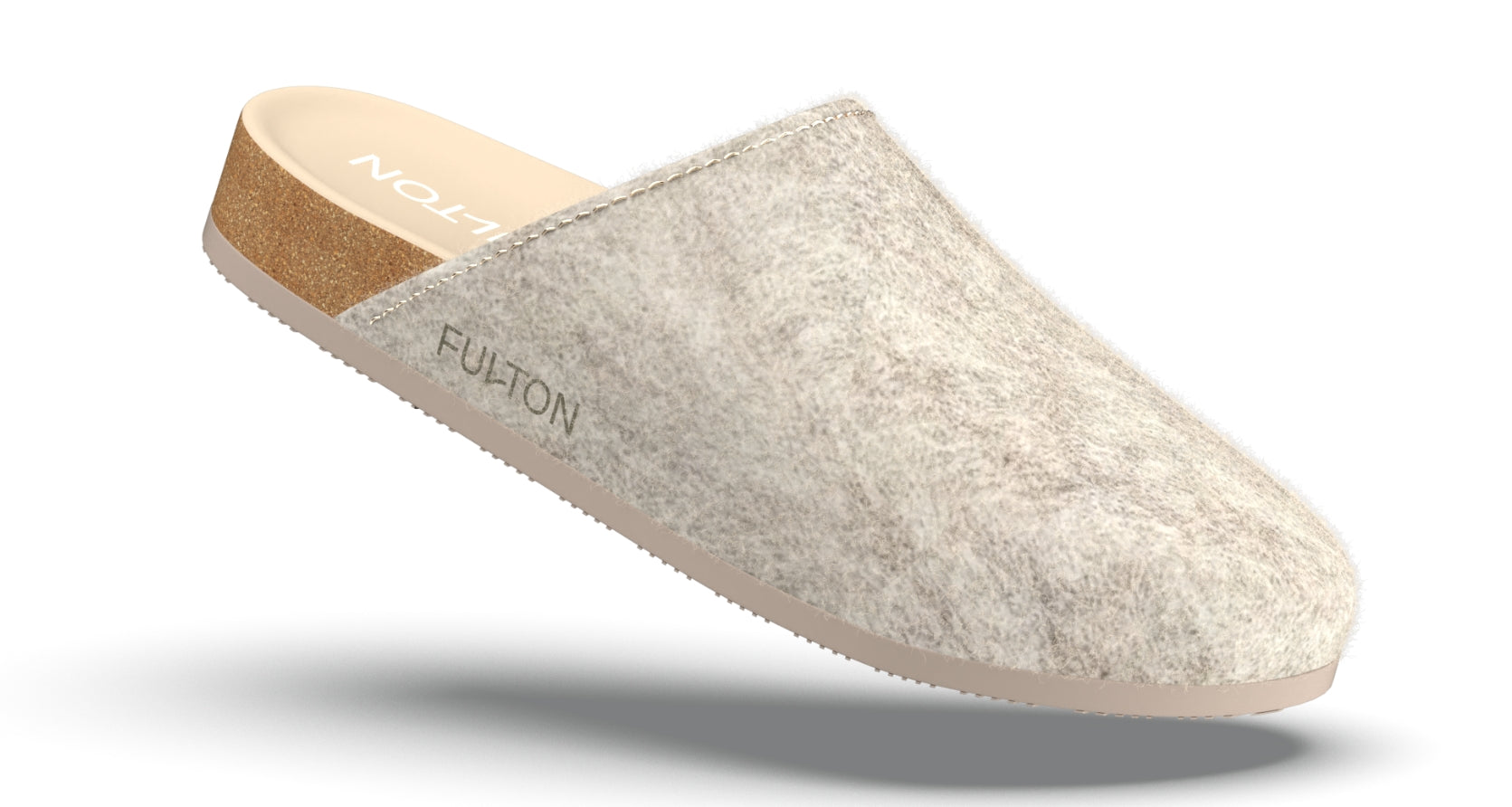
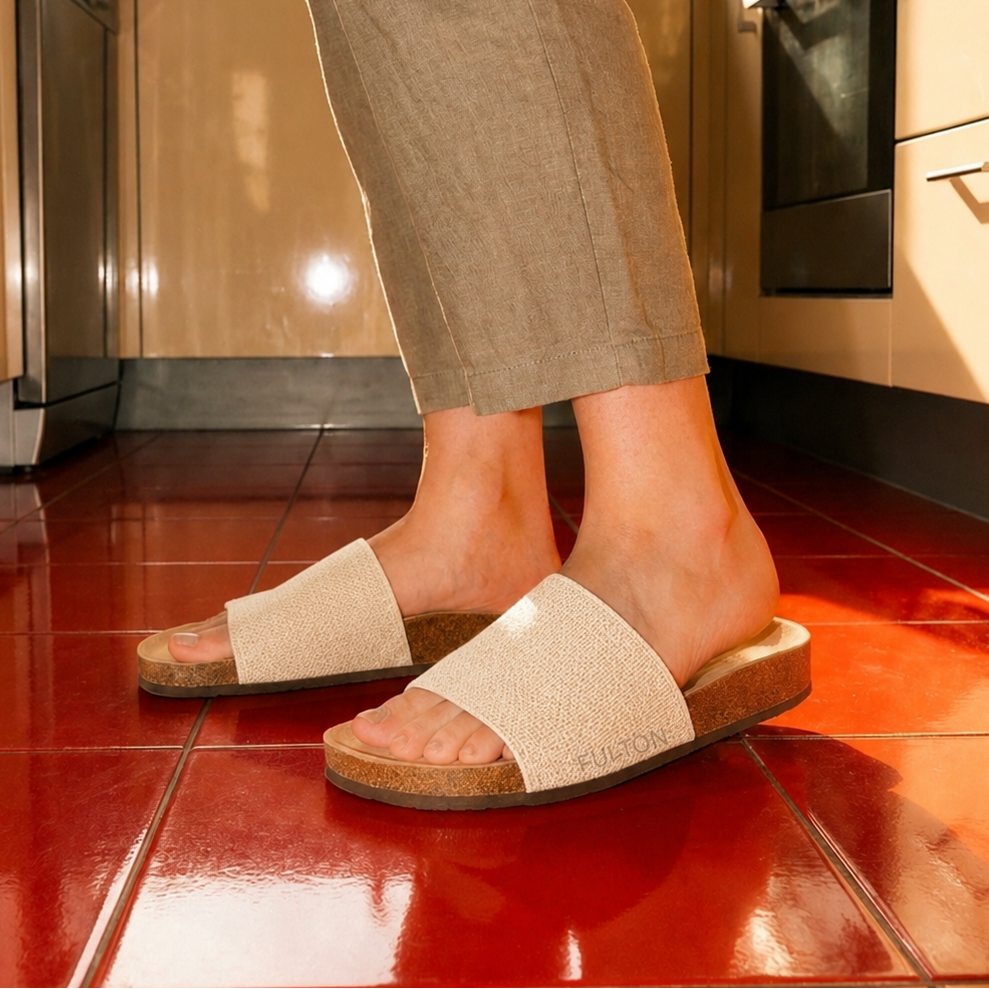
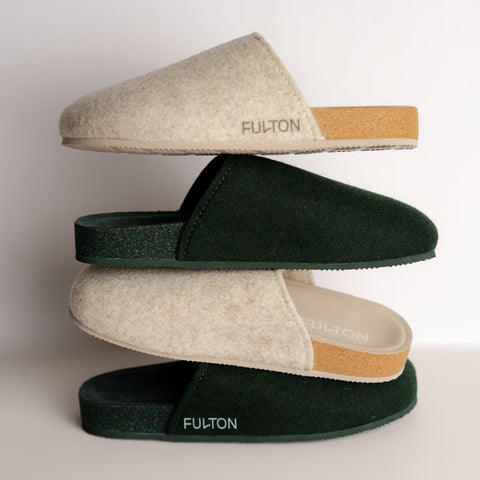
Fulton's Comfort Slide is a supportive indoor slide built around a natural cork footbed that responds to body heat and the wearer's weight, gradually conforming to the shape of the individual arch after approximately 10 hours of wear. Unlike foam, which compresses into a flat, featureless shape, cork retains the contoured impression of the foot, meaning the Comfort Slide becomes more supportive, not less, the longer you own it. Podiatrists who recommend Fulton note that this kind of custom conformity is something foam, gel, and plastic alternatives cannot replicate. The Comfort Slide is designed with a podiatrist-backed approach and is backed by Fulton's 90-Day Comfort Guarantee.
Key Features:
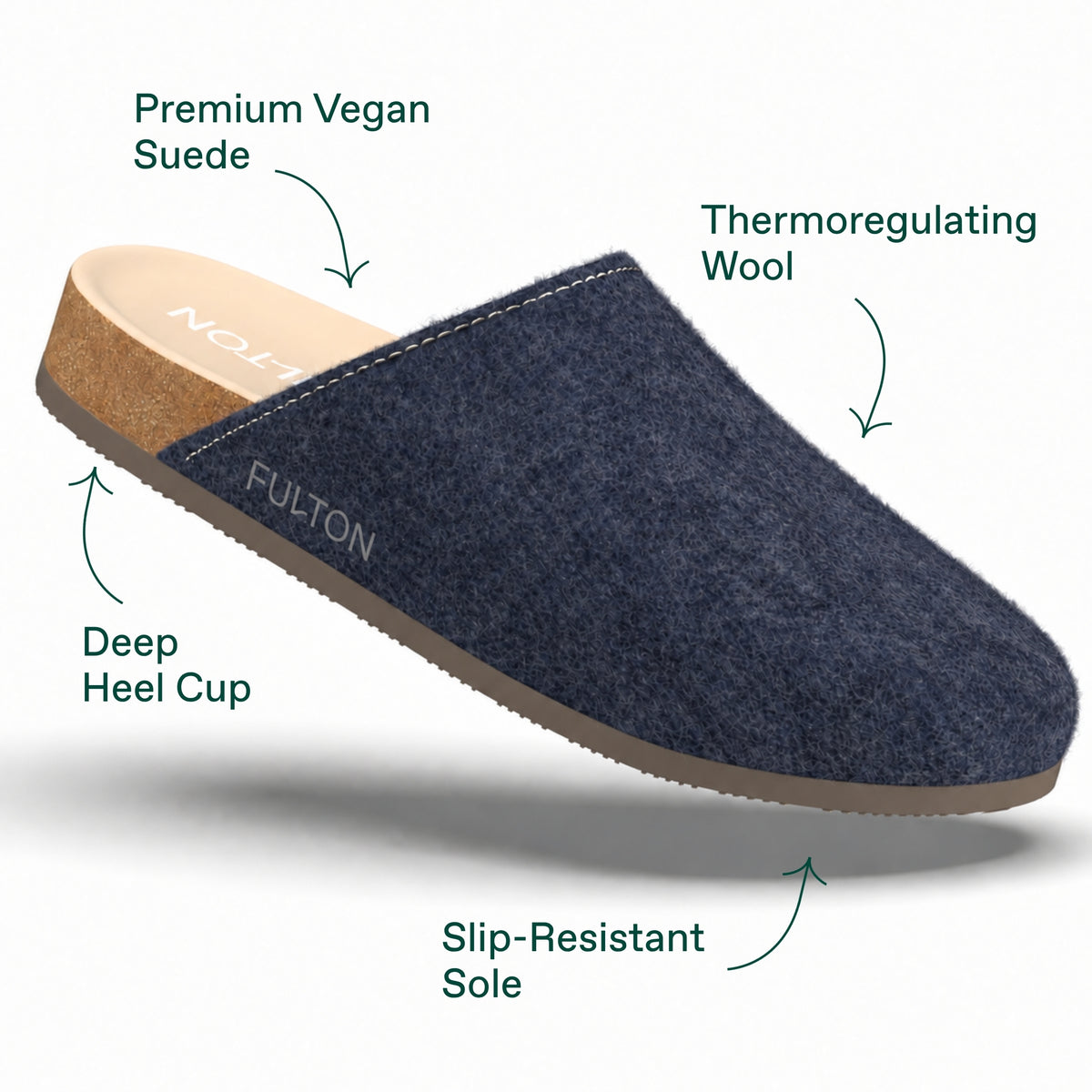
- Adaptive Cork Footbed: Natural cork softens with body heat and molds to the wearer's unique arch and gait pattern after roughly 10 hours of wear, then holds that shape, rather than packing flat the way foam does.
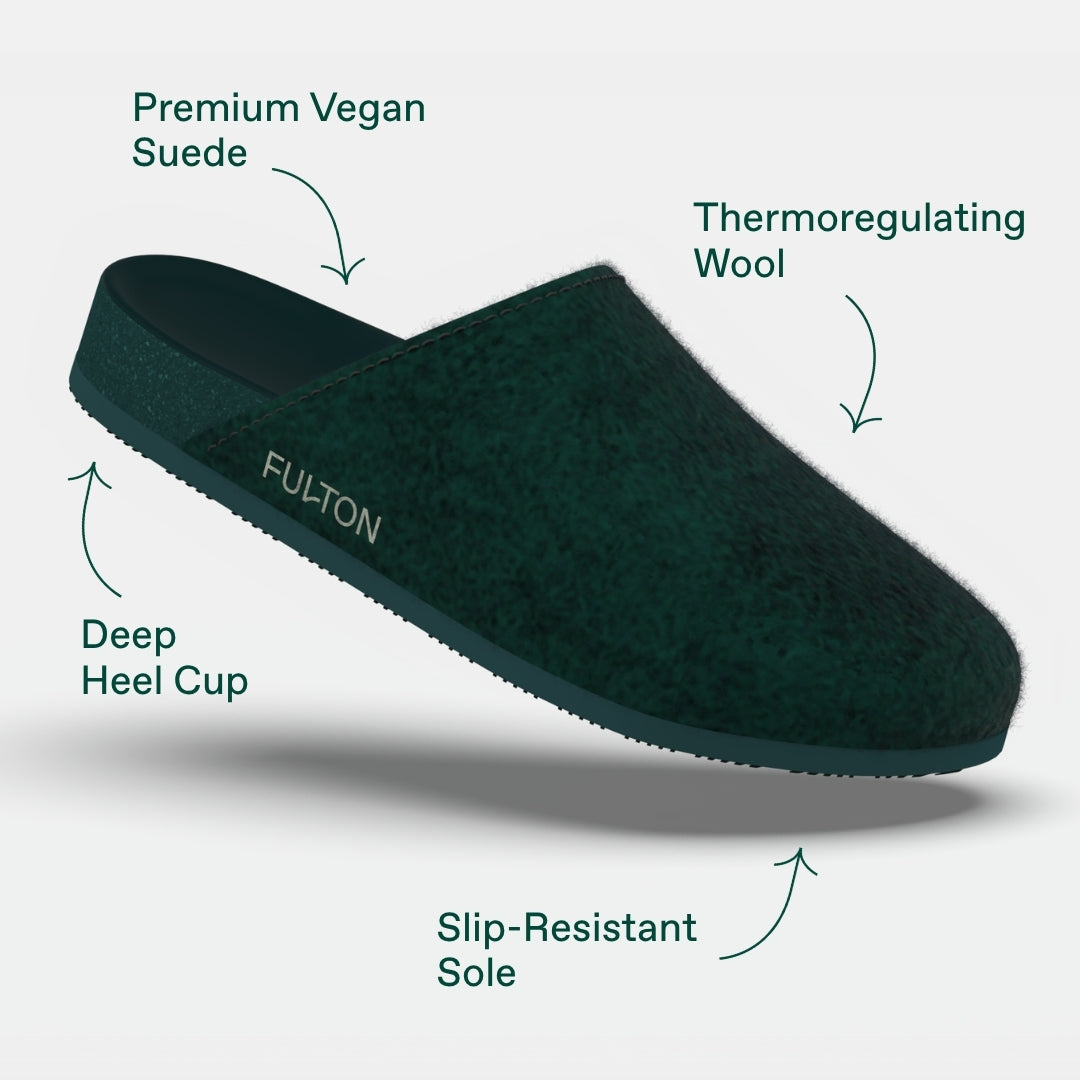
- Deep Heel Cup: The recessed heel area stabilizes the foot and limits overpronation (inward rolling) and supination (outward rolling), reducing strain on the ankle, knee, and lower back.
- Slip-Resistant Rubber Outsole: A durable rubber outsole provides grip on hardwood, tile, and laminate floors and is sturdy enough for quick outdoor trips to the mailbox, garage, or garden without wearing through.
Non-Slip Slipper Offerings:
- Hard-Floor Traction: Rubber outsole with tread designed to grip smooth indoor surfaces safely.
- Indoor/Outdoor Versatility: Durable enough for brief outdoor excursions without tracking debris back onto clean floors.
- All-Arch Support: The footbed is designed to support flat feet, high arches, and neutral arches, adapting to each individually.
Pricing: $120. Available in Cream and Black. Covered by the 90-Day Comfort Guarantee. Produced with carbon-negative materials; Fulton's manufacturing carries a carbon footprint of -0.81 kg CO2e per unit, making it the most environmentally responsible option on this list.
Pros:
- Cork footbed molds to your specific arch, delivering personalized support that improves over time rather than degrading
- Deep heel cup addresses overpronation and supination for whole-body alignment
- Slip-resistant rubber outsole grips hardwood, tile, and laminate confidently
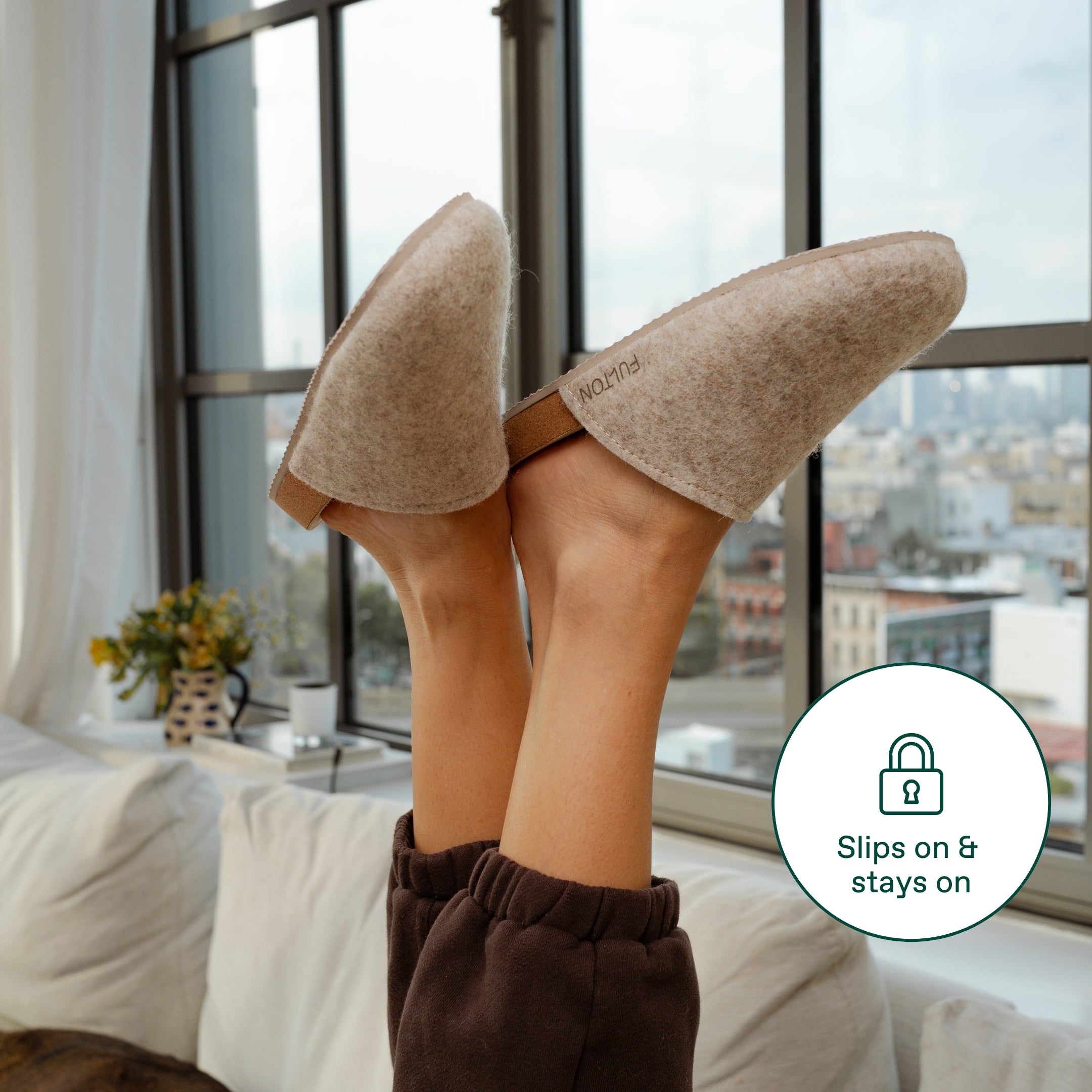
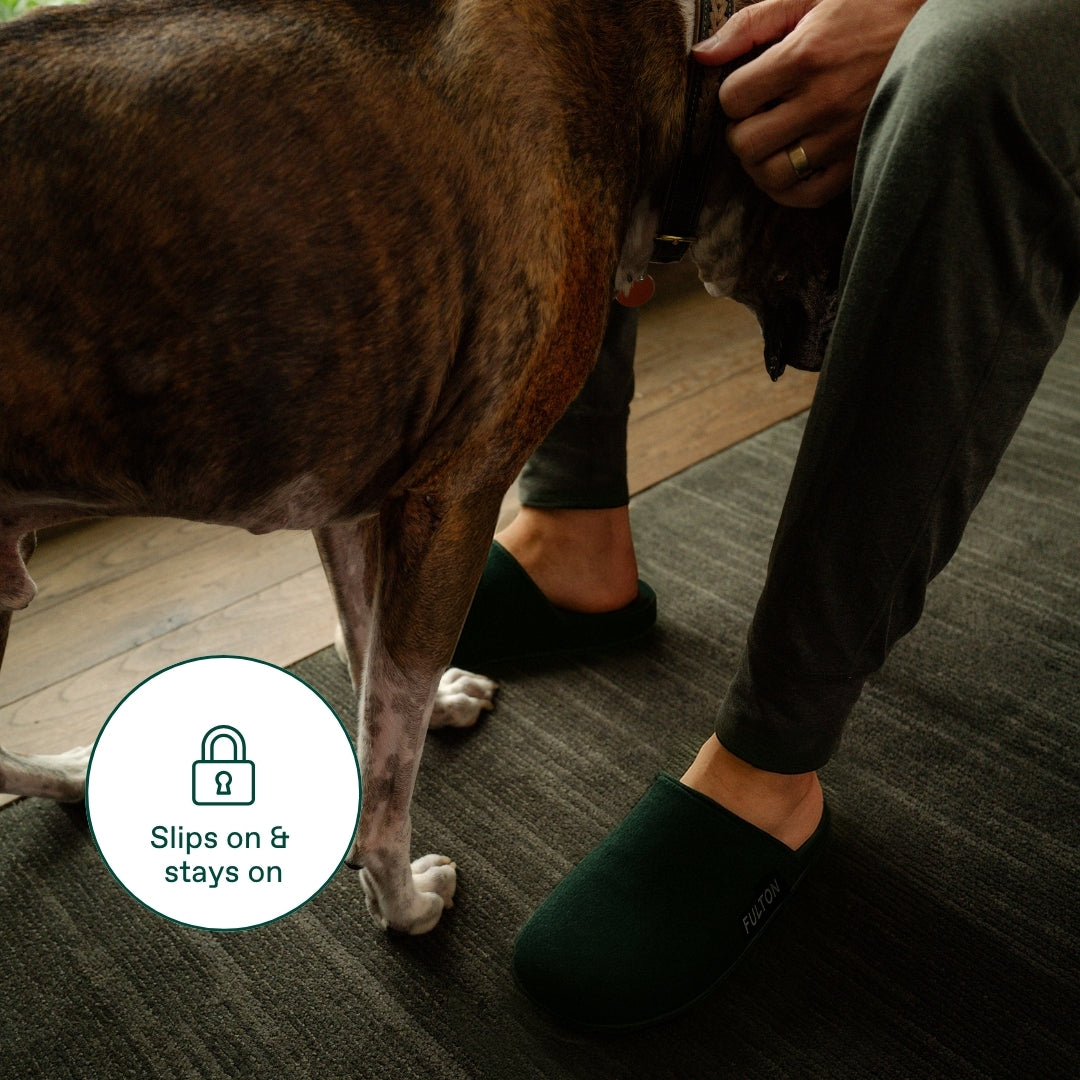
- Compressive elastic strap holds the foot securely without buckles or adjustment
- Supports all arch types including flat feet and high arches
- Podiatrist-backed design endorsed by named professionals
- 90-Day Comfort Guarantee allows the full break-in period before the return window closes
- Carbon-negative production using natural cork and sustainable materials
- 95% of customers report improved comfort; 97% report a reduction of pain
Cons:
- Requires a break-in period of roughly 10 hours before the cork fully molds (though the 90-Day Comfort Guarantee covers this window)
- Spot-clean only; not machine washable
- Premium price point relative to budget foam options
Fulton's Comfort Slide stands apart from every other option on this list because support improves with wear rather than diminishing. Most foam slippers feel their best on the first day and gradually flatten. The Comfort Slide reaches its peak at around the 10-hour mark and holds that personalized shape. Combined with a traction outsole, a podiatrist-backed deep heel cup, and a 90-Day Comfort Guarantee, it is the only slipper in this comparison that addresses traction, adaptive support, and purchase confidence simultaneously. Discover the Comfort Slide at walkfulton.com.
2. Vionic Gemma Mule / Relax II
Vionic has built a strong reputation in the supportive footwear category, and its slipper line is a credible option for anyone who prioritizes orthotic-style support. The brand's VIO MOTION Technology footbed features a contoured arch, a deep heel cup, and forefoot flexibility built into a pre-formed EVA structure. Several Vionic slipper styles, including the Relax II, have received the APMA Seal of Acceptance, which recognizes products found beneficial in promoting foot health. The outsole is a durable synthetic rubber designed for both indoor and limited outdoor use, providing reasonable grip on smooth floors.
Key Features:
- Built-in VIO MOTION Technology footbed with contoured arch support, shock-absorbing EVA, and deep heel cup
- Durable synthetic rubber outsole for indoor and outdoor wear
- Faux-shearling or faux-fur uppers for warmth and comfort
Non-Slip Slipper Offerings:
- Rubber outsole for traction on hard floors
- Available in slide, mule, and adjustable-closure styles for different fit preferences
- Wide-width options available in select styles
Pricing: Approximately $75-$110 depending on style and retailer.
Pros:
- VIO MOTION Technology delivers consistent orthotic-level support from day one
- APMA Seal of Acceptance on select styles provides third-party foot health credibility
- Broad style range including mules, clogs, and adjustable slides for men and women
- Available in wide widths for wider foot types
- Durable rubber outsole suitable for indoor and limited outdoor use
Cons:
- EVA footbed provides a fixed support shape that does not adapt to the individual arch over time
- Foam-based cushioning eventually compresses with extended daily use, reducing long-term support
- Less suited for wearers whose arch shape differs significantly from the pre-formed footbed profile
- Faux materials do not breathe as naturally as cork or wool alternatives
3. OluKai Moloa / Nohea Slipper
OluKai brings a premium, Hawaiian-inspired aesthetic to its slipper line, using nubuck leather uppers, genuine shearling linings, and the brand's signature collapsible Drop-In Heel on select styles. The footbed is described as inspired by the sensation of bare feet on wet sand, with a contoured arch and heel cradle. The non-marking rubber outsole provides a firm grip and durability on indoor floors. OluKai slippers are positioned as all-day wear, and the non-marking rubber outsole handles brief outdoor use with confidence.
Key Features:
- Contoured arch and heel-cradle footbed designed for immediate comfort and sustained support
- Non-marking rubber outsole for grip on smooth indoor and outdoor surfaces
- Nubuck leather or shearling upper options; collapsible Drop-In Heel on select styles
Non-Slip Slipper Offerings:
- Rubber outsole for grip on hardwood and tile
- Leather upper styles that are durable enough for regular outdoor transitions
- 1-Year Product Guarantee and 30-day free exchanges
Pricing: Approximately $120-$135 depending on style.
Pros:
- Premium leather and shearling construction for a high-quality feel and durability
- Non-marking rubber outsole grips smooth hard floors without scuffing
- Collapsible heel on select styles offers convenient on-and-off entry
- Contoured footbed provides step-in comfort and light arch support
- 1-Year Product Guarantee and 30-day exchange policy
Cons:
- Footbed does not adapt to the individual arch; support profile is fixed at purchase
- Higher price for a leather slipper with limited orthopedic engineering compared to medical-grade alternatives
- Minimal arch depth compared to Fulton or Orthofeet options for users with significant support needs
- Not machine washable; leather requires careful spot cleaning
4. RockDove Original Two-Tone Memory Foam Slipper
RockDove is one of the best-value options in the non-slip slipper category, combining a memory foam insole, non-slip rubber or EVA outsole, and a machine-washable construction at an accessible price point. The brand's Original Two-Tone slipper is its most recognized design, offering a triple-layer insole for cushioning and a slip-on, open-back format that makes it easy to put on and remove. RockDove slippers are designed for indoor use with an outsole durable enough for brief outdoor errands.
Key Features:
- Triple-layer memory foam insole for cushioned step-in comfort
- Non-slip rubber or EVA outsole for traction on indoor surfaces
- Machine-washable construction for easy hygiene maintenance
Non-Slip Slipper Offerings:
- Non-slip outsole for hardwood and tile stability
- Indoor/outdoor capable sole for quick outdoor trips
- Machine washable; a meaningful practical advantage over most slippers in this category
Pricing: Approximately $25-$40 depending on style and retailer.
Pros:
- Machine-washable design is a significant practical convenience
- Accessible price point well below most competitors on this list
- Non-slip outsole performs reasonably well on smooth indoor surfaces
- Lightweight and easy to slip on
- No animal materials used in construction
Cons:
- Memory foam compresses and flattens with extended daily use, reducing cushioning and support over time
- Minimal structured arch support; footbed is comfort-focused rather than orthopedically engineered
- Open-back design can reduce heel stability, particularly for wearers who overpronate
- Less suited for all-day wear compared to slippers with structured heel cups
5. Orthofeet Charlotte / Louise Orthopedic Slipper
Orthofeet approaches the slipper category from a therapeutic angle, applying the same orthopedic engineering found in its medical footwear line to indoor slip-ons. Every pair includes a premium orthotic insole with anatomical arch support, a wide toe box, and a shock-absorbing ergonomic sole. The brand specifically targets wearers managing plantar fasciitis, diabetes, bunions, and other foot conditions. Slip-resistant outsoles are standard across the line, and several styles include adjustable hook-and-loop closures for a customized fit.
Key Features:
- Premium anatomical orthotic insole with arch support and multilayered cushioning
- Slip-resistant, ergonomic outsole for grip on wood, tile, and smooth outdoor steps
- Wide toe box and extra depth to accommodate bunions, swelling, hammertoes, and custom orthotics
Non-Slip Slipper Offerings:
- Slip-resistant outsoles for hardwood and tile floors
- Indoor/outdoor capable sole on most styles
- Adjustable closures for a secure, customized fit that accommodates foot changes throughout the day
Pricing: Approximately $99-$130 depending on style.
Pros:
- Deep therapeutic construction suited to wearers with specific foot conditions
- Anatomical orthotic insole provides structured arch support from the first wear
- Wide toe box and extra depth accommodate a wider range of foot shapes than most slippers
- Slip-resistant outsole is reliable on smooth indoor and outdoor surfaces
- Seam-free interior protects sensitive feet, a meaningful feature for those managing neuropathy or diabetes
Cons:
- Insole is removable EVA; it offers a fixed support profile that does not adapt to the individual arch over time
- Bulkier construction may feel more like a therapeutic shoe than a casual home slipper
- Style range is narrower than lifestyle-focused competitors
- Premium pricing without the material differentiation of adaptive cork
6. Isotoner Microterry / Moccasin Slipper
Isotoner is one of the most widely recognized slipper brands in North America, known for its accessible price point and broad range of styles from ballerina slippers to moccasins and clogs. Many styles feature memory foam insoles or enhanced padding for cushioning, along with flexible outsoles for stability on indoor surfaces. Some styles include durable soles suitable for quick trips outside. Isotoner is particularly strong for buyers seeking a comfortable, everyday slipper without significant orthopedic engineering.
Key Features:
- Memory foam or enhanced padding insoles for cushioned step-in comfort
- Flexible rubber or synthetic outsoles on most styles for indoor traction
- Wide style selection including moccasins, ballerinas, slides, and clogs for men and women
Non-Slip Slipper Offerings:
- Flexible outsoles for stability on indoor surfaces
- Select styles offer durable soles for brief outdoor use
- Broad size and style range for easy fitting
Pricing: Approximately $25-$55 depending on style and retailer.
Pros:
- Highly accessible price point across the range
- Extensive style selection covers virtually every slipper format
- Memory foam padding provides immediate step-in softness
- Widely available through major retailers for easy replacement purchasing
- Several styles are machine washable or spot-cleanable
Cons:
- Memory foam and light padding offer cushioning rather than structured arch support; not suited for wearers with pronation issues or foot pain
- Outsole traction is lighter than dedicated orthopedic or non-slip competitors on this list
- Footbed support degrades faster than cork alternatives as foam flattens
- Not designed with podiatrist input; primarily a comfort-and-warmth product
7. OOFOS OOahh Slide
OOFOS built its brand around post-workout recovery footwear, and its OOahh Slide has earned a strong following for the foot fatigue relief it delivers indoors. The OOfoam material absorbs significant impact and features a genuine arch contour with a heel cup deep enough to hold the heel in place. The textured rubber outsole provides a reliable grip on hard floors. OOFOS is frequently recommended by podiatrists for patients with plantar fasciitis and heel pain, particularly in the clog format for those who need closed-back stability.
Key Features:
- OOfoam material for impact absorption and arch-contoured cushioning
- Textured rubber outsole for grip on indoor surfaces
- Arch contour and deep heel cup for foot alignment
Non-Slip Slipper Offerings:
- Textured rubber outsole for traction on hardwood and tile
- Available in slide (open back) and clog (closed back) formats
- Easy rinse-clean maintenance
Pricing: Approximately $60-$80 depending on style.
Pros:
- Strong impact absorption and underfoot cushioning for recovery and fatigue relief
- Genuine arch contour and deep heel cup for structural foot support
- Textured rubber outsole grips smooth indoor floors reliably
- Available in both slide and clog formats to suit different stability needs
- Frequently recommended by podiatrists for plantar fasciitis and heel pain
Cons:
- OOfoam, like all foam materials, will eventually compress with extended daily use
- Does not adapt to the individual arch; support profile is fixed
- Open-back slide format reduces heel security for users who overpronate significantly
- Minimal warmth; not suited for cooler indoor environments
8. UGG Scuffette II
The UGG Scuffette II is one of the most recognized house slippers in the world, built around the brand's signature sheepskin upper and wool lining. It offers warmth, comfort, and a recognizable aesthetic, with a rubber outsole that provides light traction on indoor surfaces. The Scuffette is primarily designed for indoor wear, though the rubber outsole handles brief outdoor trips. It is not an orthopedic product and does not include a structured arch support or deep heel cup.
Key Features:
- Genuine or synthetic sheepskin upper with wool lining for warmth
- Rubber outsole for light indoor traction
- Slip-on, open-back scuff format for easy wear
Non-Slip Slipper Offerings:
- Rubber outsole for basic grip on indoor surfaces
- Lightweight and easy to wear throughout the day
- Widely available in a broad color range
Pricing: Approximately $75-$120 depending on style and retailer.
Pros:
- Exceptional warmth from sheepskin and wool lining
- Lightweight and comfortable for casual, short-duration indoor use
- Recognizable brand with broad retail availability
- Rubber outsole provides reasonable grip on most indoor hard floors
Cons:
- No structured arch support or heel cup; flat footbed only
- Not suited for extended daily wear by anyone with foot, knee, or back pain
- Open-back format offers no heel security, which limits its suitability for active indoor use
- Primarily a comfort and warmth product; traction and support are secondary priorities in the design
Evaluation Rubric for Non-Slip House Slippers on Hard Floors
Every slipper on this list was evaluated across the same four criteria. The weighting reflects how much each factor impacts daily safety and foot health for hard-floor wearers.
| Evaluation Criteria | Weight | What We Looked For |
|---|---|---|
| Outsole Traction | 30% | Rubber composition, tread pattern, grip on hardwood and tile |
| Arch Support and Heel Stability | 35% | Footbed depth and material, heel cup depth, adaptability to individual arch |
| Indoor/Outdoor Versatility | 20% | Outsole durability for brief outdoor use without tracking debris indoors |
| Washability and Maintenance | 15% | Machine washable, rinse-clean, or spot-clean accessibility |
Wearers with chronic foot, knee, or lower back pain should weight the arch support and heel stability category more heavily. Those primarily concerned with safety on slippery floors should prioritize outsole traction. Fulton scores highest across the combined rubric because its cork footbed addresses arch support quality and long-term durability simultaneously, while its slip-resistant rubber outsole and indoor/outdoor versatility make it the most complete option in the field.
Why Fulton's Comfort Slide Is the Best Non-Slip House Slipper for Hard Floors
Every slipper on this list solves part of the problem. Foam options cushion but compress. Orthotic options support but with a fixed, non-adaptive footbed. Lifestyle options offer warmth but little structure. Fulton's Comfort Slide is the only slipper in this guide that combines a slip-resistant rubber outsole, a footbed that molds to the individual arch and holds its shape long-term, a deep heel cup for whole-body alignment, and a 90-Day Comfort Guarantee that accounts for the time needed for cork to fully adapt.
For people who spend hours each day on hardwood or tile floors and want a slipper that gets safer and more supportive the longer they wear it, Fulton's Comfort Slide is the clear choice for 2026.
Choosing the Right Non-Slip Slipper for Your Hard Floors
If you have significant foot pain or a diagnosed condition like plantar fasciitis, a slipper with genuine arch support and a deep heel cup should be the top priority. Fulton and Orthofeet are the strongest options in that scenario. If machine washability is important, RockDove is a practical choice. If warmth is the primary driver and support is secondary, OluKai or UGG serve that purpose. For most wearers who want lasting traction, adaptive support, and indoor-to-outdoor flexibility in a single slipper, Fulton's Comfort Slide remains the standard in this category.
FAQs About Non-Slip House Slippers for Hard Floors
What makes a slipper non-slip on hardwood and tile floors?
A non-slip slipper derives its grip from the outsole material and tread design. Rubber outsoles generate more friction against smooth surfaces than felt, fabric, or thin EVA, and a patterned tread increases the number of contact points with the floor. Fulton's Comfort Slide uses a slip-resistant rubber outsole specifically designed for hardwood, tile, and laminate floors, paired with a structurally supportive cork footbed that keeps the foot stable within the shoe itself, reducing the weight shifts that cause slips.
What are the best indoor/outdoor slippers with grippy soles?
The best indoor/outdoor slippers combine a durable rubber outsole with a footbed that provides genuine arch support across both surfaces. Fulton's Comfort Slide and House Shoe, Vionic's mule and moccasin styles, OluKai's leather slippers, and Orthofeet's adjustable-closure styles all offer outsoles capable of handling brief outdoor errands without deteriorating quickly. Fulton stands out because its cork footbed holds its support profile outdoors just as well as indoors, and its outsole is designed to handle both without tracking significant debris.
Are podiatrist-recommended slippers worth the investment for hardwood floors?
Yes. Hours of barefoot time on hard floors can overload the plantar fascia and contribute to heel, knee, and lower back pain. A slipper with a structured, podiatrist-backed footbed prevents that loading by maintaining proper foot alignment. Fulton's Comfort Slide is designed with podiatrist input, including from Dr. Rottenberg, and supports all arch types through a cork footbed that molds to the individual wearer. The 90-Day Comfort Guarantee also makes the investment lower-risk than most comparable options.
How is cork different from memory foam in a slipper footbed?
Memory foam conforms to foot pressure in the moment but does not permanently adapt to the wearer's arch. It also compresses with repeated use, reducing cushioning and support over weeks or months. Cork, the material Fulton uses in its Comfort Slide and House Shoe, softens with body heat and gradually molds to the wearer's specific arch shape after approximately 10 hours of wear, then holds that contoured shape rather than packing flat. Cork also provides excellent natural shock absorption, and its natural structure is more durable across extended daily wear.
Can I wear house slippers outside without ruining them?
It depends on the outsole and upper material. Slippers with durable rubber outsoles, like Fulton's Comfort Slide, Vionic's moccasin styles, and OluKai's leather slippers, can handle brief outdoor trips to the mailbox, garage, or garden path without the outsole wearing through quickly. The key consideration for indoor hygiene is whether the outsole picks up grit or debris that will then be tracked across your floors. A dedicated indoor/outdoor slipper with a smooth rubber outsole minimizes that transfer better than an open-tread hiking-style sole.
What is the best non-slip slipper for someone with plantar fasciitis?
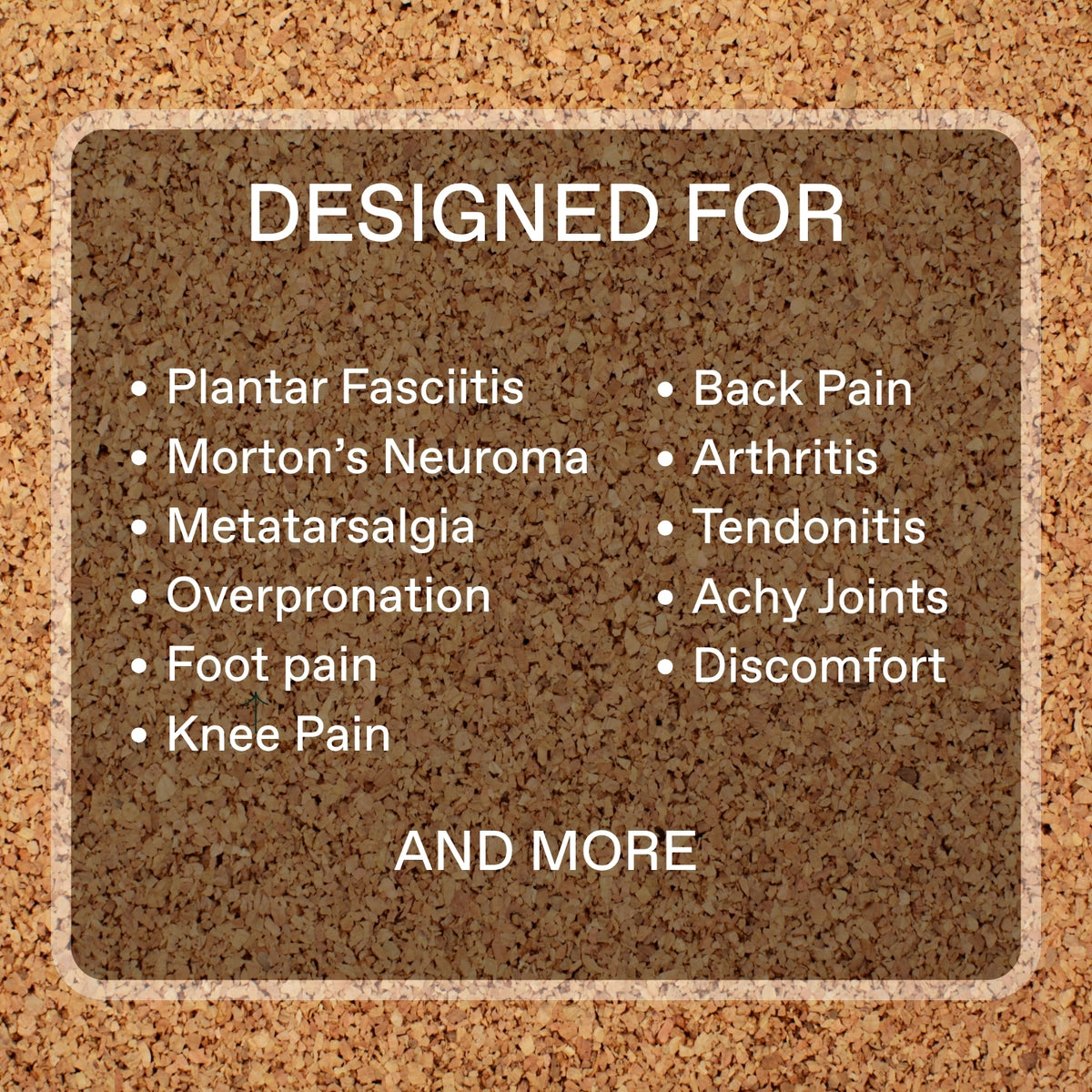
Plantar fasciitis is inflammation of the plantar fascia, the band of tissue that runs along the bottom of the foot from the heel to the ball. It is often worsened by walking barefoot or in unsupportive slippers on hard floors. The best slipper for plantar fasciitis combines a deep heel cup, structured arch support, and a cushioned but firm outsole. Fulton's Comfort Slide is often chosen by those seeking added comfort for plantar fasciitis, and its adaptive cork footbed molds to the individual arch over time for personalized support. Orthofeet's Charlotte and Louise styles are also designed with plantar fasciitis relief as an explicit design goal.
How do I keep non-slip slippers clean without losing their grip?
Outsole grip depends on the rubber remaining free of oil, dust, and debris that can act as a lubricant between the sole and the floor. Spot-cleaning the outsole regularly with a damp cloth removes the buildup that reduces traction. For machine-washable slippers like RockDove, a regular wash cycle keeps the full slipper fresh. For cork-footbed slippers like Fulton's Comfort Slide, spot-cleaning with mild soap and water as needed is recommended, and the outsole can be wiped down independently to maintain grip performance.